Description
Hard-Numbers: Technical Specifications
- Series: I/A Series Fieldbus
- Input Channels: 8 (independent, isolated)
- Input Range: 4-20mA (1-21mA extended range)
- Accuracy: ±0.1% of span
- Resolution: 16-bit
- HART Support: Bell 202 FSK, 1200 bps (per channel)
- Isolation Rating: 1500 VDC channel-to-channel, 1500 VDC channel-to-system
- Power Supply: 24V DC fieldbus power
- Power Draw: 18W typical
- Operating Temperature: -40°C to +70°C
- Storage Temperature: -40°C to +85°C
- Relative Humidity: 5% to 95% non-condensing
- Certifications: CE, UL, CSA, FM, ATEX, IECEx
-

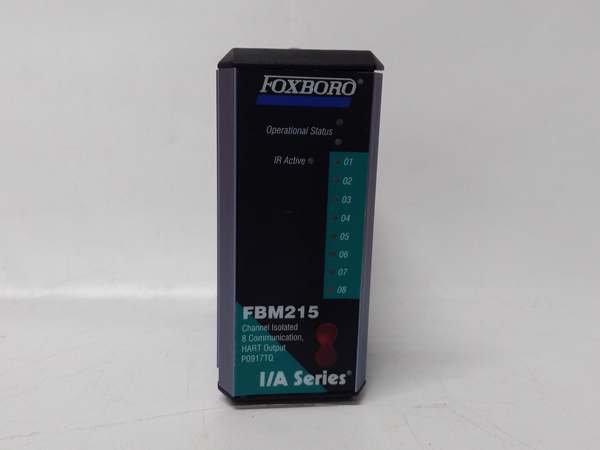
FOXBORO FBM215
The Real-World Problem It Solves
Analog inputs suffer from ground loops, noise, and lack of diagnostics in industrial environments. Non-isolated cards let ground potential differences corrupt measurements, while missing HART support limits device diagnostic capability. The FBM230 provides per-channel isolation eliminating ground loops, HART communication for device diagnostics, and high-resolution A/D conversion for accurate process variable measurement.
Where you’ll typically find it:
- Pressure transmitter monitoring in chemical process plants
- Flow meter inputs in refinery operations
- Temperature transmitter inputs in power generation
- Level transmitter measurement in storage tanks
Bottom line: It delivers accurate, isolated analog input with full HART diagnostic capability.
Hardware Architecture & Under-the-Hood Logic
This analog input module contains isolated A/D converters, HART modem circuitry, and a microprocessor for signal processing and diagnostics. Each channel has independent isolation barriers, preventing ground potential differences between field devices from affecting measurements. The module communicates over the Foxboro fieldbus to the I/A Series control system.
- 4-20mA signals from field transmitters enter through the terminal block and pass through 250Ω shunt resistors.
- Voltage drops across the shunt resistors are converted to digital values by isolated A/D converters per channel.
- HART modems extract digital FSK signals superimposed on the 4-20mA waveform for device communication.
- The microprocessor applies scaling and linearization to raw values based on configured range and engineering units.
- Processed analog values and HART diagnostic data are transmitted over the fieldbus to the I/A Series controller.
- Diagnostics circuits monitor input current, open circuits, short circuits, and HART communication status per channel.
- Watchdog timers monitor microprocessor health, triggering fault alerts if system integrity is compromised.
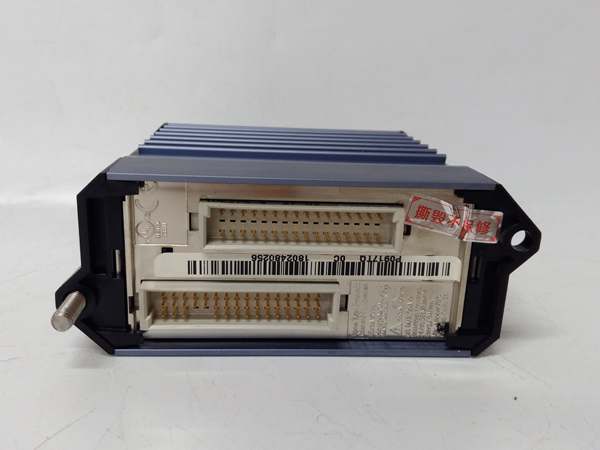
FOXBORO FBM215
Field Service Pitfalls: What Rookies Get Wrong
Incorrect Loop Resistor InstallationRookies omit the 250Ω HART loop resistor or install it in the wrong location. HART communication fails because the minimum loop resistance for FSK modulation isn’t met, losing device diagnostics and configuration capability.
- Field Rule: Install a 250Ω resistor at the input terminal or within the field device loop. Verify the resistor is installed correctly and that total loop resistance meets HART requirements (minimum 250Ω). Test HART communication using a handheld communicator.
Mixed Grounding on Isolated InputsNew engineers ground the loop return side at both the module and the field device. Ground potential differences create circulating currents through the isolation barrier, corrupting analog measurements and causing reading drift.
- Quick Fix: For isolated inputs, ground the loop return at the module end only. If the field device requires grounding, verify grounding potentials are within 1V. Never create ground loops through isolated channels.
Ignoring HART Polling ConflictsTechnicians configure HART polling on multiple channels without considering timing conflicts. Simultaneous HART requests cause communication timeouts, missing diagnostic data, and delayed analog value updates.
- Field Rule: Stagger HART polling times across channels to avoid conflicts. Use the I/A Series HART configuration to set appropriate polling intervals (typically 1-5 seconds per device). Verify communication success through diagnostic displays.
Poor Wiring on High-Density TerminalsRookies wire all 8 channels into tight terminal blocks without considering maintenance access. Testing individual channels becomes difficult during troubleshooting, and wire damage occurs from crowding.
- Field Rule: Use properly sized terminal blocks with adequate spacing. Label wires clearly at both ends. Leave sufficient slack for individual wire removal. Document channel assignments and transmitter tag numbers for quick reference.
Please note: The listed price is for reference only and is not binding. Final pricing and terms are subject to negotiation based on current market conditions and availability.