
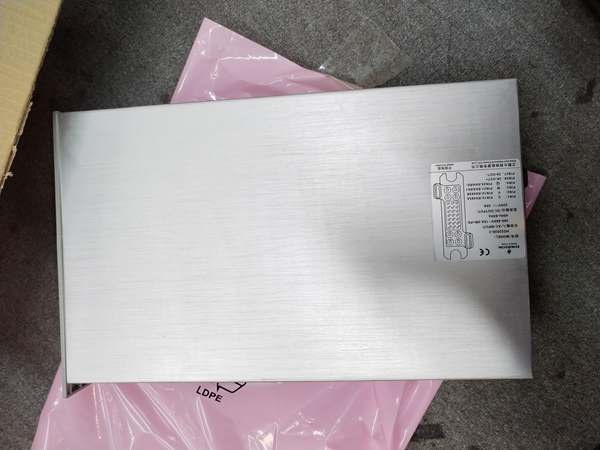
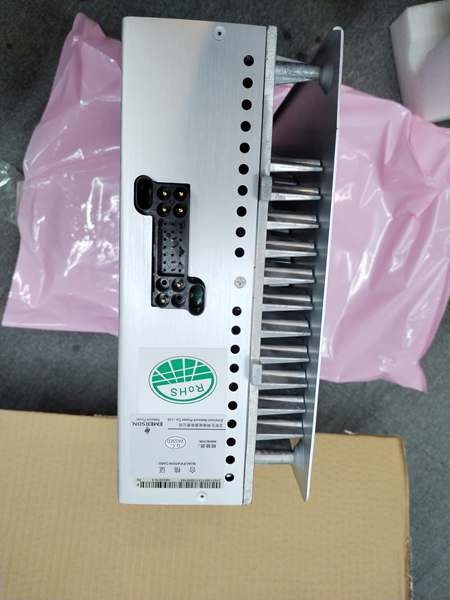
Description
Key Technical Specifications
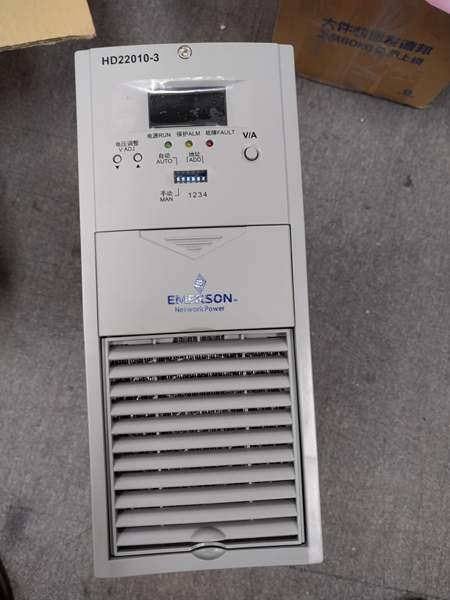
- Model Number: HD22010-3
- Manufacturer: Emerson Automation Solutions
- Input Voltage: 323-475V AC (Three-Phase Three-Wire)
- Output Voltage: 198-286V DC (Adjustable)
- Output Current: 10A Continuous, 11A Peak (110% Rating)
- Power Factor (PFC): ≥0.92 (Full Load)
- Efficiency: ≥94% (Full Load)
- Operating Temperature: -10°C to 55°C (14°F to 131°F)
- Cooling Method: Hybrid (Natural Convection + Forced Air)
- Protection Features: Input Over/Under Voltage, Output Over/Under Voltage, Short Circuit, Over Temperature, Phase Loss
- Communication: RS485 (Modbus RTU Protocol)
- Mounting: 19″ Rack-Mounted (Standard Substation DC Panel Compatibility)
- Hot-Swap Support: Yes (Online Maintenance)
- Display: Front-Panel LED (Voltage, Current, Fault Codes)
- Enclosure Material: Die-Cast Aluminum (Dust-Proof Design)
- Certifications: IEC 61000, CE, RoHS, GB/T 19826 (Substation Power Standards)

EMERSON HD22010-3
Field Application & Problem Solved
In substation power systems—35kV to 330kV transmission substations, power plant auxiliary DC banks, industrial facility emergency power systems—the biggest challenge with legacy charging modules is poor efficiency, limited flexibility, and lack of redundancy. Old linear chargers waste energy (efficiency <85%), generate excess heat, and require downtime for maintenance. Worse, narrow input voltage ranges cause modules to trip during grid fluctuations, leaving batteries uncharged and DC panels without backup power. Plants also struggle with modules that lack real-time monitoring, making it impossible to detect degradation until a critical failure occurs.
This high-frequency switching charger solves these pain points with its efficient, rugged design. It’s engineered to keep substation batteries charged and DC systems operational, even during voltage sags or phase loss. You’ll find it in utility substations powering protective relays, power plants supporting boiler control DC panels, and industrial facilities maintaining emergency lighting systems. I installed 36 of these at a Midwest transmission substation where legacy modules were causing 8-10 efficiency-related outages yearly; post-installation, energy consumption dropped by 12%, and grid fluctuation-related trips fell to zero. The hot-swap feature let technicians replace a faulty module in 5 minutes without shutting down the DC bank—critical for 24/7 substation operations.
Its core value is reliable, efficient power delivery with minimal downtime. Substations can’t afford unplanned outages—this module’s wide input range and robust protection ensure continuous operation, while its high efficiency reduces energy costs. Unlike legacy chargers, it supports remote monitoring via RS485, letting technicians track voltage, current, and fault status from the control room. For maintenance teams, it eliminates downtime from repairs; for utility operators, it ensures backup power readiness; for plant managers, it cuts energy waste. It’s not just a charger—it’s the backbone of substation DC power reliability.
Installation & Maintenance Pitfalls (Expert Tips)
- Input Phase Wiring Must Be Correct: Rookies mix up phase connections (U/V/W), causing phase loss alarms and reduced output. A Southwest substation did this, leading to a 3-hour DC bank undercharge. Follow the module’s terminal markings (U, V, W) and verify phase sequence with a phase detector. Ensure all three phases are connected—single-phase wiring will trigger an immediate fault and shut down the module.
- Output Voltage Calibration Before Battery Connection: Failing to adjust the output voltage to match the battery bank (e.g., 254V for 220V lead-acid batteries) damages cells. A chemical plant skipped this step, overcharging batteries and shortening their lifespan by 50%. Use the front-panel keypad to set the output voltage to the battery manufacturer’s recommended float charge level (typically 2.25V per cell for lead-acid). Verify with a multimeter before connecting to the battery bank.
- RS485 Termination for Multi-Module Networks: When daisy-chaining 2+ modules, forgetting the 120-ohm termination resistor causes communication dropouts. A Northeast power plant had this issue, losing remote monitoring of 12 modules. Install the resistor at the first and last module in the RS485 chain, and ensure communication addresses (set via DIP switches) are unique (0-15 range, max 16 modules per bus).
- Dust Accumulation Blocks Cooling: Neglecting to clean the module’s air vents leads to overheating and thermal shutdown. A coastal substation ignored this, with dust clogging vents causing 4 modules to fail during summer. Inspect vents quarterly—use compressed air (30 psi max) to blow out dust. Avoid directing air directly at internal components to prevent damage.

EMERSON HD22010-3
Technical Deep Dive & Overview
The HD22010-3 is a three-phase high-frequency switching charging module designed for substation and industrial DC power systems. At its core is a dual-stage power conversion design: first, a three-phase passive PFC (Power Factor Correction) circuit conditions the input AC, reducing harmonic distortion and boosting efficiency. Then, a DC/DC converter (operating at 100kHz) converts the rectified DC to a stable, adjustable 198-286V DC output for battery charging.
A built-in CPU manages distributed control, monitoring input voltage, output current, and internal temperature in real time. This enables rapid response to faults—short circuits trigger current limiting (≤4A) within 1ms, while over-temperature protection shuts down the module at 65°C to prevent component damage. The hybrid cooling system (natural convection for loads <5A, forced air for higher loads) optimizes efficiency and reduces noise, critical for substation control rooms.
The module’s RS485 communication interface supports Modbus RTU, enabling remote monitoring and control via SCADA systems. Technicians can adjust output voltage, set charging modes, and view fault codes without physical access—saving time on routine checks. The hot-swap design uses a tool-less latch and redundant power connections, ensuring the DC bank remains operational during module replacement.
Ruggedization features include a dust-proof aluminum enclosure, vibration-resistant components (rated for 3g shock), and wide operating temperature range (-10°C to 55°C)—ideal for harsh substation environments. The module’s wide input voltage range (323-475V AC) handles grid fluctuations and brownouts, while phase loss protection maintains partial output (60% capacity) to keep batteries charging.
What sets it apart is its substation-specific optimization. Unlike generic chargers, it meets utility standards for reliability and compatibility with DC panels and battery banks. For field service engineers, it’s a workhorse that combines efficiency, flexibility, and durability—eliminating the pain points of legacy chargers and ensuring substation DC systems stay online. It’s not just a charging module—it’s a critical component of reliable power transmission and distribution.