
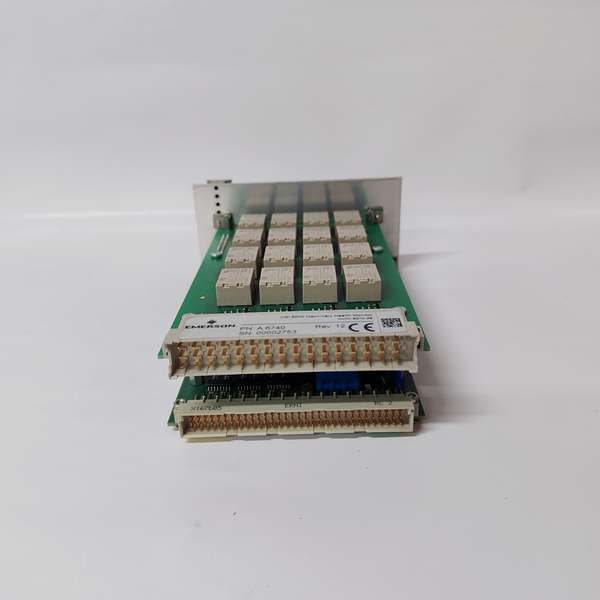
Description
Key Technical Specifications
-
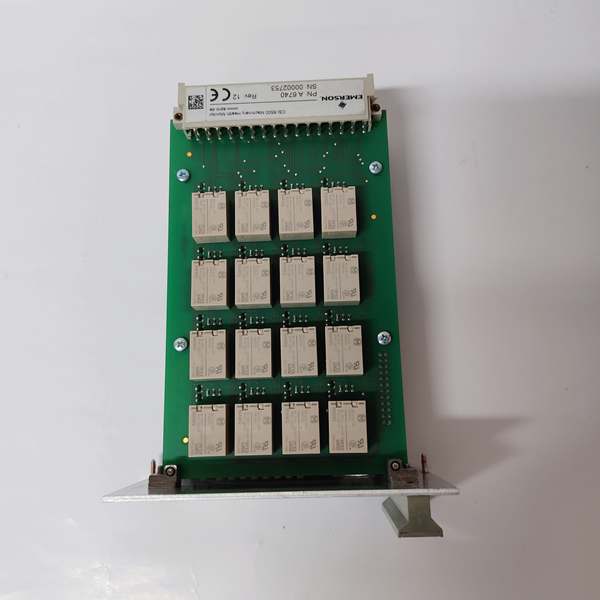
Model Number: A6740
-
Manufacturer: Emerson Automation Solutions
-
Port Configuration: Configurable 48x 10/100/1000BASE-T (PoE++) + 6x 25GBASE-X (SFP28) uplink ports
-
PoE Support: PoE++ (IEEE 802.3af/at/bt), 60W per port, 740W total power budget
-
Switching Capacity: 176 Gbps
-
Forwarding Rate: 130.9 Mpps
-
Redundancy Protocols: MRP, PRP, HSR (High-availability Seamless Redundancy), RSTP/STP
-
Operating Temperature: -40°C to 75°C (-40°F to 167°F)
-
Power Supply: Quad redundant 24V DC / 48V DC / 110V AC / 220V AC inputs
-
Protection Rating: IP30 (rack-mount), IP67 (with optional enclosure)
-
Management: Web GUI, CLI, SNMP v3, Emerson AMS Device Manager, NetFlow v9, sFlow
-
EMC Compliance: IEC 61000-4-2 (ESD ±15kV), IEC 61000-4-4 (EFT ±4kV), IEC 61000-4-5 (Surge ±4kV)
-
Mounting: 2U rack-mount, DIN-rail compatible (with adapter)

EMERSON A6740
Field Application & Problem Solved
Large industrial sites—think integrated refineries or multi-unit power plants—face a unique network challenge: connecting hundreds of PoE-enabled devices (from high-power PTZ cameras to AI-driven sensors) while maintaining zero downtime for critical control traffic. I was called to a Gulf Coast refinery in 2024 where they’d strung together 6 consumer-grade switches to handle 80 devices—this created 5 single points of failure, and a port failure took down their FCC unit’s safety interlock system for 3 hours. The A6740 solves this: its 48 PoE++ ports eliminate the need for switch cascading, 25Gbps uplinks handle massive data loads, and triple redundancy protocols ensure control traffic never drops—even during a cable cut or power surge.
You’ll find this switch at the core of large-scale industrial networks: integrated petrochemical complexes, nuclear power plants with multiple reactor units, and mining operations with distributed SCADA systems. At a Midwest power plant with 4 coal-fired units, we installed 4 A6740s in a PRP/HSR redundant mesh to connect 192 devices—including 40 high-power video analytics cameras, 80 vibration sensors, and 72 motor controllers. When a tornado took out a section of cable, the HSR protocol rerouted traffic in under 1ms—no data loss, no safety system trips. The switch’s PoE++ ports powered even the most demanding devices (60W thermal imagers) without external power supplies, cutting installation costs by $120k.
Its core value is “scalable resilience.” Large plants can’t afford the complexity of cascaded switches—each additional switch adds latency and failure points. The A6740’s 48 ports and 25Gbps uplinks let teams connect hundreds of devices to a single, reliable node. For IIoT deployments, its 740W PoE budget powers high-bandwidth, high-power devices that older switches can’t handle—like AI edge computers and 3D machine vision cameras. Its quad redundant power inputs (unique in its class) mean it keeps running even if two power feeds fail—critical for nuclear or chemical plants where network outage risks catastrophic consequences. For network teams, it’s a “centralized command center” that simplifies management while delivering industrial-grade reliability.
Installation & Maintenance Pitfalls (Expert Tips)
PoE++ Power Management: Balance High-Wattage Devices
Rookies assign 60W devices to adjacent PoE++ ports, overloading the switch’s internal power rails. A Texas petrochemical plant did this—they plugged 8x 60W thermal cameras into ports 1-8, tripping the rail’s 300W limit and shutting down all 8 ports. The A6740 splits its 48 ports into 4 power rails (12 ports each), each with a 200W limit. Spread high-power devices (45-60W) across rails: put one 60W camera in rail 1 (ports 1-12), one in rail 2 (13-24), etc. Use the A6410’s “PoE Rail Balancing” tool in the web GUI—it auto-assigns devices to rails to avoid overloads. Enable “Power Throttling” for non-critical devices: if the budget is exceeded, it reduces power to cameras (e.g., from 60W to 30W) instead of shutting them down entirely.
Redundancy Mesh: Don’t Mix PRP and HSR Without Planning
Mixing PRP and HSR in the same network creates “redundancy conflicts” that cause packet loss. A Pennsylvania steel mill made this mistake—they used PRP for control loops and HSR for IIoT data, leading to 10-second outages when traffic overlapped. Use HSR for time-critical control networks (e.g., turbine speed control) — its sub-1ms failover is faster than PRP. Reserve PRP for non-critical but high-bandwidth traffic (e.g., video analytics). If you must integrate both, use the A6740’s “Redundancy VLAN” feature to separate PRP and HSR traffic into dedicated VLANs. Test the mesh quarterly with a traffic generator: inject 1Gbps of data and pull a cable—control traffic latency should stay below 50µs, with zero packet loss.
SFP28 Uplinks: Match Transceivers to Cable Distance
Using the wrong SFP28 transceiver for long-distance uplinks causes intermittent connectivity. A Wyoming mining operation used A6SFP28-25G-SR (short-reach) transceivers for a 500m fiber run— the link dropped 3-4 times a day. The A6740’s SFP28 ports support three transceiver types: SR (up to 100m, multimode fiber), LR (up to 10km, single-mode), and ER (up to 40km, single-mode). For runs over 100m, use LR transceivers (e.g., A6SFP28-25G-LR) — they’re more expensive but eliminate signal degradation. Clean the fiber connectors with a lint-free wipe and isopropyl alcohol before inserting the transceiver—dirty connectors are the #1 cause of SFP28 link faults. Use the switch’s DDM (Digital Diagnostic Monitoring) to track signal strength—anything below -20dBm means a bad connection.
EMERSON A6740
Technical Deep Dive & Overview
Its PoE++ support is a game-changer for modern industrial deployments. PoE++ (IEEE 802.3bt) delivers up to 60W per port, enough to power devices like industrial PCs, high-definition thermal cameras, and AI edge sensors—devices that couldn’t run on older PoE+ switches. The 740W total power budget and 4 power rails ensure even high-power device mixes don’t cause overloads. The quad redundant power inputs accept everything from 24V DC (plant battery systems) to 220V AC (mains power), with automatic failover if a feed drops—critical for plants with strict safety compliance requirements.
Ruggedization features include a conformal-coated circuit board (resists oil and chemical sprays), fanless or filtered fan options (reduces dust intake), and an operating temperature range of -40°C to 75°C—perfect for outdoor switch cabinets or harsh process areas. For security, it includes role-based access control (RBAC), 802.1X authentication, and MAC address filtering to block unauthorized devices. Integration with Emerson’s AMS Device Manager lets teams monitor switch health, PoE usage, and redundancy status alongside other plant assets—no need for separate network management software.
What sets it apart from generic high-density switches is its industrial-specific redundancy. HSR (High-availability Seamless Redundancy) provides zero-loss failover for safety-critical control loops, while PRP handles high-bandwidth traffic with minimal latency. The switch’s ability to integrate with DeltaV DCS means control engineers can troubleshoot network issues from the same HMI they use to monitor valves and pumps—eliminating the “IT vs. operations” handoff that delays problem-solving. For large plants scaling to IIoT, the A6740 isn’t just a switch—it’s the foundation of a reliable, future-proof network.
The A6740 is a high-density Layer 2/Layer 3 managed switch built for the most demanding industrial networks. It uses a dual-core ARM Cortex-A53 processor paired with a high-performance switching ASIC to handle 176 Gbps of traffic—enough to support 48 simultaneous 1Gbps PoE++ connections and 6x 25Gbps uplinks without latency spikes. Unlike lower-density switches, its Layer 3 routing engine supports OSPF and BGP, making it suitable for connecting geographically distributed plant sections (e.g., a refinery’s crude unit and alkylation unit).
The A6410 is a Layer 2/Layer 3 managed switch designed for the unique demands of industrial networks. It uses a high-performance ASIC (application-specific integrated circuit) to process packets in hardware, ensuring deterministic latency (less than 50µs) for time-sensitive control traffic. Unlike Layer 2-only switches, its Layer 3 capabilities let you route traffic between VLANs, eliminating the need for a separate router in small to mid-sized plants.
Its PoE+ ports simplify device installation by delivering both data and power over a single Ethernet cable—critical for remote locations like tank farms where running separate power lines is expensive. The dual redundant power inputs accept a wide range of voltages (24V DC to 110V AC), making it compatible with most plant power systems. The switch’s fanless design (on some models) reduces dust buildup, while the conformal-coated circuit board resists moisture and chemicals. For security, it supports 802.1X authentication and ACLs (access control lists) to block unauthorized devices from accessing control networks.
Integration with Emerson’s ecosystem sets it apart from generic industrial switches. It works seamlessly with DeltaV DCS and AMS Device Manager, so you can monitor switch health (port status, PoE usage, temperature) alongside your transmitters and valves. The switch’s firmware can be updated remotely via AMS, eliminating the need for site visits. Its rugged design and redundancy features make it ideal for mission-critical applications—from offshore oil platforms to nuclear power plants. In a world where industrial networks are the backbone of automation, the A6410 is the reliable, easy-to-manage switch that keeps data flowing—no matter what the plant throws at it.