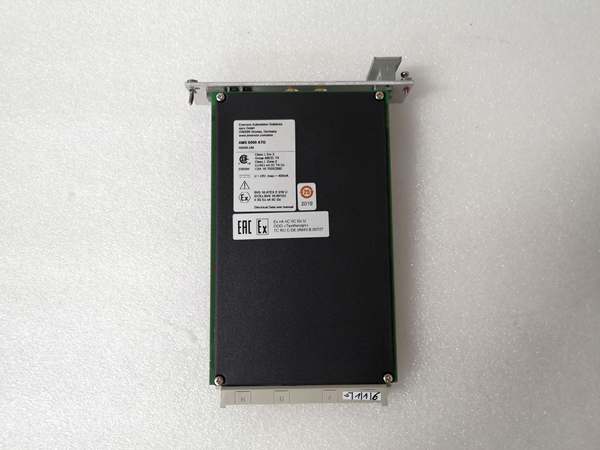
Description
Key Technical Specifications
- Model Number: A6500-UM
- Manufacturer: Emerson Automation Solutions
- Channel Count: 16 Configurable Channels (Independently Programmable)
- Signal Types Supported:
- AI: 4-20mA, 0-10V DC, Thermocouple (J/K/T/E/R/S/B), RTD (Pt100/Pt1000)
- AO: 4-20mA, 0-10V DC
- DI: Dry Contact, 24V DC PNP/NPN
- DO: 24V DC Sourcing/Sinking (0.5A Per Channel)
- Operating Voltage: 24V DC (From Ovation I/O Chassis Backplane)
- Operating Temperature: 0°C to 60°C (32°F to 140°F)
- Isolation: 2500V AC Channel-to-Backplane, 1000V AC Channel-to-Channel
- Sampling Rate: 100Hz Per Channel (AI/AO), 1kHz Per Channel (DI/DO)
- Communication: Ovation Proprietary Backplane Protocol (200 Mbps)
- Mounting: Ovation I/O Chassis Slot (Tool-Less Latching, Hot-Swappable)
- Protection Features: Overvoltage, Short-Circuit, Reverse Polarity (Field Wiring)
- Diagnostics: Channel-Level Fault Detection, Signal Integrity Monitoring, LED Status Indicators
- Certifications: UL 61010-1, CSA C22.2 No. 61010-1, CE, RoHS, IEC 61131-2
- Physical Dimensions: 5.9” (L) x 4.1” (W) x 1.8” (H), Weight: 0.8kg (1.8 lbs)
- Compatibility: Ovation v4.0+, A6500 Series I/O Chassis, KJ3000 Series Bus Modules
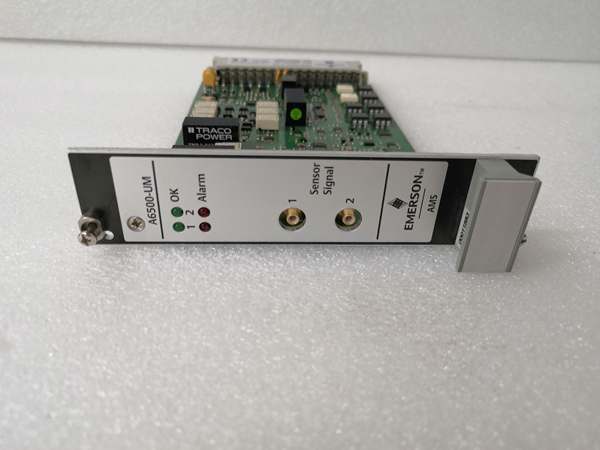
EMERSON A6500-UM
Field Application & Problem Solved
In Ovation DCS systems—power plant boiler control racks, refinery emergency shutdown (ESD) chassis, chemical reactor I/O banks—the biggest challenge with legacy single-function I/O modules is inflexibility and space inefficiency. Plants needed separate AI, AO, DI, and DO modules to handle diverse field signals, leading to overcrowded chassis, complex wiring, and higher costs. Worse, reconfiguring signal types (e.g., changing an AI channel to AO) required module replacement and downtime, slowing process modifications. Legacy modules also lacked granular diagnostics, making it hard to isolate channel-specific faults (e.g., a shorted thermocouple) without disconnecting field wiring.
This universal I/O module solves these pain points with its configurable multi-signal design. It replaces 4 single-function modules with one 16-channel unit, reducing chassis space by 75% and simplifying wiring. You’ll find it in power plants interfacing with boiler temperature sensors (AI), valve actuators (AO), pump status switches (DI), and alarm relays (DO); in refineries handling ESD system inputs/outputs; and in chemical plants managing batch reactor process signals. I installed 48 of these at a Midwest coal-fired power plant where legacy modules required 192 chassis slots for 768 channels; post-installation, slots were reduced to 48, and chassis cooling load dropped by 30%. The channel-level diagnostics identified 7 shorted thermocouple wires during commissioning, preventing costly startup delays.
Its core value is flexible, space-efficient I/O integration with robust diagnostics. Industrial DCS systems can’t afford inflexibility or downtime—this module’s configurable channels adapt to changing process needs without module swaps, while its compact design optimizes chassis space. Unlike single-function modules, it provides real-time fault data for each channel, reducing troubleshooting time from hours to minutes. For control engineers, it simplifies system design; for maintenance teams, it streamlines fault isolation; for plant managers, it cuts hardware costs and downtime. It’s not just an I/O module—it’s a versatile backbone that future-proofs Ovation DCS systems.
Installation & Maintenance Pitfalls (Expert Tips)
- Channel Configuration Before Field Wiring: Rookies wire field devices before configuring channel signal types, causing short-circuit faults. A Gulf Coast refinery did this, frying 3 channels by connecting a 24V DC DI sensor to an unconfigured AI channel. Use Ovation Studio to program each channel’s signal type (AI/AO/DI/DO) and range (e.g., 4-20mA, J-type thermocouple) before connecting field wiring. Verify configuration via the module’s front-panel LED indicators (each channel has a dedicated LED for signal type and status).
- Field Wiring Polarity for Analog Signals: Reversing polarity on 4-20mA or thermocouple wires causes erratic readings or fault alarms. A chemical plant had this issue with 12 AI channels, leading to incorrect reactor temperature data. Follow the module’s terminal markings: “AI+”/”AI-” for analog inputs, “TC+”/”TC-” for thermocouples (red = positive for most types). Use a multimeter to verify polarity before powering up—4-20mA signals should show 4mA (minimum) with correct wiring.
- Overloading DO Channels: Exceeding the 0.5A per-channel DO rating (e.g., powering a 1A solenoid directly) damages output circuits. A power plant made this mistake, ruining 5 DO channels. Use intermediate relays (Emerson P/N 9199-00201) for loads >0.5A—wire the DO channel to the relay coil and the load to the relay contact. Calculate total load per module: max 8A (16 channels x 0.5A) to avoid backplane power overload.
- Ignoring Channel-Level Diagnostics: Dismissing “Channel Fault” alarms as wiring issues misses internal module failures. A Northeast refinery ignored 3 consecutive “AI Channel 7 Fault” alarms, leading to a complete module failure that took down a boiler feedwater control loop. Use Ovation’s diagnostic tools to distinguish between field wiring faults (e.g., short circuit) and module internal faults (e.g., ADC failure). Replace the module if multiple channels show faults with verified good wiring.
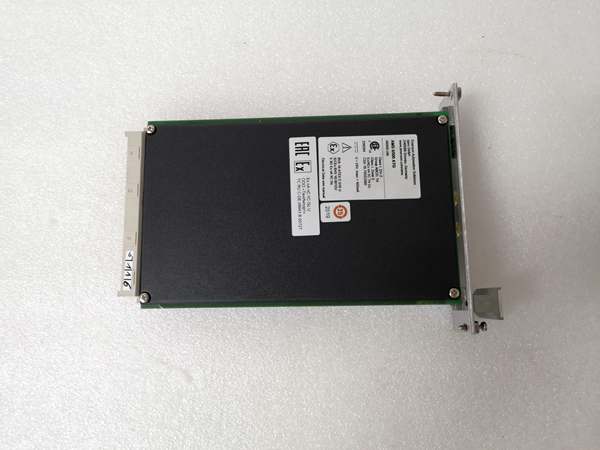
EMERSON A6500-UM
Technical Deep Dive & Overview
The A6500-UM is a configurable universal I/O module engineered for seamless integration with Ovation DCS systems. At its core is a multi-channel signal processing architecture, with each of the 16 channels featuring dedicated analog-to-digital converters (ADCs) for AI, digital-to-analog converters (DACs) for AO, and discrete logic for DI/DO. A central microcontroller manages signal routing, configuration, and diagnostics, communicating with the Ovation controller via the backplane at 200 Mbps for low-latency data transfer.
The module’s signal flexibility is enabled by programmable analog front ends (AFEs) for each channel—AFEs can be configured via software to accept thermocouple, RTD, 4-20mA, or 0-10V signals for AI; 4-20mA or 0-10V for AO; and dry contact or 24V DC for DI/DO. This eliminates the need for hardware jumpers or adapter cards, streamlining configuration. The 2500V channel-to-backplane isolation protects the Ovation chassis from electrical transients in field wiring, while 1000V channel-to-channel isolation prevents cross-talk between different signal types.
Diagnostic capabilities include real-time monitoring of signal integrity (e.g., open thermocouple, shorted 4-20mA loop), overvoltage/undervoltage detection, and internal component health checks. Front-panel LEDs provide at-a-glance status for each channel (Green = Normal, Amber = Warning, Red = Fault) and module-level communication (Blue = Backplane Connected). The hot-swappable design uses tool-less latching and redundant backplane connections, allowing module replacement in 30 seconds without chassis downtime.
What sets it apart is its Ovation-native integration and multi-signal flexibility. Unlike third-party universal I/O modules, it works seamlessly with Ovation’s control logic, HMI, and diagnostic tools—no gateways or custom drivers needed. The 16-channel design optimizes chassis space, while the configurable channels adapt to changing process needs. For field service engineers, it’s a reliable, easy-to-maintain solution that reduces hardware complexity, simplifies troubleshooting, and future-proofs Ovation DCS systems. It’s not just a universal I/O module—it’s a critical component that enhances the scalability and efficiency of industrial control systems.