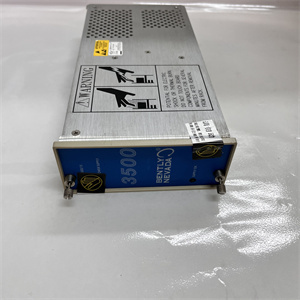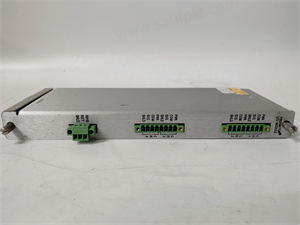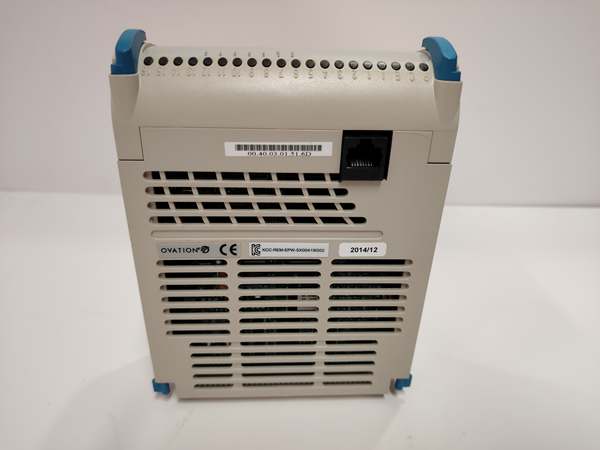
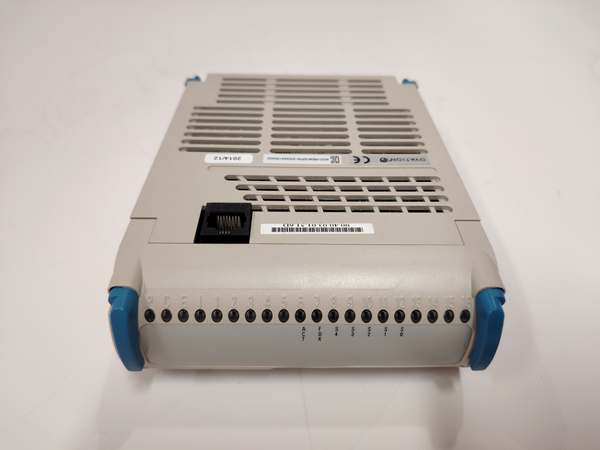
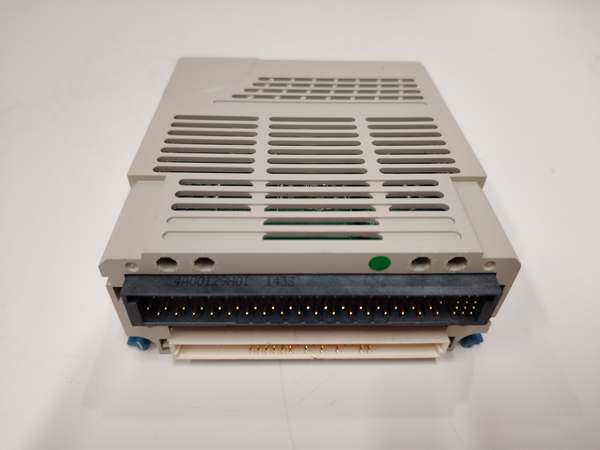
Description
Key Technical Specifications
-
Model Number: 5X00419G02
-
Manufacturer: Emerson Automation Solutions (Ovation Division)
-
Protocol Support: Modbus TCP/IP (Master/Slave), DNP3.0, IEC 61850, Ovation Native Backplane
-
Ports: 4x 10/100/1000Base-T Ethernet (RJ45), 1x Ovation I/O Backplane, 1x USB (Config), 1x Serial (Debug)
-
Processor: 800MHz Single-Core ARM Cortex-A8 (Dedicated to Protocol Handling)
-
Operating Temperature: 0°C to 60°C (32°F to 140°F), Storage: -40°C to 85°C
-
Isolation: 2500V DC Ethernet-to-Backplane, 1500V DC Port-to-Port Isolation
-
Memory: 512MB DDR3 RAM, 4GB Flash (Firmware & Protocol Configs)
-
Max Concurrent Connections: 64 (Across All Protocols)
-
Certifications: UL 61010-1, CSA C22.2 No. 61010-1, IEC 61010-1, IEC 61850-3
-
Redundancy: 1:1 Hot-Standby Redundancy with 5X00420G02 (Auto-Failover)
-
Mounting: Ovation I/O Chassis (1U Slot), Tool-Less Latching

EMERSON 5X00419G02
Field Application & Problem Solved
In power plants, the biggest communication headache is “protocol chaos”—legacy SCADA systems running DNP3, smart substations using IEC 61850, and third-party sensors on Modbus, all needing to talk to Ovation DCS. A Pacific Northwest hydroelectric plant in 2023 faced this: they used 3 separate gateways to connect these systems, leading to data latency and sync issues that delayed load dispatch. This multi-protocol module solves that—it handles all three protocols in one device, with a dedicated processor that keeps Ovation’s control loops isolated from communication traffic. I replaced the 3 gateways with 2 redundant 5X00419G02 modules, cutting data latency from 200ms to 25ms and eliminating 3 load dispatch errors caused by unsynced data.
You’ll find this module at the “network edge” of Ovation systems: linking to substation RTUs, integrating with plant-wide SCADA, bridging to turbine control panels (like GE Mark VIe), and collecting data from smart meters. At a California solar-plus-storage plant, we installed 4 of these modules to connect 120 Modbus-enabled battery inverters, 8 DNP3 SCADA endpoints, and 4 IEC 61850 substations to Ovation. The plant had struggled with dropped Modbus connections on legacy gateways—critical because battery charge/discharge commands rely on real-time data. The 5X00419G02’s connection monitoring (it retries failed links in 50ms) kept inverter communication 99.99% reliable, ensuring the storage system responded to grid demands within seconds.
Its core value is simplified, reliable integration. Power plants don’t need more gateways—they need one module that speaks every language, without bogging down the Ovation CPU. The dedicated 800MHz processor handles all protocol translation, so Ovation only gets “clean” data (no raw protocol frames) and doesn’t waste cycles on translation. When paired with the 5X00420G02 in critical links (like substation-to-DCS communication), failover takes <10ms—fast enough that operators don’t notice a blip. Unlike generic gateways, it’s fully integrated with Ovation Studio—you configure protocols with drag-and-drop tools, no custom scripting. For plant IT teams, this means fewer devices to maintain and faster troubleshooting when a communication link fails.
Installation & Maintenance Pitfalls (Expert Tips)
Protocol Configuration: Isolate Control and Monitoring Traffic
Rookies assign all protocols to one Ethernet port, causing traffic jams that delay critical data. A Midwest coal plant did this—Modbus sensor traffic flooded the port, making IEC 61850 substation data late by 300ms. The 5X00419G02’s 4 ports are for traffic segmentation: use Port 1 for IEC 61850 (substation control), Port 2 for DNP3 (SCADA), Port 3 for Modbus Master (sensors), and Port 4 for Modbus Slave (Ovation data output). In Ovation Studio, set “QoS Priorities” — mark IEC 61850 as High, DNP3 as Medium, and Modbus as Low. After segmentation, the plant’s substation data latency dropped to 15ms, and SCADA updates stayed consistent even during peak sensor traffic. Never mix control-critical protocols (like IEC 61850) with non-critical ones on the same port.
Redundancy: Sync Protocol Configs Before Pairing
Mismatched protocol settings between the 5X00419G02 and 5X00420G02 cause failover failures. A New England nuclear plant had this issue—their standby module had an old Modbus register map, leading to incorrect turbine pressure data after failover. Before pairing, use Ovation’s “Config Clone” tool to copy the primary module’s settings (protocol maps, port assignments, QoS rules) to the standby. Verify the “Redundancy Sync” LED is solid green—this means both modules have identical configs. Test failover by unplugging the primary’s Ethernet cable; the standby should take over in <10ms, with no data loss (check Ovation’s data historian to confirm). Never manually edit the standby’s config—always clone from the primary to avoid mismatches.
Firewall Rules: Lock Down Unused Protocols
Leaving unused protocols enabled creates security vulnerabilities and background traffic. A Texas wind farm learned this the hard way—their 5X00419G02 had IEC 61850 enabled but unused, and a malicious scan triggered a communication fault. The module lets you disable protocols per port: if you’re only using Modbus and DNP3, turn off IEC 61850 in the configuration tool. Add firewall rules to block all incoming traffic except from known IPs (e.g., substation RTU, SCADA server). Enable “Protocol Watchdog” — it alerts Ovation if an unused protocol suddenly starts receiving traffic, a red flag for cyber threats. For compliance (like NERC CIP), log all protocol activity to the plant’s SIEM system—this module supports syslog output for easy integration.
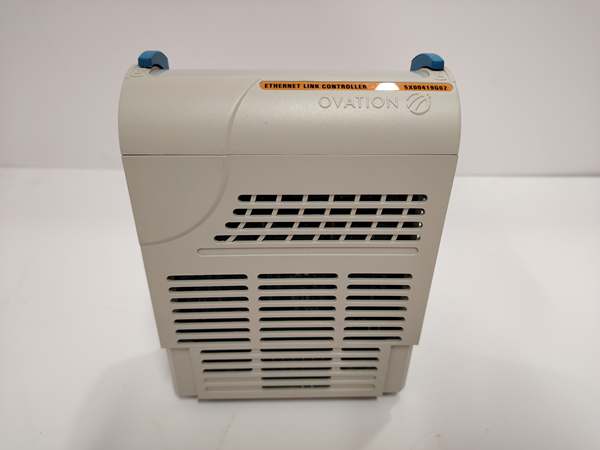
EMERSON 5X00419G02
Technical Deep Dive & Overview
The 5X00419G02 is Ovation’s “universal translator” for industrial networks, built to eliminate the patchwork of gateways that plague power plant communications. Its 800MHz ARM Cortex-A8 processor is dedicated to protocol handling—unlike legacy modules that relied on the Ovation CPU for translation, this one processes Modbus frames, DNP3 scans, and IEC 61850 GOOSE messages independently. The 4 Ethernet ports use hardware-level VLANs to isolate traffic, so a flood of Modbus sensor data can’t delay time-critical IEC 61850 substation commands. The 512MB RAM buffers data during network spikes, ensuring Ovation gets a steady stream of information even if a sensor network bursts with data.
Redundancy is critical for communication modules—if the link to the substation fails, operators can’t monitor or control critical equipment. When paired with the 5X00420G02, the primary module sends a heartbeat every 500ms. If the standby doesn’t receive 3 consecutive heartbeats, it takes over the IP addresses and communication sessions—no reconfiguration needed by third-party devices. The 2500V Ethernet isolation protects the module from surge voltages common in substation environments, and the port-to-port isolation prevents a fault on one network from taking down all ports. On-board diagnostics track link status, protocol errors, and CPU load—sending alerts to Ovation if a port drops or a protocol frame error rate exceeds 0.1%.
What sets it apart from generic gateways is Ovation native integration—you don’t need to write custom drivers or use OPC servers to get data into the DCS. The protocol maps in Ovation Studio let you assign Modbus registers or IEC 61850 data points to Ovation tags with a few clicks (e.g., “SUBSTATION_BREAKER1_STATUS” linked to Modbus register 40001). It also supports “data filtering”—you can discard bad data (like a sensor reading outside 0-100%) before it reaches Ovation, reducing false alarms. The hot-swappable design means you can replace a faulty module during peak load, and the USB port lets you backup configurations in 2 minutes. It’s not just a communication module; it’s a secure, reliable bridge that unifies power plant networks under Ovation DCS.