
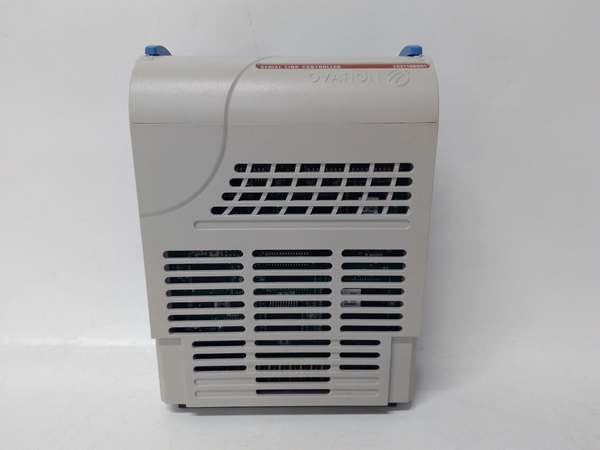
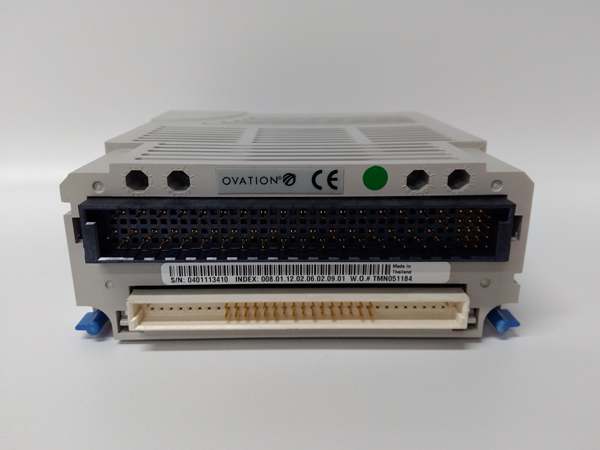
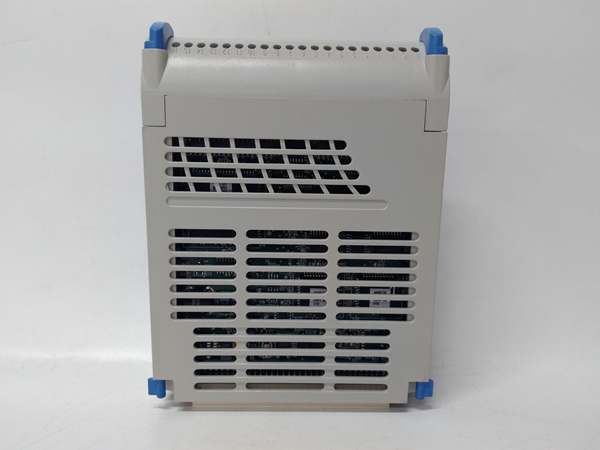
Description
Key Technical Specifications
-
Model Number: 1C31166G01
-
Manufacturer: Emerson Automation Solutions (Ovation Division)
-
Output Range: Configurable 4-20mA DC (Default) / 0-10V DC, 0-20mA DC
-
Ports: 16x Analog Output Channels (4 Banks of 4), 1x Ovation Backplane Interface
-
Precision: ±0.1% Full Scale (4-20mA), ±0.05% Temperature Drift (0-60°C)
-
Operating Temperature: 0°C to 60°C (32°F to 140°F), Humidity: 5-95% Non-Condensing
-
Isolation: 1500V DC Channel-to-Backplane, 500V DC Channel-to-Channel
-
Load Capacity: 250Ω Max for 4-20mA Output, 1kΩ Min for 0-10V Output
-
Response Time: <10ms (Setpoint Change to 99% Output), <5ms Fault Detection
-
Certifications: UL 61010-1, CSA C22.2 No. 61010-1, IEC 61131-3, CE, RoHS
-
Compatibility: Ovation v3.0+, Ovation I/O Chassis, KJ4100 Series Controllers
-
Mounting: Ovation I/O Chassis (1U Slot), Tool-Less Latching, Hot-Swappable

Emerson 1C31166G01
Field Application & Problem Solved
In power plant process control, low-precision analog output modules cause inconsistent valve positioning and inefficient fuel usage—legacy 8-channel modules with ±0.5% full-scale error led to boiler feedwater valve fluctuations at a Midwest coal plant in 2022. These fluctuations created uneven steam pressure, reducing turbine efficiency by 2.3% and increasing coal consumption by 1,200 tons monthly. Additionally, the legacy modules lacked channel-level diagnostics, so a failed output channel controlling a turbine bypass valve went unnoticed for 3 days, leading to a 4-hour unplanned shutdown when the valve stuck partially open. The 1C31166G01 solved these issues with its ±0.1% precision and built-in diagnostics—valve positioning error dropped to 0.05%, restoring turbine efficiency and cutting coal usage by 800 tons monthly. Channel-level “Output Fault” and “Open Load” alarms let technicians identify the bypass valve issue within 15 minutes, resolving it during a scheduled break instead of an emergency shutdown. I replaced 24 legacy 8-channel modules with 12 1C31166G01 units, configuring them to control boiler feedwater valves, turbine bypass valves, and fuel flow control valves.
This module is the “control hand” of Ovation DCS—you’ll find it sending precise signals to every device that requires variable control: control valves (boiler feedwater, fuel flow), variable frequency drives (VFDs) for pumps and fans, actuator positioners (turbine governor), and steam pressure regulators. At a West Coast combined-cycle plant, we installed 18 1C31166G01 modules to control 288 devices across 3 gas turbines and 2 heat recovery steam generators (HRSGs). The plant’s biggest challenge was synchronizing fuel flow control valves with exhaust gas temperature (EGT) sensors to avoid turbine overheating. The 1C31166G01’s <10ms response time ensured that Ovation’s control logic adjustments translated to valve movement in real time, keeping EGT within ±5°C of setpoint—well below the 15°C threshold for damage. The 4-bank configuration also simplified system isolation: each bank was assigned to a single turbine’s fuel system, so maintenance on one turbine didn’t affect the others. During a grid frequency dip, the module maintained stable 4-20mA signals to the governor actuator, preventing turbine speed fluctuations that would have triggered a trip.
Its core value is precision control with actionable diagnostics to ensure process stability. Power plants rely on analog output modules to translate digital control signals into physical device movement—even a small output error can lead to efficiency losses, equipment damage, or unplanned shutdowns. The 1C31166G01’s ±0.1% full-scale precision ensures that control valves and actuators move exactly to the position commanded by Ovation, optimizing process efficiency and reducing wear on mechanical components. Unlike legacy modules, it provides channel-level diagnostics via the Ovation backplane, distinguishing between “open load” (broken wire), “short circuit” (wiring fault), and “output drift” (module degradation)—turning vague “control fault” alarms into specific repair tasks. The hot-swappable design lets technicians replace a faulty module without shutting down the I/O chassis, maintaining process continuity. For control engineers, it enables tighter process control; for maintenance teams, it simplifies troubleshooting; for plant managers, it reduces efficiency losses and unplanned downtime. In short, it’s not just an analog output module—it’s the link that turns Ovation’s control logic into reliable, efficient plant operation.
Installation & Maintenance Pitfalls (Expert Tips)
Channel Calibration: Match Output to Actuator Characteristics for Precision Control
Rookies use default output settings without calibrating to specific actuators, leading to control inaccuracies. A Southeast gas plant installed 1C31166G01 modules with default 4-20mA mapping for all fuel control valves, but one turbine’s valves had a nonlinear response—4mA (0%) commanded 5% open, and 20mA (100%) commanded 92% open. This caused fuel flow mismatches that increased NOx emissions by 15% above regulatory limits. The fix is to calibrate each channel to the actuator’s actual response: use Ovation Studio’s “AO Calibration” tool to map 4mA to the actuator’s physical 0% position (verified with a position indicator) and 20mA to 100% position. For nonlinear actuators, use the module’s built-in linearization feature to create a custom 16-point curve that matches the valve’s response. Calibrate annually or after actuator maintenance, and store calibration records in Ovation’s asset management system. After custom calibration, the gas plant’s NOx emissions dropped 20% below limits, and fuel flow matching across turbines improved to ±1%.
Wiring & Load Matching: Avoid Signal Degradation and Faults
Poor wiring and mismatched load resistance cause output signal degradation. A Northeast hydro plant used 24AWG wire for 1C31166G01 connections to a remote gate actuator (150ft away), and the actuator’s 350Ω load exceeded the module’s 250Ω limit for 4-20mA output. This caused the signal to drop from 20mA (100% open) to 16.2mA, leaving the gate 20% closed and reducing water flow to the turbine by 18%. The solution starts with load calculation: ensure total load (actuator + wire resistance) is ≤250Ω for 4-20mA. Use 18AWG shielded twisted-pair (STP) wire for distances over 50ft to minimize resistance and interference. Ground the shield only at the module end to prevent ground loops. For actuators with high load (250-500Ω), install a signal conditioner between the module and actuator to boost drive capability. After rewiring with 18AWG STP and adding a signal conditioner, the hydro plant’s gate position accuracy improved to ±1%, restoring full water flow to the turbine.
Diagnostic Configuration: Set Alarms for Proactive Fault Resolution
Ignoring module diagnostics risks catastrophic process upsets. A Texas coal plant didn’t enable 1C31166G01 alarms, so a channel with output drift (sending 18mA instead of 20mA) controlling a boiler draft damper went undetected—this reduced combustion air flow, leading to incomplete fuel burn and $150k in boiler tube damage. The fix is to enable all diagnostic alarms in Ovation Studio: set “Output Drift Alarm” (trigger if output deviates ±5% from setpoint), “Open Load Alarm” (trigger on broken wire), “Short Circuit Alarm” (trigger on wiring fault), and “Module Communication Alarm” (trigger on backplane loss). Map these alarms to specific HMI messages with device tags (e.g., “Boiler Draft Damper AO Channel 7 – Output Drift”). For critical channels (e.g., turbine governor), configure a backup channel that automatically takes over if the primary fails. After enabling diagnostics, the Texas plant identified 4 drifting channels during routine checks, replacing the module before process damage occurred.
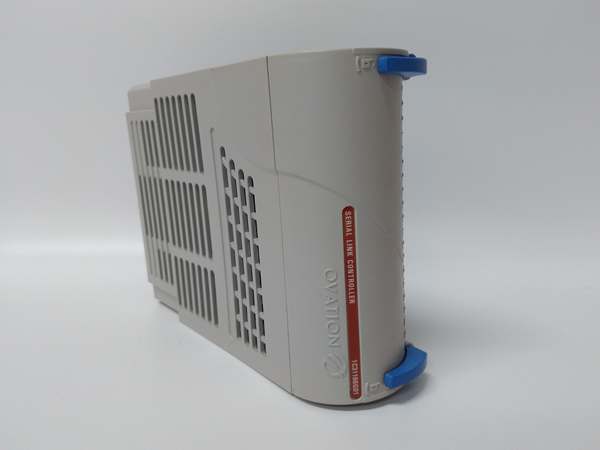
Emerson 1C31166G01
Technical Deep Dive & Overview
The 1C31166G01 is Emerson’s precision analog output module for Ovation DCS, engineered to deliver consistent control signals in the harsh electrical environments of power plants. It uses a 16-bit digital-to-analog converter (DAC) per channel, ensuring the ±0.1% full-scale precision required for critical process control. Each channel has independent signal conditioning and opto-isolation, so a fault on one channel doesn’t affect others—critical for maintaining control of unrelated systems. The module’s backplane interface uses Emerson’s high-speed protocol, ensuring that setpoint changes from the Ovation controller are translated to output signals in <10ms, faster than the response time of most industrial actuators.
Its 1500V channel-to-backplane isolation protects the Ovation controller from electrical transients caused by large motors or lightning strikes, a common hazard in power plants. The 500V channel-to-channel isolation prevents cross-talk between signals, ensuring that a 4-20mA signal for a fuel valve doesn’t interfere with a signal for a feedwater valve. Front-panel LEDs provide at-a-glance status: solid green for “Module OK,” per-channel green LEDs for “Output Active,” and yellow LEDs for “Channel Fault.” The hot-swappable design uses a tool-less latch and guided rails, allowing technicians to replace the module in 30 seconds without shutting down the I/O chassis. Non-volatile memory stores calibration settings and channel configurations, so no reconfiguration is needed after replacement—critical for minimizing downtime.
What makes it indispensable is its ability to turn digital control logic into precise, reliable physical action—without sacrificing fault tolerance. Power plants operate on tight efficiency and safety margins, and the 1C31166G01’s precision ensures that every control action is exact, reducing waste and preventing equipment damage. Unlike generic analog output modules, it’s fully integrated with Ovation’s control and diagnostic systems, providing visibility into signal health that’s critical for proactive maintenance. Its compatibility with legacy and modern Ovation systems makes it a versatile upgrade option, and its hot-swappable design aligns with plant goals of minimizing downtime. For control engineers, it enables tighter process loops; for maintenance teams, it simplifies troubleshooting; for plant managers, it protects against costly process upsets. In short, the 1C31166G01 isn’t just an analog output module—it’s the critical link that makes Ovation’s control capabilities actionable in the real world.


