Description
Key Technical Specifications
-
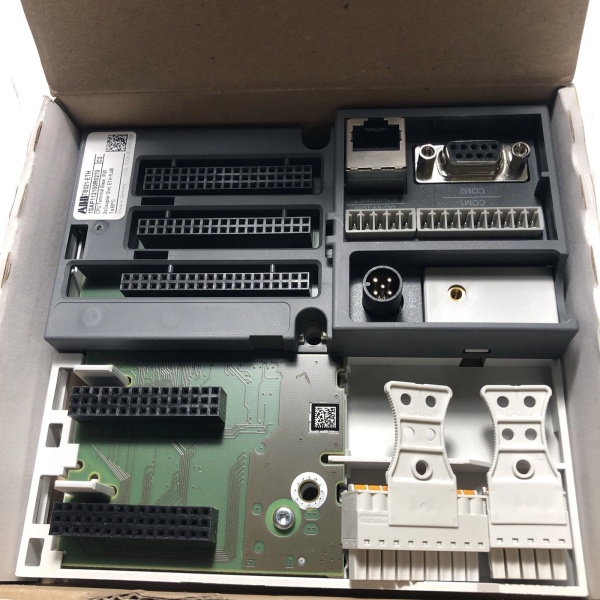
Model Number: TB521-ETH
-
Manufacturer: ABB
-
Supply Voltage: 24 VDC (18…30 V range)
-
Current Draw: 70 mA typical @ 24 V (no modules fitted)
-
Communication Slots: 2, any AC500 comm modules (CM574-RCOM, CM577-ETH, etc.)
-
Onboard Ethernet: 1 × 10/100 RJ45, auto-negotiate, green/orange LEDs
-
Onboard Serial: 2 ports, jumper-less switch between RS-232 & RS-485, 300…115 kbit/s, no isolation
-
Isolation: 1 kV DC Ethernet-to-logic; 500 V port-to-backplane
-
Operating Temperature: 0…+60 °C (horizontal mounting)
-
Storage Temperature: –40…+70 °C
-
Degree of Protection: IP20
-
Mounting: 35 mm DIN rail or panel plate; 0.186 kg
-
Dimensions: 123.5 × 135 × 28 mm

ABB TB521-ETH
Field Application & Problem Solved
Refineries and wastewater plants keep old flow computers, gas analyzers, and VFDs that only speak Modbus RTU or plain ASCII. The TB521-ETH lets you park those devices on the existing AC500 rack without burning a full slot for each protocol. Drop the base, plug in a CPU (PM564 or PM592), and the two native serial ports immediately start polling the legacy gear while the onboard RJ45 publishes the data upstream via Modbus TCP or OPC. No external gateways, no added panel clutter, and—crucially—no extra scan-time load on the CPU; the serial transceivers are handled by the base’s own ASIC, so cyclic load stays flat even at 19.2 k on both ports. I’ve used it on a three-boiler upgrade in Kansas: we replaced the archaic GE 90-30 racks but kept the original Bailey actuators. One TB521-ETH per boiler node, two twisted pairs, job done—no re-cabling, no downtime window longer than a shift change. That’s the real value: it collapses three hardware layers (gateway, switch, serial card) into a single DIN-rail clip.
Refineries and wastewater plants keep old flow computers, gas analyzers, and VFDs that only speak Modbus RTU or plain ASCII. The TB521-ETH lets you park those devices on the existing AC500 rack without burning a full slot for each protocol. Drop the base, plug in a CPU (PM564 or PM592), and the two native serial ports immediately start polling the legacy gear while the onboard RJ45 publishes the data upstream via Modbus TCP or OPC. No external gateways, no added panel clutter, and—crucially—no extra scan-time load on the CPU; the serial transceivers are handled by the base’s own ASIC, so cyclic load stays flat even at 19.2 k on both ports. I’ve used it on a three-boiler upgrade in Kansas: we replaced the archaic GE 90-30 racks but kept the original Bailey actuators. One TB521-ETH per boiler node, two twisted pairs, job done—no re-cabling, no downtime window longer than a shift change. That’s the real value: it collapses three hardware layers (gateway, switch, serial card) into a single DIN-rail clip.
Installation & Maintenance Pitfalls (Expert Tips)
Reverse-power will cook it – The 24 V spring clamp is marked “+ / –” but the silkscreen is tiny. I’ve seen techs wire negative to the shield earth terminal because it lines up with the rail. Smoke follows. Double-check before first power-up.
RS-485 bias resistors are NOT inside – Out of the box the port is high-impedance. If you hang more than four devices on the daisy-chain, add 120 Ω termination and a 560 Ω pull-up/down at the TB521 end or you’ll get framing errors every 30 min when the sun heats the cable.
Ethernet port is auto-MDIX but not auto-isolation – If you run the plant fiber patch through a non-managed switch with a grounded shield, ground loops will reset the link every time the VFD starts. Use an isolated media converter or tie the TB521 rail to the same PE bar as the switch.
Firmware mismatch kills the serial ports – Upgrade the CPU to the same Automation Builder rev as the base bootloader. I’ve seen V2.2.0 CPUs lose COM2 after a warm start because the base had factory FW 1.8. Flash the base through the SD card slot—takes 45 s, saves a 2-hour service call at 2 a.m.
Reverse-power will cook it – The 24 V spring clamp is marked “+ / –” but the silkscreen is tiny. I’ve seen techs wire negative to the shield earth terminal because it lines up with the rail. Smoke follows. Double-check before first power-up.
RS-485 bias resistors are NOT inside – Out of the box the port is high-impedance. If you hang more than four devices on the daisy-chain, add 120 Ω termination and a 560 Ω pull-up/down at the TB521 end or you’ll get framing errors every 30 min when the sun heats the cable.
Ethernet port is auto-MDIX but not auto-isolation – If you run the plant fiber patch through a non-managed switch with a grounded shield, ground loops will reset the link every time the VFD starts. Use an isolated media converter or tie the TB521 rail to the same PE bar as the switch.
Firmware mismatch kills the serial ports – Upgrade the CPU to the same Automation Builder rev as the base bootloader. I’ve seen V2.2.0 CPUs lose COM2 after a warm start because the base had factory FW 1.8. Flash the base through the SD card slot—takes 45 s, saves a 2-hour service call at 2 a.m.
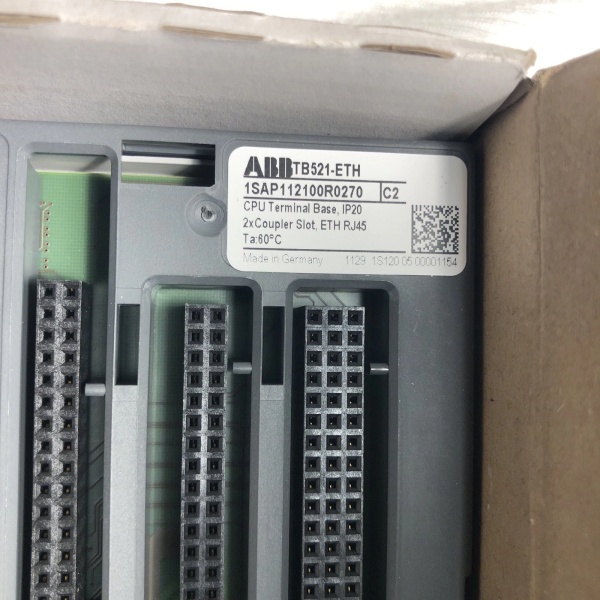
ABB TB521-ETH
Technical Deep Dive & Overview
The TB521-ETH is basically a passive backplane with three add-ons: a switched 24 VDC rail, a two-port UART controller, and a dedicated PHY for 10/100 Ethernet. A local ARM M0+ manages the UARTs, DMAs the raw frames into a dual-port RAM slice, and alerts the CPU via the V-bus backplane interrupt. Because the serial work is off-loaded, the CPU sees two new I/O mappings (COM1 & COM2) that behave like on-board ports even though they physically live on the base. Ethernet is even simpler—just a standard MII routed through the same backplane, so the CPU TCP stack thinks it has a native NIC. No configuration fuses; everything is set through Automation Builder. The whole assembly is potted except for the spring clamps, so it survives 5 g vibration and paper-mill humidity, but if you do manage to blow a port, you swap the entire base—no field-replaceable sub-components.
The TB521-ETH is basically a passive backplane with three add-ons: a switched 24 VDC rail, a two-port UART controller, and a dedicated PHY for 10/100 Ethernet. A local ARM M0+ manages the UARTs, DMAs the raw frames into a dual-port RAM slice, and alerts the CPU via the V-bus backplane interrupt. Because the serial work is off-loaded, the CPU sees two new I/O mappings (COM1 & COM2) that behave like on-board ports even though they physically live on the base. Ethernet is even simpler—just a standard MII routed through the same backplane, so the CPU TCP stack thinks it has a native NIC. No configuration fuses; everything is set through Automation Builder. The whole assembly is potted except for the spring clamps, so it survives 5 g vibration and paper-mill humidity, but if you do manage to blow a port, you swap the entire base—no field-replaceable sub-components.