Description
Key Technical Specifications
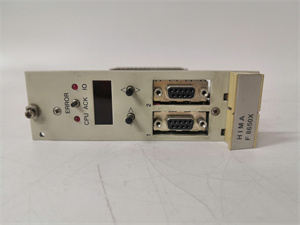
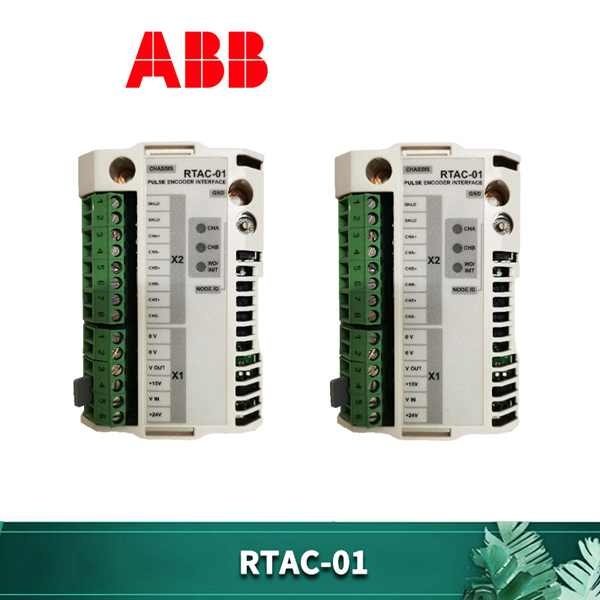
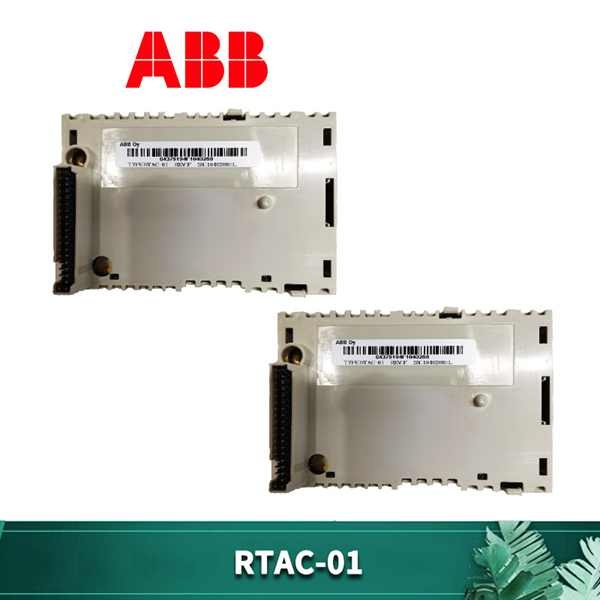
- Model Number: RTAC-01-A
- Manufacturer: ABB
- Processor: 32-bit industrial-grade CPU (800MHz clock speed)
- Memory: 512MB RAM, 2GB flash storage (expandable to 8GB)
- Protocol Support: IEC 61850, DNP3, Modbus TCP/IP, Profinet, Ethernet/IP
- Communication Ports: 4 x Gigabit Ethernet (RJ45), 2 x RS-485 (Modbus RTU), 1 x USB 2.0
- Operating Temperature: -40°C to +70°C (-40°F to +158°F)
- Storage Temperature: -50°C to +85°C (-58°F to +185°F)
- Isolation: 2kV AC (Ethernet ports to power, serial to backplane)
- Power Supply: 12–48V DC (2A typical), 85–264V AC (optional variant)
- Dimensions (W x H x D): 120mm x 180mm x 80mm
- Weight: Approx. 550g
- Mounting: DIN rail (35mm) or panel-mount (IP65-rated front panel)
- Compliance: IEC 61850-3 (substation automation), IEC 61010-1, UL 61010-1
- Control Capabilities: Real-time task execution (<1ms latency), PID control loops (up to 32), sequential logic
- Protection Features: ESD protection (±25kV), surge protection (6kV), reverse polarity tolerance

ABB RTAC-01- A
Field Application & Problem Solved
In industrial and energy systems—smart grids, refineries, and water treatment plants—the biggest challenge is bridging real-time control with networked connectivity, especially in distributed environments. Legacy controllers lack multi-protocol support, suffer from high latency, or can’t process data at the edge, leading to delayed decision-making, inefficient resource use, and difficulty integrating with modern IoT/IIoT systems. This controller solves that by combining real-time processing with edge computing and multi-protocol compatibility, eliminating the gap between local control and centralized monitoring.
You’ll typically find this controller in smart grid substation automation, where it processes IEC 61850 data for real-time load balancing and fault detection. In refineries, it’s used for distributed control of auxiliary systems (e.g., cooling tower fans) while syncing with the central DCS via Ethernet/IP. It’s also critical in water treatment plants, managing pump stations and chemical dosing systems with DNP3 protocol integration, and in manufacturing lines, handling real-time motion control while logging data to cloud platforms. For retrofits, it replaces outdated PLCs, adding edge computing and modern protocol support without ripping out existing field devices.
Its core value is speed and connectivity. The <1ms task latency ensures critical control decisions (e.g., substation fault isolation) happen instantaneously, while edge computing reduces bandwidth usage by processing data locally before sending insights to the cloud. The multi-protocol design eliminates the need for gateways, simplifying integration with diverse systems. For operators, this translates to faster response to process upsets, lower operational costs, and seamless scalability—critical in industries moving toward smart, connected operations.
Installation & Maintenance Pitfalls (Expert Tips)
Power Supply Polarity & Voltage Range
Rookies often ignore the 12–48V DC range or reverse the power wires. Connecting a 50V supply or reversing polarity damages the internal power regulator. Use a multimeter to confirm input voltage is within range and polarity matches the terminal markings (positive to +, negative to -). For AC-powered variants, verify the 85–264V input—using a 277V supply on a 120V-only unit will destroy the module.
Protocol Stack Overloading
Technicians frequently enable all supported protocols simultaneously, overloading the controller’s processor. This increases latency beyond the <1ms threshold, leading to slow control responses. Enable only the protocols needed for your application (e.g., IEC 61850 for substations, Modbus TCP for DCS integration). Monitor CPU usage via the controller’s web interface—keep it below 70% to maintain real-time performance.
Ethernet Cable Shielding for Substation Environments
In high-EMI settings like substations, using unshielded Ethernet cables causes packet loss and protocol errors. The controller’s Gigabit ports are isolated, but unshielded cables pick up noise from transformers or switchgear. Use shielded Cat6A cable for all Ethernet runs, and ground the shield at both ends (substation-specific best practice). This reduces EMI-induced errors by 80% compared to unshielded wiring.
Firmware Updates: Don’t Skip Validation
Rushing firmware updates without validating compatibility is a common mistake. New firmware may conflict with custom logic or protocol configurations, causing the controller to lock up. Before updating, back up the current configuration and test the new firmware in a non-production environment. Verify all protocols and control loops work post-update—skipping this step can lead to unplanned downtime in critical applications like substation control.
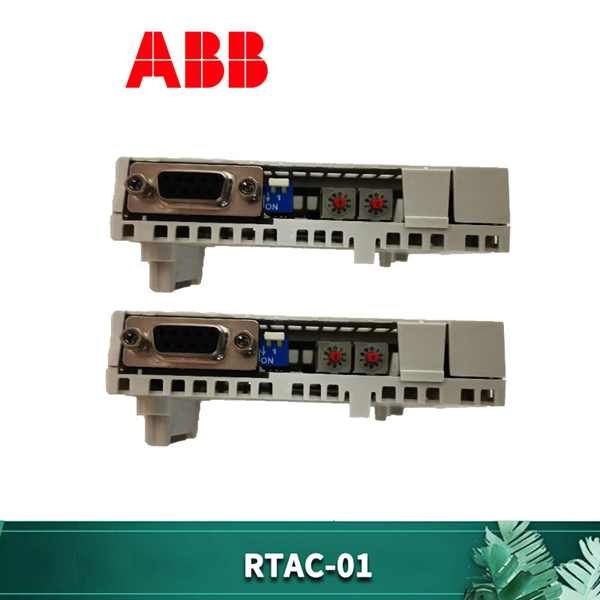
ABB RTAC-01- A
Technical Deep Dive & Overview
The ABB RTAC-01-A is a real-time edge controller engineered to unify local control and networked connectivity in industrial environments. At its core, it uses an 800MHz industrial-grade CPU optimized for low-latency task execution, with dedicated hardware for protocol processing to avoid CPU bottlenecks. This design ensures real-time control tasks (e.g., PID loops, fault detection) run within <1ms, while network communication and edge computing operate in parallel without impacting performance.
The controller’s multi-protocol support is enabled by embedded firmware stacks for IEC 61850, DNP3, and industrial Ethernet protocols. Each protocol runs on a separate thread, preventing cross-talk and ensuring reliable communication with diverse systems—from substation IEDs (Intelligent Electronic Devices) to cloud platforms. The 4 Gigabit Ethernet ports support link aggregation for redundant connections, critical for high-availability applications like smart grids.
Edge computing capabilities allow the controller to process sensor data locally, running analytics to identify trends or faults before sending compressed insights to central systems. This reduces bandwidth usage and enables faster decision-making, as the controller doesn’t need to wait for cloud-based instructions. The expandable flash storage accommodates custom logic (written in IEC 61131-3 languages) and data logs, supporting offline operation if network connectivity is lost.
Ruggedness is built for harsh environments: the IP65 front panel resists dust and water, while the -40°C to +70°C operating range handles extreme temperatures in outdoor substations or unconditioned control cabinets. The DIN rail mounting simplifies integration into existing setups, and the status LEDs provide at-a-glance visibility into power, protocol activity, and faults. Overall, the RTAC-01-A is a versatile workhorse that bridges the gap between real-time control and modern networked automation, designed for the demands of smart, connected industrial systems.