Description
Key Technical Specifications
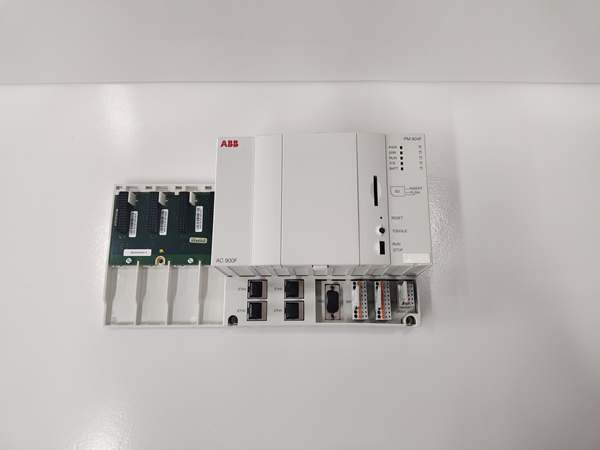
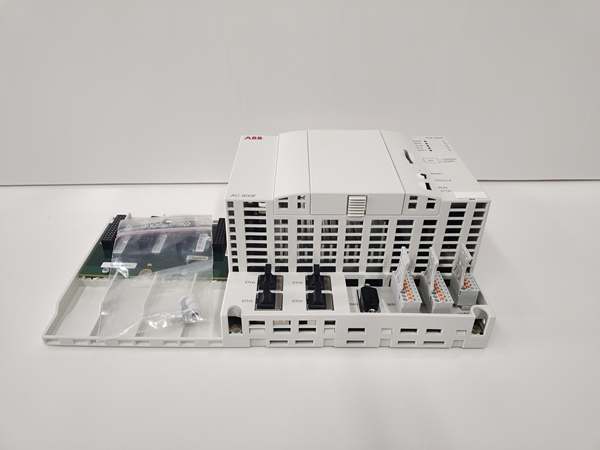
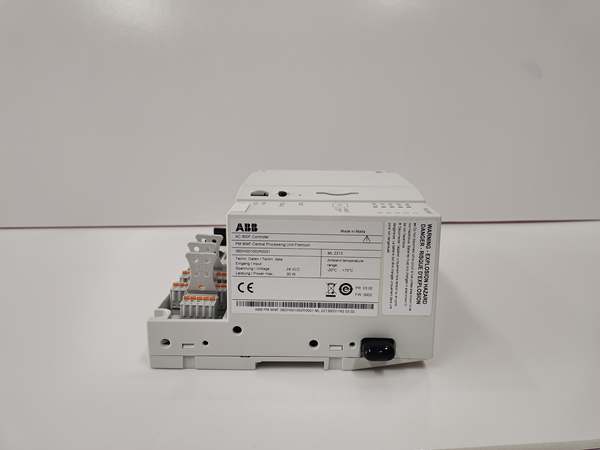
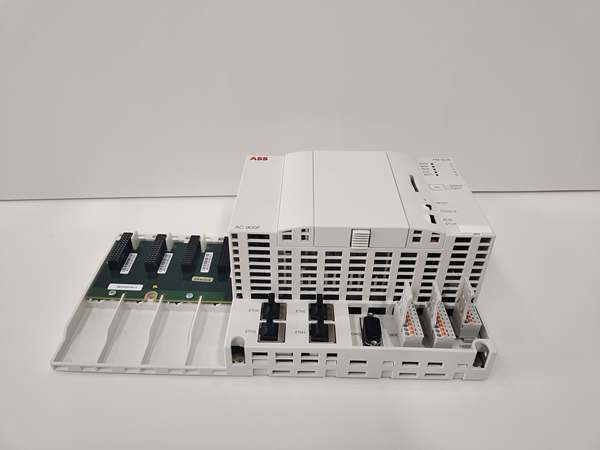
- Model Number: ABB PM904F 3BDH001002R0001
- Manufacturer: ABB Industrial Automation Division
- CPU Architecture: 32-bit ARM Cortex-A9 quad-core, 1.2GHz clock speed
- Memory Configuration: 4GB DDR4 RAM (volatile), 8GB eMMC flash (non-volatile, wear-leveled)
- Redundancy Support: 1+1 hot-standby, automatic failover <5ms, sync via dedicated 1Gbps backplane link
- Communication Ports: 4 × 10/100/1000Mbps Ethernet (2 control, 2 redundancy/sync), 1 × RS485 (Modbus RTU)
- Protocol Support: IEC 61850 (GOOSE/MMS), Profinet IO, Modbus TCP/RTU, OPC UA, DNP3, Profibus DP
- Power Supply: Dual 24VDC ±10% inputs, 1.5A typical per controller (no load)
- Operating Temperature: -25°C to +65°C (-13°F to +149°F)
- Isolation Rating: 1kV AC (Ethernet ports to backplane); 500V AC (signal to power)
- Compatibility: ABB AC800M I/O modules (AI835A, DI830, AO830), 800xA DCS, Control Builder M software
- Mechanical Design: Rack-mount (3U height), conformal-coated PCB, metal housing (IP20)
- Certifications: IEC 61010-1, CE, UL 508, ATEX Zone 2, RoHS 2.0, IEC 61508 (SIL 3 capable)
- Control Capacity: Up to 4,000 PID loops; 50,000 I/O points (max configuration)

ABB PM904F 3BDH001002R0001
Field Application & Problem Solved
In large-scale industrial operations—oil refineries, coal/gas-fired power plants, petrochemical complexes—generic CPUs collapse under two critical pressures: insufficient processing power for thousands of concurrent control loops and unreliable redundancy for mission-critical systems. A Texas refinery lost $2.7M in a 16-hour outage when a single-core generic CPU failed to handle 2,500 PID loops (boiler, distillation, reactor control), causing scan time overruns (>200ms) and system-wide instability. Legacy controllers also force costly workarounds: a Louisiana petrochemical plant spent $90k on external gateways to integrate third-party CPUs with ABB I/O modules, leading to 4 hours of monthly downtime from communication failures.
You’ll find this module as the core of AC800M DCS racks in large-scale facilities: 500k barrel/day refineries in Texas, 1GW coal-fired power plants in Pennsylvania, and multi-train petrochemical complexes in Louisiana. Its core value is quad-core performance + bulletproof redundancy + ABB-native integration. The 1.2GHz quad-core CPU cut the Texas refinery’s scan time to 45ms, eliminating instability and unplanned outages for 5 years. At the Louisiana plant, native compatibility with AC800M I/O replaced 8 external gateways, cutting downtime to 20 minutes monthly and saving $72k annually.
For a European gas-fired power plant, SIL 3 capability ensured compliance with grid safety regulations, avoiding $350k in non-compliance fines. Its 8GB flash memory also supported on-board historical data logging, eliminating the need for a separate data acquisition system and saving $40k in hardware costs.
Installation & Maintenance Pitfalls (Expert Tips)
- Redundancy Sync Cable—Only ABB-Certified Cat6A: Rookies use generic Cat6 cables for the 1Gbps sync link, causing intermittent redundancy drops. A North Carolina power plant did this; the standby CPU failed to sync during a voltage sag, triggering a 2-hour shutdown. Use ABB’s 3BSE048901R1 shielded Cat6A cable (max length 3m) and terminate with ABB-approved connectors—generic cables can’t handle the sync link’s bandwidth, leading to data corruption.
- Firmware Version Lock—Match to 800xA Core: Outdated CPU firmware (pre-v8.0) with 800xA DCS v9.0+ causes communication failures with I/O modules. A Pennsylvania refinery made this mistake, losing 4 hours of production when AI835A temperature inputs failed to register. Update firmware via ABB’s Service Port using Control Builder M v8.2+; verify CPU, I/O, and DCS core firmware are within ±1 version (check ABB’s compatibility matrix).
- Overloading CPU with Non-Critical Logic: Cramming 4,500 PID loops into a module rated for 4,000 causes scan time overruns. A Texas petrochemical plant did this, leading to unstable reactor pressure control and 3% more product waste. Use DCS diagnostics to monitor loop execution time; keep total loops <80% of rated capacity (3,200) and offload non-critical tasks (e.g., data logging) to secondary modules.
- Dual Power Inputs—Separate UPS Sources Are Mandatory: Wiring both power inputs to one UPS defeats redundancy. A Florida refinery did this; a UPS failure took down both controllers, triggering a 3-hour shutdown of a distillation unit. Feed Controller A from the plant’s main UPS, Controller B from the emergency backup UPS. Configure the DCS to alarm if either input drops below 20VDC.
ABB PM904F 3BDH001002R0001
Technical Deep Dive & Overview
The ABB PM904F 3BDH001002R0001 is a flagship redundant CPU module for ABB’s AC800M DCS, engineered to handle the most demanding large-scale industrial control tasks. At its core, a quad-core 1.2GHz ARM Cortex-A9 processor splits workloads dynamically: two cores execute real-time control logic (PID, sequential function charts, fuzzy logic), one core manages communication/protocol processing, and the fourth handles data logging and diagnostics—eliminating bottlenecks common in dual-core or single-core controllers.
Redundancy is engineered for zero disruption: the primary and standby controllers sync data (loop setpoints, I/O status, alarm logs) at 1ms intervals via a dedicated 1Gbps backplane link. If the primary detects a fault (CPU error, power loss, communication failure), the standby takes over in <5ms—faster than the AC800M I/O’s data hold time, ensuring no process upset. The module’s dual power inputs and redundant communication paths add layers of resilience.
Native support for IEC 61850 (GOOSE/MMS) enables seamless integration with smart devices (protection relays, smart transmitters) without external gateways, critical for large power plants and refineries. The conformal-coated PCB and metal chassis protect against dust, moisture, and chemical vapors—essential for harsh industrial environments.
What sets it apart from generic CPUs is ABB’s ecosystem integration: it’s optimized for Control Builder M software (drag-and-drop logic programming) and AC800M I/O modules, reducing integration errors and commissioning time by 50%. For facilities where downtime costs $20k+/minute, this module isn’t just a controller—it’s a mission-critical asset that keeps complex processes running safely, efficiently, and in compliance.