Description
Key Technical Specifications
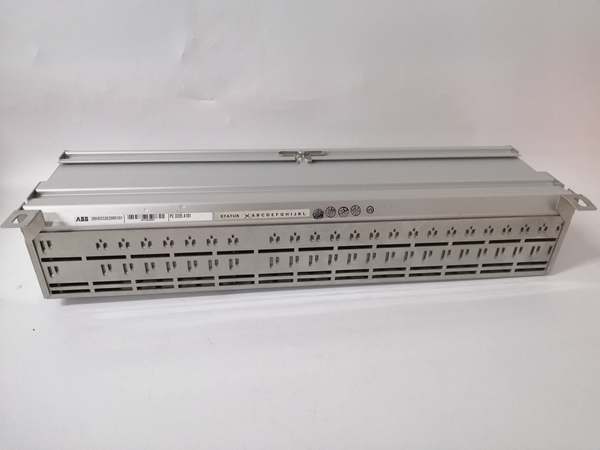
- Model Number: PCD235A101
- Manufacturer: ABB
- Compatible Systems: ABB AC 800M DCS, Compact Control Builder (CCB)
- Input Configuration: 16 digital inputs (24V DC, sinking/sourcing configurable), 2ms response time
- Output Configuration: 16 digital outputs (24V DC, 0.5A per channel, 8A total), PNP/NPN selectable
- Operating Temperature: -20°C to +60°C (-4°F to +140°F)
- Storage Temperature: -40°C to +85°C (-40°F to +185°F)
- Isolation: 2kV AC (channel-to-channel, channel-to-backplane)
- Power Supply: Derived from AC 800M backplane (24V DC, 300mA typical)
- Protection Features: ESD protection (±15kV), short-circuit protection (outputs), over-voltage tolerance
- Dimensions (W x H x D): 80mm x 140mm x 115mm
- Weight: Approx. 380g
- Mounting: DIN rail (35mm) via AC 800M base unit, backplane-connected
- Compliance: IEC 61131-2, IEC 61000-4 (EMC), UL 508, CE
- Status Indicators: Power (PWR), Input Activity (1–16), Output Activity (1–16), Fault (RED)
- Diagnostic Capabilities: Short-circuit detection, over-current alert, channel fault reporting

ABB PCD235A101
Field Application & Problem Solved
In process industries—refineries, chemical plants, and power stations—the biggest challenge is handling high volumes of discrete I/O signals (sensors, relays, actuators) while maintaining reliable connection to the central DCS. Legacy digital I/O modules lack density, suffer from poor isolation, or require complex wiring, leading to crowded control cabinets, signal cross-talk, and unplanned downtime from short-circuits or EMI. This module solves that by offering high-density (32 total channels), configurable I/O, and robust protection—consolidating discrete signals while ensuring signal integrity in harsh industrial environments.
You’ll typically find this module in AC 800M DCS racks powering critical discrete control: refinery pump start/stop circuits, chemical plant valve interlocks, power plant boiler flame detection sensors, or pulp mill conveyor position switches. It’s also a staple in batch processing systems, where it coordinates discrete actuators (mixers, valves, alarms) with the DCS. For retrofits, it replaces older low-density I/O modules, reducing the number of modules needed per cabinet and freeing up backplane slots—critical in space-constrained control rooms.
Its core value is density and flexibility. The 16-in/16-out configuration cuts down on module count, simplifying wiring and reducing failure points. The configurable sinking/sourcing inputs and PNP/NPN outputs adapt to almost any discrete device, eliminating the need for adapter modules. For technicians, the per-channel status LEDs and short-circuit diagnostics enable fast troubleshooting—no need for specialized tools to identify a faulty sensor or shorted output. For plant operators, this translates to cleaner control cabinets, fewer I/O-related faults, and consistent process coordination—critical when discrete signal failures can halt entire production lines.
Installation & Maintenance Pitfalls (Expert Tips)
Input/Output Configuration: Match Device Type
Rookies often leave inputs set to sinking when connecting sourcing sensors (or vice versa), resulting in no signal detection. The module won’t auto-adjust—you must configure each channel via Control Builder. For sensors (inputs), confirm if they’re sinking (NPN) or sourcing (PNP) before setup. For actuators (outputs), select PNP or NPN to match the device’s power requirement. Test each channel with a multimeter post-configuration—this catches mismatches that would cause “ghost” signals or failed actuation.
Overloading Output Channels: Respect Per-Channel Limits
Each output is rated for 0.5A, but technicians frequently daisy-chain relays or indicators onto a single channel. Overloading triggers short-circuit protection, shutting down the channel and triggering a fault. Calculate the total current draw of connected devices (e.g., 0.2A relay + 0.1A indicator = 0.3A, safe) and never exceed 0.5A per channel or 8A total. For high-current devices (e.g., 1A solenoids), use external power amplifiers—overloading is the #1 cause of output channel failure in the field.
Backplane Connection: Avoid Partial Seating
Forcing the module into the AC 800M base unit or stopping short of full backplane engagement causes intermittent I/O faults or communication drops. Align the module with the base unit’s guide rails and push firmly until it seats flush—listen for a subtle “click” to confirm. Never use tools to pry or secure the module; bent backplane pins are expensive to repair and can disable the entire base unit slot.
Wiring Torque: Don’t Over-Tighten Terminals
The module’s removable terminal blocks are sensitive to over-tightening. Rookies often crank down screws to “ensure a tight fit,” stripping threads or damaging terminal contacts. Use a torque screwdriver set to ABB’s spec (0.6–0.8Nm) for all wiring connections. Recheck torque after the first week of operation—thermal cycling and vibration can loosen terminals, leading to intermittent signal loss in high-vibration environments like pump rooms.
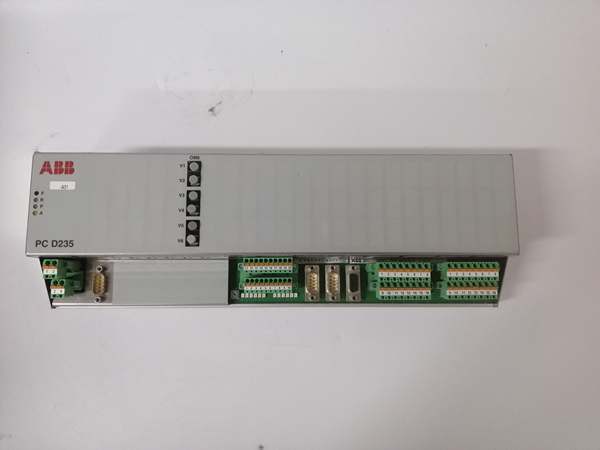
ABB PCD235A101
Technical Deep Dive & Overview
The ABB PCD235A101 is a high-density digital I/O module engineered to integrate discrete field devices with ABB’s AC 800M DCS. At its core, it acts as a signal interface: converting raw discrete signals (on/off) from sensors into digital data for the DCS, while translating DCS commands into power signals for actuators. The module’s 32-channel design (16 in/16 out) maximizes I/O density per backplane slot, reducing cabinet footprint and wiring complexity.
Each input channel features configurable sinking/sourcing logic, enabled by internal switching circuitry that adapts to different sensor types without hardware changes. The 2ms response time ensures fast detection of discrete events (e.g., a pump pressure switch tripping), critical for time-sensitive interlocks. Output channels include built-in short-circuit protection—if a channel is shorted, it shuts down independently without affecting other channels, and reports the fault to the DCS for remote monitoring.
Communication with the AC 800M controller happens via the system backplane, ensuring low-latency data transfer (sub-1ms) between the module and DCS. The 2kV isolation between channels and backplane prevents ground loops and cross-talk, common in industrial environments with multiple grounded devices. Internally, ESD protection guards against electrical transients from wiring or device connection, extending the module’s lifespan.
Ruggedness is built for industrial conditions: the wide operating temperature range (-20°C to +60°C) handles unconditioned control cabinets, while the compact DIN rail design fits into standard AC 800M racks. The removable terminal blocks simplify wiring and maintenance—technicians can disconnect the module without rewiring field devices, reducing downtime during replacements. The per-channel status LEDs provide at-a-glance visibility, letting technicians quickly identify active signals or faulted channels without connecting a laptop.
Overall, this module is a workhorse for discrete I/O integration: it delivers high density, flexibility, and reliability, while seamlessly integrating with the AC 800M DCS. Its design prioritizes the industrial reality of crowded cabinets, diverse devices, and harsh conditions—making it a trusted choice for process control environments worldwide.