Description
Key Technical Specifications
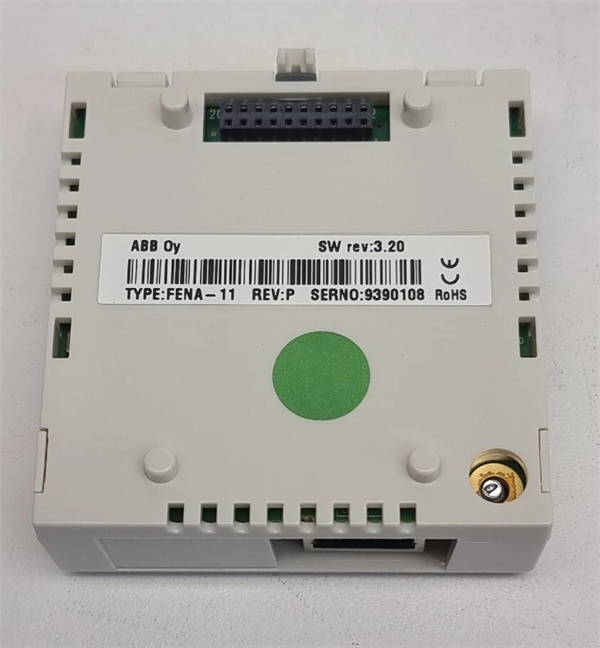
- Model Number: ABB FENA-11
- Manufacturer: ABB
- Module Type: Ethernet communication gateway for variable frequency drives (VFDs)
- Supported Protocols: PROFINET IO (RT), EtherNet/IP, Modbus TCP, TCP/IP, UDP
- Ethernet Port: 1 x RJ45 (10/100 Mbps, auto-negotiation)
- Compatibility: ABB ACS800 (firmware ≥5.1), ACS880 (all firmware versions)
- Control Interface: Drive bus (connects to drive’s option slot)
- Operating Temperature: 0°C to 60°C (32°F to 140°F)
- Storage Temperature: -40°C to 85°C (-40°F to 185°F)
- Isolation: 500V AC (Ethernet port to drive bus, 1-minute withstand)
- Power Supply: 24V DC (drawn from drive’s internal power supply)
- Power Consumption: 2.5W (max load)
- Mounting: Drive option slot (plug-and-play, no external mounting required)
- Dimensions: 140mm x 80mm x 40mm
- Weight: 0.25kg
- Protection Features: ESD protection (±8kV contact, ±15kV air), surge protection
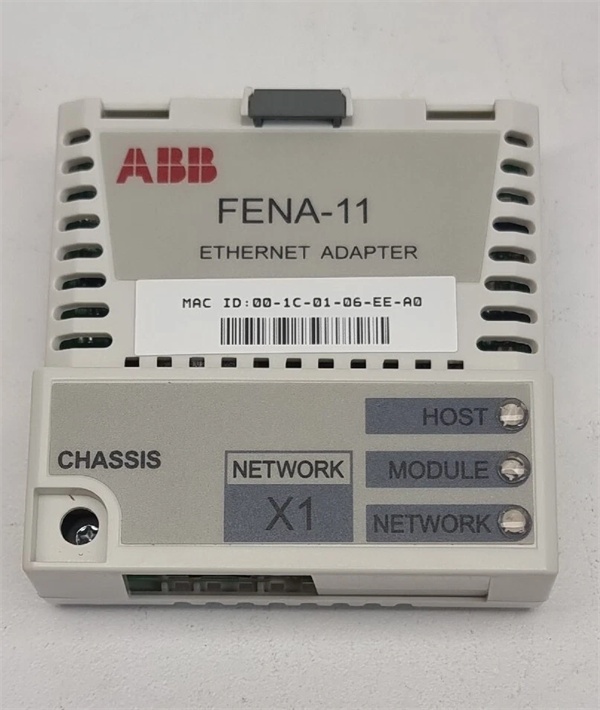
ABB FENA-11
Field Application & Problem Solved
In industrial automation—manufacturing lines, pumping stations, and HVAC systems—ABB ACS800/ACS880 drives are workhorses for motor speed control. The challenge? Legacy drives rely on serial communication (e.g., RS-485) that’s slow, limited to short distances, and incompatible with modern Ethernet-based SCADA systems. This creates data bottlenecks, prevents remote drive monitoring, and forces technicians to access drives locally for configuration or troubleshooting. The ABB FENA-11 solves these gaps by adding Ethernet connectivity to legacy and modern ACS drives, enabling high-speed, long-distance communication with control systems.
You’ll find this module in applications like integrating conveyor system drives with factory SCADA in automotive plants, enabling remote monitoring of pump drives in water treatment facilities, or syncing HVAC fan drives with building management systems (BMS). It’s a staple in retrofits, where it upgrades older ACS800 drives to support PROFINET or EtherNet/IP—eliminating the need for costly drive replacements. In large-scale facilities (e.g., warehouses, chemical plants), it allows centralized control of dozens of drives from a single SCADA station, reducing wiring complexity and operational costs. It’s also critical in industries requiring compliance with data logging standards (e.g., food processing, pharmaceuticals), as it streams drive data (speed, current, faults) to SCADA for audit trails.
Its core value is connectivity and simplicity. The plug-and-play design makes installation straightforward, even for non-specialized technicians. Multi-protocol support ensures compatibility with existing control architectures (PROFINET for European systems, EtherNet/IP for North American) without reconfiguring the entire network. High-speed Ethernet (10/100 Mbps) enables real-time drive control and instant fault alerts, reducing downtime by allowing remote troubleshooting. For operators, this means improved visibility into drive performance, faster issue resolution, and reduced on-site maintenance—critical in 24/7 automated environments.
Installation & Maintenance Pitfalls (Expert Tips)
- Drive Firmware Compatibility (Outdated Firmware = No Communication): The FENA-11 requires ACS800 drives to have firmware version 5.1 or higher—rookies often skip checking firmware before installation. Outdated firmware prevents the drive from recognizing the module, leading to “no communication” faults. Use ABB’s DriveWindow Light software to check the drive’s firmware version before installing the module. If outdated, update the drive firmware (via USB or serial) before plugging in the FENA-11—never force the module into an incompatible drive.
- IP Address Conflict (Duplicate IP = Network Collisions): The module uses a default IP address (192.168.1.1) that’s often duplicated in industrial networks. Rookies often leave the default IP, causing collisions that disrupt communication with the drive and other network devices. Use DriveWindow Light or a web browser (connect directly to the module) to assign a unique static IP address, subnet mask, and gateway that matches the SCADA/BMS network. Verify the IP with a ping test before integrating the drive into the network.
- Ethernet Cable Quality (Cat5 vs. Cat5e/Cat6 = Signal Loss): For long cable runs (over 100 meters) or noisy environments, rookies often use Cat5 cable instead of Cat5e or Cat6. Cat5 lacks twisted-pair shielding and has higher crosstalk, leading to signal loss and intermittent communication. Use Cat5e (minimum) or Cat6 shielded twisted-pair (STP) cable for runs over 50 meters. Terminate cables with RJ45 connectors following T568B standards, and avoid running Ethernet cables parallel to high-voltage power lines (minimum 30cm separation) to reduce EMI.
- Protocol Configuration Mismatch (Wrong Protocol = Data Silos): The module supports multiple protocols, but rookies often leave it in default mode (Modbus TCP) while the SCADA system uses PROFINET or EtherNet/IP. This creates a protocol mismatch, where the SCADA can’t read drive data. Use the module’s web interface or DriveWindow Light to select the correct protocol (matching the SCADA/BMS). For PROFINET, assign a device name and slot number; for EtherNet/IP, set the device ID. Test communication with a protocol analyzer (e.g., Wireshark) to confirm data is being transmitted correctly.

Technical Deep Dive & Overview
The ABB FENA-11 is a plug-and-play Ethernet communication module designed to add network connectivity to ABB ACS800 and ACS880 variable frequency drives. Its core is a low-power 32-bit microprocessor optimized for industrial communication protocols, handling data transfer between the drive’s internal bus and the Ethernet network. The module connects directly to the drive’s dedicated option slot, drawing 24V DC power from the drive’s internal supply—eliminating the need for external power or wiring.
The module’s communication architecture uses a dual-port design (internal drive bus + external Ethernet port) with a dedicated protocol processor. This separates drive control data (e.g., speed setpoints, current feedback) from network traffic, ensuring drive performance isn’t compromised by communication delays. Supported protocols include PROFINET IO (Real-Time) for time-critical control, EtherNet/IP for seamless integration with Rockwell systems, and Modbus TCP for legacy SCADA compatibility. The 10/100 Mbps Ethernet port auto-negotiates with the network switch, adapting to the available bandwidth.
Data exchange between the module and the drive occurs via the drive’s internal bus, which transmits real-time parameters (speed, torque, voltage) and control commands. The module caches critical drive data to reduce bus traffic, updating the cache at 100ms intervals (configurable to 10ms for real-time applications). It also supports event-driven data transmission, sending instant alerts to SCADA when drive faults occur (e.g., overcurrent, overheating).
Built for industrial reliability, the FENA-11 includes ESD and surge protection to withstand harsh factory environments. The RJ45 port features integrated surge protection (±15kV air discharge, ±8kV contact discharge) to prevent damage from electrostatic discharge during maintenance. The module’s compact, rugged design (IP20-rated) fits within the drive’s enclosure, protecting it from dust and physical damage.
Configuration is simplified via three methods: ABB’s DriveWindow Light software (direct USB connection to the drive), a web browser (via Ethernet), or the drive’s local control panel. The web interface provides a user-friendly dashboard for setting IP addresses, selecting protocols, and monitoring drive status. The module also supports remote firmware updates, allowing technicians to upgrade the module’s software via Ethernet without accessing the drive physically.
Its plug-and-play functionality and broad compatibility make it a cost-effective solution for upgrading drive connectivity, extending the lifespan of legacy ACS800 drives and enhancing the flexibility of modern ACS880 systems. The module’s low power consumption (2.5W) and passive cooling design ensure it doesn’t add heat load to the drive enclosure, maintaining drive reliability.