Description
Key Technical Specifications
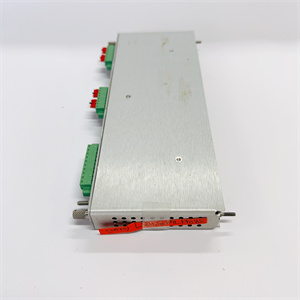
Model Number: ABB DSRF180A
Manufacturer: ABB
Output Type: Discrete digital (Form C SPDT relays – Single Pole Double Throw)
Number of Output Channels: 8 (individually isolated)
Rated Load Current: 6A @ 250V AC, 4A @ 24V DC (per channel)
Relay Surge Current: 10A (1-second peak)
Operating Temperature: -25°C to 70°C (-13°F to 158°F)
Storage Temperature: -40°C to 85°C (-40°F to 185°F)
Isolation: 2kV AC (channel-to-channel, channel-to-backplane, 1-minute withstand)
Diagnostics: Relay contact wear detection, overcurrent monitoring
Power Supply: 24V DC ±10% (21.6V DC to 26.4V DC), from AC 800M backplane
Power Consumption: 1.2W (standby), 3.5W (all relays energized)
Mounting: AC 800M I/O rack (compatible with PM850/PM860/PM861/PM865 CPUs)
Connector Type: Spring-cage terminal block (accepts 0.5-2.5mm² wire)
Relay Life: 100,000 operations (rated load), 10,000,000 operations (no load)
ABB DSRF180A
Field Application & Problem Solved
In industrial process control—chemical plants, water treatment facilities, and manufacturing lines—switching discrete loads (solenoid valves, pump starters, alarm horns) requires modules that balance durability, current capacity, and fault visibility. The challenge? Many low-cost digital output modules use underrated relays that fail under inductive load spikes, or lack channel isolation that causes cross-talk in noisy environments. Others offer no way to monitor relay health, leaving technicians to discover failed contacts only when a load doesn’t activate—leading to unplanned downtime. The ABB DSRF180A solves these issues with rugged Form C relays, robust isolation, and built-in contact diagnostics.
You’ll typically find this module in applications like controlling diaphragm valves in chemical batch processes, activating pump motors in wastewater treatment plants, or triggering safety alarms in power plant control rooms. It’s a staple in AC 800M-based systems, where its 8-channel design maximizes I/O density in tight rack spaces—eliminating the need for multiple smaller modules. In food processing facilities, it switches heating elements and conveyor motors, relying on its wide temperature range (-25°C to 70°C) to withstand factory floor conditions. It also excels in safety-critical applications (e.g., emergency stop circuits), where Form C relays provide fail-safe normally closed (NC) contact options.
Its core value is reliability and proactive maintenance support. The 6A AC/4A DC relay rating handles common industrial loads without contact degradation, while 2kV isolation blocks interference from motors, transformers, and high-voltage equipment. Contact wear diagnostics flag deteriorating relays early, allowing scheduled replacements instead of emergency repairs. For operators, this means fewer process disruptions, faster troubleshooting, and consistent load control—critical in 24/7 environments where even minor downtime impacts productivity.
Installation & Maintenance Pitfalls (Expert Tips)
Neglecting Inductive Load Protection (Spikes = Welded Contacts): Rookies often skip surge protection for inductive loads (motors, solenoids), which generate voltage spikes when de-energized. These spikes weld relay contacts closed, rendering the channel useless. For AC loads, install RC snubbers (100Ω + 0.1μF) across the load terminals. For DC loads, use a freewheeling diode (rated for 1.5x load current) in reverse bias—wire it directly across the load, not the module, to avoid backfeeding voltage into the module.
Wire Gauge Mismatch (Undersized = Terminal Overheating): Using 22 AWG or smaller wire for 4-6A loads causes resistance buildup, leading to terminal heating and intermittent connections. Match wire gauge to load: 18 AWG for 2-4A loads, 16 AWG for 4-6A loads. Keep wire runs under 100 meters—longer runs increase resistance and voltage drop, which strains the relay. Use ferrules on stranded wire to prevent fraying and short circuits between terminals.
Misconfiguring NO/NC Contacts (Safety Risks): Form C relays offer NO (normally open) and NC (normally closed) contacts, but rookies often wire the wrong one for safety-critical loads. For emergency shutdown valves or E-Stop circuits, NC contacts are required—they de-energize the load if power fails. For standard loads (e.g., fans), NO contacts work. Test each channel manually via the AC 800M controller: energize the relay and confirm the load activates/deactivates as expected. Never assume the wiring matches the diagram—verify with a multimeter.
Ignoring Diagnostic Mapping (Blind to Relay Wear): The module’s contact wear diagnostics are useless if not mapped to the PLC’s alarm system. Rookies often skip this step, missing early warnings of rising contact resistance. In Control Builder M, assign diagnostic bits for each channel to trigger alarms when contact resistance exceeds 100Ω. Set up a maintenance schedule to replace relays approaching 80,000 operations—this prevents sudden failures during critical processes.
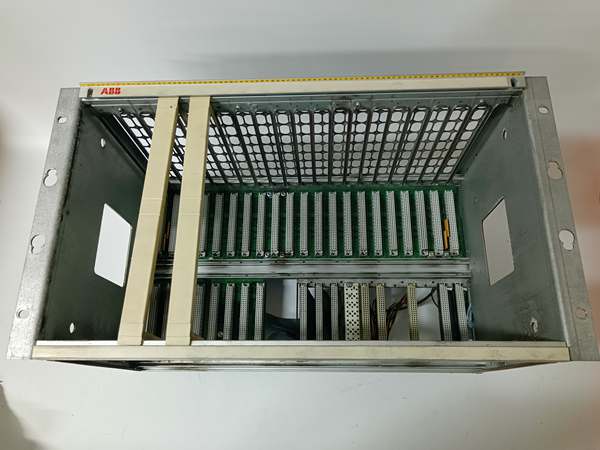
ABB DSRF180A
Technical Deep Dive & Overview
The ABB DSRF180A is an 8-channel digital output module engineered for load switching in ABB’s AC 800M control systems. Its core design revolves around rugged Form C (SPDT) relays, each optimized for industrial inductive and resistive loads. The module acts as a bridge between the AC 800M CPU’s low-voltage digital signals and high-power field devices, using opto-isolated relay drivers to convert control commands into mechanical switching.
Each output channel features 2kV AC isolation from the others and the backplane, a critical safeguard in noisy industrial environments. Isolation prevents ground loops and electromagnetic interference (EMI) from affecting the module or controller, ensuring reliable operation near motors or transformers. The relays use silver-nickel contacts for enhanced durability and arc resistance, extending their operational life under repeated switching.
Communication with the AC 800M CPU occurs via the rack’s backplane bus, with sub-10ms response time for real-time load control. Diagnostic data—including contact wear and overcurrent events—is transmitted back to the CPU for monitoring. Contact wear detection works by measuring contact resistance: as contacts degrade from arcing, resistance increases, and the module triggers a diagnostic flag when it exceeds a threshold (typically 100Ω).
The module draws 24V DC power from the AC 800M backplane, with separate power paths for the control circuit and relay drivers to avoid voltage drops during simultaneous relay activation. A built-in thermal sensor monitors internal temperature, triggering an overload alarm if it exceeds 70°C. The spring-cage terminals simplify tool-less wiring, reducing installation time and human error.
Built for industrial ruggedness, the DSRF180A withstands vibration (up to 5g at 10-2000Hz) and humidity (10-95% non-condensing), making it suitable for harsh plant floors. Its compact 1-slot design maximizes I/O density, and hot-swappable capability (with compatible AC 800M racks) allows module replacement without shutting down the control system. Compliance with IEC 61131-2 and safety certifications (CE, UL) ensures compatibility with global industrial standards, while its long relay life minimizes maintenance overhead.