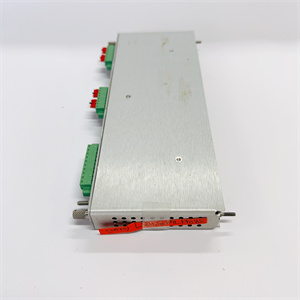
Description
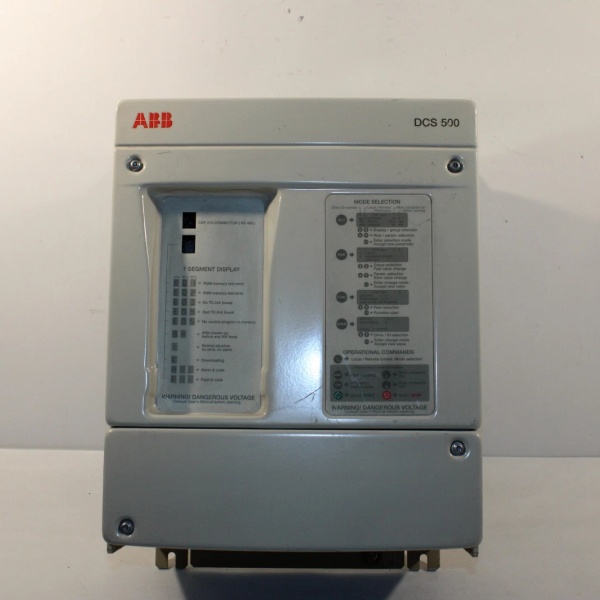
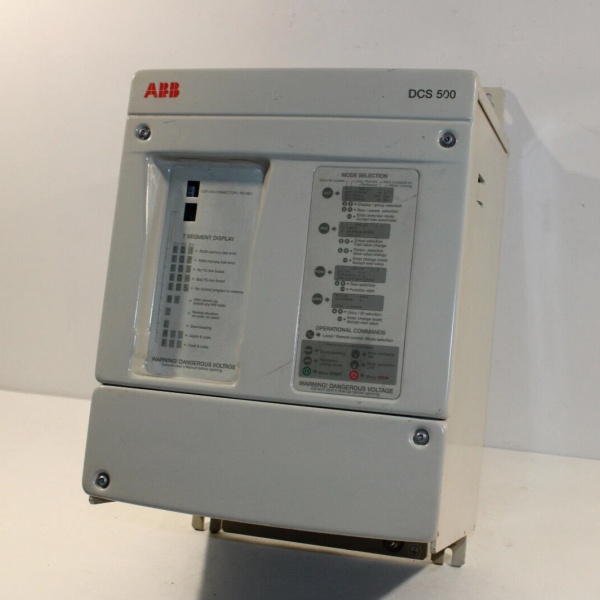
ABB DCS501B0520 41021P0000
Key Technical Specifications
- Model Number: ABB DCS501B0520 41021P0000
- Manufacturer: ABB Drives Division
- Rated Armature Current: 52A (continuous), 104A (peak, 10s)
- Input Voltage: 3-phase 380-480VAC ±10% (50/60Hz)
- Control Voltage Options: 24VDC ±10%, 110VAC ±10%, 220VAC ±10% (factory-configurable)
- Control Type: 4-quadrant (forward/reverse, regenerative braking)
- Speed Regulation Accuracy: ±0.1% (with tachometer feedback)
- Operating Temperature: -10°C to +50°C (14°F to +122°F)
- Protection Features: Overcurrent, overvoltage, overtemperature, undercurrent, motor stall protection
- Mounting Type: DIN rail (35mm) or panel mount (screw-on)
- Enclosure Protection: IP21 (protection against solid objects ≥12mm and dripping water)
- Certifications: CE, UL 508C, IEC 61800-5-1, RoHS 2.0
- Compatibility: Separately excited DC motors (0.75kW to 30kW), ABB PLCs/DCS via analog/digital inputs
Field Application & Problem Solved
In low-to-medium power DC motor control—packaging line conveyors, printing press drives, small industrial pumps—generic compact DC drives fail two critical tests: reliable 4-quadrant operation and resilience in space-constrained enclosures. A Wisconsin packaging plant lost $85k in a 2-hour outage when a generic drive failed during regenerative braking, causing a conveyor to overshoot and damage products. Legacy drives also suffer from poor current regulation: a Pennsylvania printing facility spent $15k annually replacing off-brand drives that couldn’t maintain consistent speed, leading to print misalignment.
You’ll find this drive installed in tight control panels across: food packaging conveyors, textile mill spindle drives, and small water treatment pumps. Its core value is compact design + 4-quadrant versatility + industrial ruggedness. The 52A continuous rating handles peak loads without tripping, while the IP21 enclosure protects against dust and dripping water common in factory environments. For a Texas electronics assembly line, the drive’s precise speed regulation (±0.1%) eliminated component misalignment issues that plagued generic drives, reducing scrap rates by 30%.
Installation & Maintenance Pitfalls (Expert Tips)
- Input Voltage Wiring: Don’t Mix Single/3-Phase: Rookies mistakenly wire single-phase AC to the 3-phase input, burning the drive’s rectifier. An Ohio metal shop destroyed two drives ($1,800 total) before verifying the power supply. Use a multimeter to confirm 3-phase voltage (380-480VAC) and follow ABB’s color-coded terminals (L1=R, L2=S, L3=T).
- Control Voltage Mismatch: Match to Drive Configuration: Installing a 220VAC control signal on a 24VDC-configured drive fries the control circuit. A Florida bakery’s drive failed during startup due to this error. Check the drive’s nameplate for control voltage (marked “Uc”) and verify with the PLC/DCS output before wiring.
- Heat Dissipation: Maintain 100mm Clearance Above/Below: Crowded panels block airflow, leading to overtemperature shutdowns. A Michigan plastics plant’s drives tripped hourly until technicians relocated adjacent wiring to create 100mm of open space. Avoid mounting the drive above heat sources (e.g., contactors) and clean dust buildup quarterly.
- Motor Parameter Setup: Calibrate Armature Current: Rookies use default motor parameters instead of nameplate data, causing overcurrent faults. A North Carolina pump system’s drive tripped repeatedly until the armature current was set to match the motor’s rated 45A. Use the drive’s local keypad or ABB DriveStudio to input motor data (armature voltage, field current, rated speed).

ABB DCS501B0520 41021P0000
Technical Deep Dive & Overview
The ABB DCS501B0520 41021P0000 is a compact 4-quadrant DC drive engineered to control separately excited DC motors in space-constrained industrial environments. At its core, a 32-bit microprocessor executes closed-loop speed/torque control: it converts 3-phase AC input to DC via a diode rectifier, then uses pulse-width modulation (PWM) to regulate armature voltage—delivering precise speed control even under variable loads. The 4-quadrant design allows the drive to act as a motor (supplying power) or generator (regenerating power back to the grid) during braking, eliminating the need for external braking resistors in many applications.
Unlike generic compact drives, it features a robust power stage with IGBTs rated for 104A peak current, handling transient loads without tripping. The control circuit includes optical isolation between power and signal paths, blocking electrical noise from VFDs or motors— a common flaw in budget drives that causes erratic operation. The drive’s local keypad provides basic configuration and troubleshooting, while analog (4-20mA) and digital inputs enable seamless integration with PLCs or DCS systems.
What sets it apart is its balance of compact size (145mm × 175mm × 100mm) and industrial performance. It’s designed to fit in tight control panels without sacrificing protection or functionality, making it ideal for machine builders and retrofits. For facilities where reliable DC motor control in limited space is critical, this drive isn’t just a component—it’s a space-efficient, rugged solution that keeps small-scale industrial processes running smoothly.