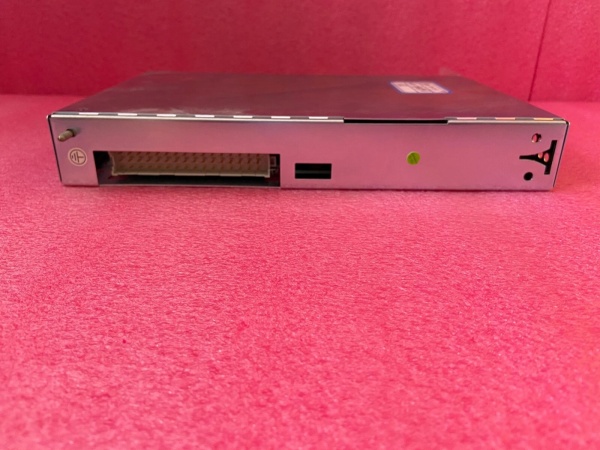
Description
Key Technical Specifications
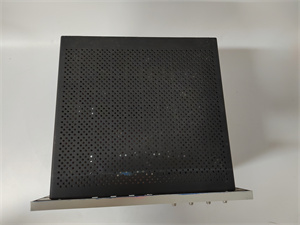
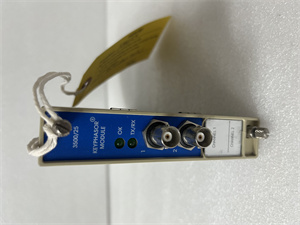
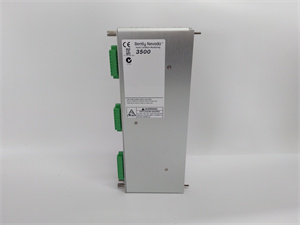
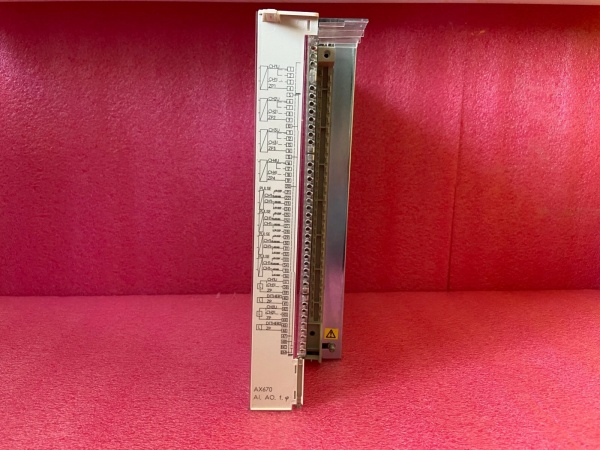
- Model Number: AX670 3BSE000566R1
- Manufacturer: ABB Industrial Automation Division
- Communication Protocol: Industrial Ethernet (TCP/IP), Profinet IO (controller/device), Modbus TCP
- I/O Capacity: Up to 128 I/O modules (digital/analog/specialty) via 800xA I/O racks
- Power Supply: 24VDC ±10% (18-32VDC), dual redundant inputs, 0.8A typical current draw
- Operating Temperature: -25°C to +65°C (-13°F to +149°F)
- Isolation Rating: 1kV AC (communication ports to I/O circuits); 500V AC (module-to-module)
- Mounting Type: Rack-mount (19″ standard), 3U height, metal chassis (IP20)
- Certifications: CE, UL 508, ATEX Zone 2, RoHS 2.0, IEC 61158-3-10 (Profinet)
- Compatibility: ABB 800xA DCS, 800xA I/O modules (AI801, DI801, AO801, DO801), third-party Profinet devices
- Redundancy Support: 1+1 controller hot-standby, auto-failover <5ms; redundant power inputs
- Diagnostic Capability: Built-in I/O module status, communication health, and power supply monitoring (transmitted to 800xA DCS)

ABB AX670 3BSE000566R1
Field Application & Problem Solved
In large-scale industrial facilities—refineries, power plants, chemical complexes—centralized I/O racks are impractical for remote process areas (e.g., distillation columns, cooling towers, reactor bays) due to long wiring runs, signal degradation, and high installation costs. Generic remote I/O systems fail to integrate with ABB 800xA DCS, lack redundancy for critical loops, and succumb to harsh conditions (extreme temperatures, dust, vibration). A Texas refinery lost $220k in a 5-hour outage when a generic remote I/O gateway failed, cutting off DCS communication with 50+ pressure transmitters in a remote crude unit. Legacy setups also force costly wiring: a Pennsylvania power plant spent $45k annually on cable replacements for centralized I/O, as long runs were prone to damage.
You’ll find this remote I/O controller installed in distributed 800xA I/O racks across: refinery alkylation units (managing temperature and pressure I/O), coal plant ash handling systems (linking to conveyor sensors and drives), and chemical reactor bays (controlling valve positioners and level transmitters). Its core value is ABB-native integration + redundant reliability + distributed control efficiency. The direct 800xA DCS communication eliminates gateway failure points, while dual controller redundancy ensures zero downtime during component failures. For an Alaskan natural gas plant, the -25°C operating range and conformal-coated circuit boards withstood sub-zero winters and dust—something generic controllers couldn’t do, costing 8 hours of production annually. By placing I/O close to field devices, the AX670 cuts wiring costs by 30-40% compared to centralized setups.
Installation & Maintenance Pitfalls (Expert Tips)
- Profinet Termination Is Non-Negotiable: Rookies forget to install 120Ω termination resistors at the start/end of Profinet segments, causing communication timeouts. A Louisiana chemical plant’s reactor I/O dropped offline hourly until resistors were added to the AX670 and final Profinet device. Use ABB’s 1SFL500001R0001 termination resistor, and verify with a multimeter (120Ω between data lines A/B).
- Firmware Mismatch Breaks DCS-I/O Sync: Outdated AX670 firmware (pre-v7.0) with 800xA v9.0+ causes I/O module detection failures. An Ohio metal fabricator’s remote temperature sensors went offline until both redundant controllers were updated to v8.1 via Control Builder M. Always batch-update redundant controllers to the same firmware version—mismatched versions corrupt data frames.
- Redundant Power Wiring: Use Separate Sources: Rookies wire both redundant power inputs to the same 24VDC supply, defeating redundancy. A Florida food processing plant’s remote I/O failed during a power glitch because both inputs relied on a single supply. Connect each power input to separate 24VDC power supplies (e.g., main and backup UPS) to ensure fault tolerance.
- Grounding: Dedicated Earth Bar for Remote Racks: Sharing the AX670’s ground with VFDs or motor cables introduces noise, leading to false I/O signals. A Michigan paper mill’s remote flow sensors gave erratic readings until a dedicated 10mm² earth bar was installed at the remote rack (ground resistance <1Ω). Route ground wires separately from power cables, and avoid daisy-chaining grounds with industrial equipment.
ABB AX670 3BSE000566R1
Technical Deep Dive & Overview
The ABB AX670 3BSE000566R1 is a redundant remote I/O controller engineered to extend ABB’s 800xA DCS to distributed process areas, acting as a local “brain” for remote I/O racks. At its core, a 32-bit ARM Cortex-A9 processor manages communication with the 800xA DCS (via Industrial Ethernet/Profinet) and local I/O modules, executing real-time data transfer with <5ms latency—critical for time-sensitive control loops. The 1+1 controller redundancy ensures that if one unit fails, the standby controller takes over instantly (<5ms failover), with no process disruption.
Unlike generic remote I/O gateways, the AX670 integrates seamlessly with 800xA’s engineering and HMI environment—no custom drivers or scripting required. It auto-discovers connected I/O modules, and diagnostics (e.g., module faults, wiring open/short circuits) are transmitted directly to the DCS, enabling predictive maintenance. The controller’s rugged design includes conformal-coated circuit boards to resist dust and humidity, dual redundant power inputs, and 1kV AC isolation to block electrical interference from industrial noise sources.
What sets it apart is its ability to scale—supporting up to 128 I/O modules per rack, it can handle thousands of digital/analog points in remote areas. For facilities with sprawling process areas, the AX670 eliminates the inefficiencies of centralized I/O, reducing wiring costs, signal degradation, and downtime. It’s not just a remote I/O controller—it’s a reliable extension of the 800xA DCS, built to deliver the same level of performance and safety in harsh, distributed environments as centralized racks.