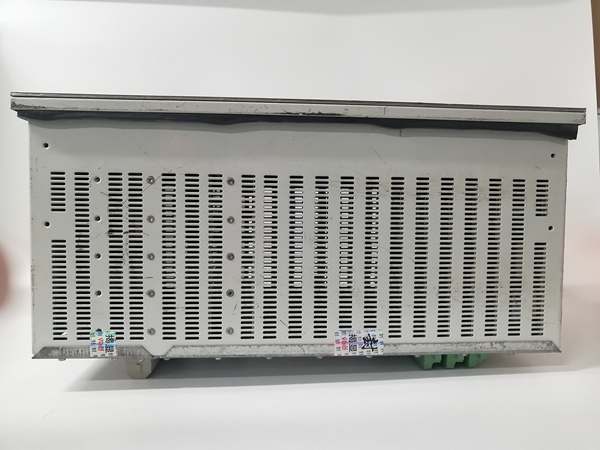
Description
Key Technical Specifications
-
Model Number: 1MRK004816-AC
-
Manufacturer: ABB (Sweden)
-
Protection Functions: 87T, 87N, 87 REF, 50/51, 50N/51N, 49, 46, 21, 24, 59/27, 81O/U, 60CTS, 60VTS, 50BF, 74TCS
-
Rated AC Voltage: 300–500 V (VT secondary 100–120 V)
-
Frequency: 45–65 Hz
-
Current Inputs: 1 A or 5 A (field-selectable)
-
Output Contacts: 2 SPDT trip, 6 SPNO signal (expandable to 24)
-
Communication: 2 × RJ-45 100BASE-FX/TX, IEC 618-50-8-1 & 9-2LE, GOOSE, Modbus-TCP, DNP3
-
Accuracy: ±1 % current / voltage, ±2 % impedance
-
Auxiliary Supply: 48–250 V DC / 100–240 V AC, < 25 W
-
Operating Temperature: –25 °C…+55 °C (continuous)
-
Housing: 4U, 177 mm withdrawable, IP 52 front, rear IP 20
-
Weight: 3.0 kg complete

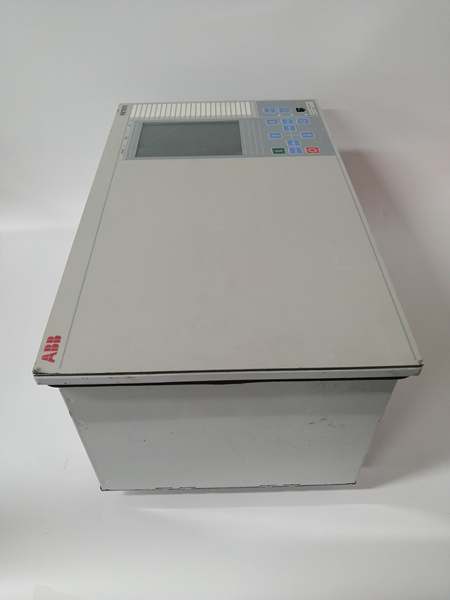
ABB 1MRK004816-AC
Field Application & Problem Solved
Large step-down transformers live a hard life—through-faults, cold-load pickup, and mis-coordinated fuses upstream. The 1MRK004816-AC drops into the RET670 rack and gives you transformer-specific curves (IEEE/IEC) plus percentage differential that actually tracks tap-changer position through the optional TCM module. I’ve hung these on 138/13.8 kV GSU units at a Kansas refinery cogen: the relay blocked on magnetizing inrush but still caught a 15 % turn-to-turn fault that traditional electromechanical 87T missed. The single-breaker variant means one withdrawable box does diff, REF, overcurrent, and volts—no separate 50/51 relay cluttering the panel. Utility guys like the dual-fiber HSR ports; lose one fiber and GOOSE still trips the high-side breaker in 8 ms. Bottom line: it collapses three legacy relays into one slot and still gives you disturbance recording that beats most standalone DFRs.
Large step-down transformers live a hard life—through-faults, cold-load pickup, and mis-coordinated fuses upstream. The 1MRK004816-AC drops into the RET670 rack and gives you transformer-specific curves (IEEE/IEC) plus percentage differential that actually tracks tap-changer position through the optional TCM module. I’ve hung these on 138/13.8 kV GSU units at a Kansas refinery cogen: the relay blocked on magnetizing inrush but still caught a 15 % turn-to-turn fault that traditional electromechanical 87T missed. The single-breaker variant means one withdrawable box does diff, REF, overcurrent, and volts—no separate 50/51 relay cluttering the panel. Utility guys like the dual-fiber HSR ports; lose one fiber and GOOSE still trips the high-side breaker in 8 ms. Bottom line: it collapses three legacy relays into one slot and still gives you disturbance recording that beats most standalone DFRs.
Installation & Maintenance Pitfalls (Expert Tips)
CT Polarity Reversal Will Fake an Internal Fault – The 87T slope is 20 %; if one CT is flipped the differential current looks like 200 % load. Always inject 5 A primary and watch the phasor display before you close the enable.
Star-Point Grounding Inside the Tank? – REF needs the neutral CT. If the transformer neutral is buried in oil and only brought out through a bushing CT, land that CT on the REF input, not the 87N. Mixing them gives nuisance trips every thunderstorm.
Forget the Tap-Position Input – RET670 can bias the 87T slope as the tap moves, but only if you wire the 19-position BCD contacts. Leave it at fixed ratio and you’ll over-trip on tap 1 during heavy winter load.
Fiber Loopback Test Before Go-Live – HSR looks bulletproof until someone crimps a patch cord. Run the built-in loopback for 24 h; if you see one dropped GOOSE frame, replace the cable—fault clearing is not the time to debug optics.
CT Polarity Reversal Will Fake an Internal Fault – The 87T slope is 20 %; if one CT is flipped the differential current looks like 200 % load. Always inject 5 A primary and watch the phasor display before you close the enable.
Star-Point Grounding Inside the Tank? – REF needs the neutral CT. If the transformer neutral is buried in oil and only brought out through a bushing CT, land that CT on the REF input, not the 87N. Mixing them gives nuisance trips every thunderstorm.
Forget the Tap-Position Input – RET670 can bias the 87T slope as the tap moves, but only if you wire the 19-position BCD contacts. Leave it at fixed ratio and you’ll over-trip on tap 1 during heavy winter load.
Fiber Loopback Test Before Go-Live – HSR looks bulletproof until someone crimps a patch cord. Run the built-in loopback for 24 h; if you see one dropped GOOSE frame, replace the cable—fault clearing is not the time to debug optics.
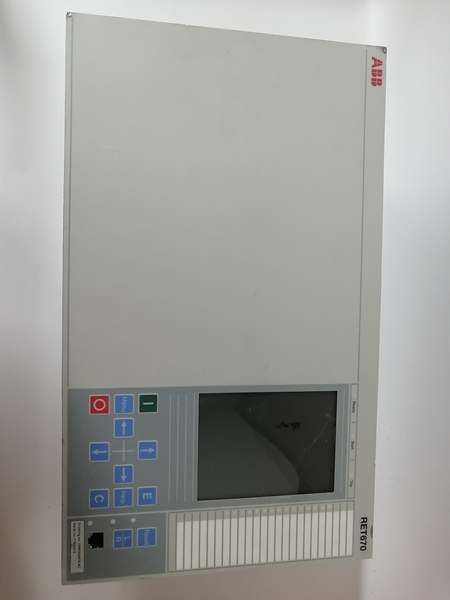
ABB 1MRK004816-AC
Technical Deep Dive & Overview
The 1MRK004816-AC is a RET670 functional variant built on the 615/670 common hardware: dual-core Blackfin DSP for protection math, separate ARM for comms & HMI. Transformer differential uses a harmonic-restraint algorithm (2nd & 5th) plus adaptive bias that auto-switches from 20 % to 50 % when CT saturation is detected. REF runs on a 50 Hz narrow-band filter to keep zero-sequence spill out of the measurement. All analog inputs hit 1 kHz sigma-delta ADCs; data is streamed over the internal 100 Mb backplane to the FPGA that time-stamps every sample to 1 µs via IEEE 1588. Output matrix is freely configurable—any protection stage can trip, pick-up, or block any binary output, so you can wire one contact to the high-side, one to the low-side, and still keep full redundancy. Firmware upgrades are drag-and-drop through the front USB; the relay keeps the old image in bank-B so you can roll back if the new rev mis-behaves.
The 1MRK004816-AC is a RET670 functional variant built on the 615/670 common hardware: dual-core Blackfin DSP for protection math, separate ARM for comms & HMI. Transformer differential uses a harmonic-restraint algorithm (2nd & 5th) plus adaptive bias that auto-switches from 20 % to 50 % when CT saturation is detected. REF runs on a 50 Hz narrow-band filter to keep zero-sequence spill out of the measurement. All analog inputs hit 1 kHz sigma-delta ADCs; data is streamed over the internal 100 Mb backplane to the FPGA that time-stamps every sample to 1 µs via IEEE 1588. Output matrix is freely configurable—any protection stage can trip, pick-up, or block any binary output, so you can wire one contact to the high-side, one to the low-side, and still keep full redundancy. Firmware upgrades are drag-and-drop through the front USB; the relay keeps the old image in bank-B so you can roll back if the new rev mis-behaves.