Product Core Brief
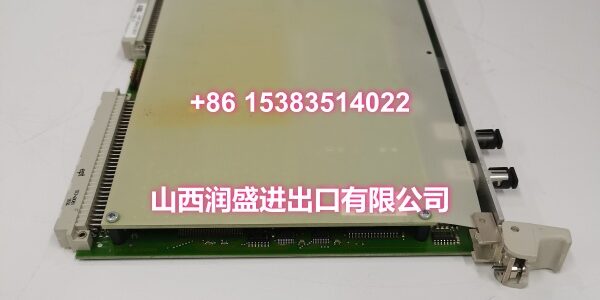
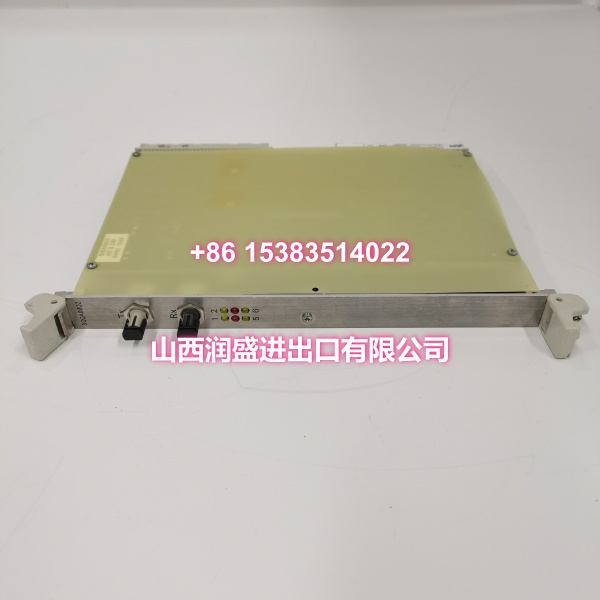
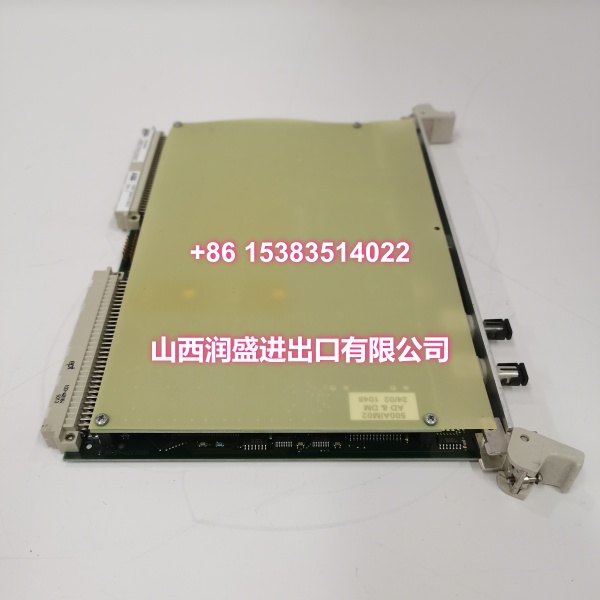
- Model: 500AIM02 (1MRB150022R001)
- Brand: ABB
- Series: ABB 500-Series Control System Platform
- Integration Role: Multi-channel analog input module for 500-series control racks, bringing plant analog signals (4-20mA, voltage ranges) safely into the controller with stable A/D conversion and robust galvanic isolation.
- Product Type: Analog Input Module / AI Card
- Key Specs: Multi-channel Acquisition | Galvanic Isolation | 12-16-bit A/D Conversion | Backplane Integration | Built-in Diagnostics
- Note: Condition: New Original (New Surplus).
Key Technical Specifications
| Parameter | Value |
|---|---|
| Manufacturer Part Number | 1MRB150022R001 |
| Device Model | 500AIM02 |
| Functional Type | Multi-channel Analog Input Module |
| Parent System | ABB 500-Series Control Rack |
| Signal Types | 4-20mA, 0-20mA, Voltage Ranges (e.g., 0-10V, ±10V) |
| A/D Resolution | 12-16-bit class |
| Isolation | Channel-to-backplane galvanic isolation |
| Mounting | Plug-in card for 500-series backplane |
| Diagnostics | Channel health & module status indicators |
| Condition | New Original (New Surplus) |
Product Introduction
The ABB 500AIM02 (order code 1MRB150022R001) is a multi-channel analog input module designed for ABB 500-series control system racks. It serves as the critical interface between field instrumentation and the controller, accepting common process signals—typically 4-20mA current loops and standard voltage ranges—and converting them into precise digital values for control and monitoring applications.
For maintenance engineers and system integrators managing legacy ABB drive cabinets or process control systems, the 500AIM02 is a sensible drop-in replacement when maintaining or extending installed I/O capacity without reworking the entire wiring scheme. The module slots directly into standard 500-series backplanes and follows ABB’s familiar wiring conventions, keeping commissioning time short and avoiding tricky field rewiring—especially valuable on brownfield upgrades where downtime must be minimized.
The module’s galvanic isolation between each channel and the backplane is a key feature for industrial environments, helping to eliminate ground loops and reduce noise pickup in electrified, high-EMI areas such as near large motor drives, rectifiers, and power conversion equipment. Its A/D conversion performance falls in the 12-16-bit class typical of ABB process I/O, delivering the accuracy needed for most control and monitoring loops in power generation, metallurgy, and chemical processing applications.
Built-in diagnostics—including per-channel health indicators and overall module status LEDs—enable quick fault finding during commissioning and routine maintenance. Technicians can rapidly identify open circuits, out-of-range signals, or module faults without specialized test equipment, reducing mean time to repair (MTTR) in critical production environments.
Integration & Application Notes
As a plug-in analog input module for 500-series racks, proper integration requires attention to signal wiring, isolation practices, and diagnostic configuration.
- Signal Type Configuration: Verify whether each channel is configured for current (4-20mA / 0-20mA) or voltage (0-10V, ±10V, etc.) input before connecting field devices. Mismatched configuration will produce incorrect readings. For current inputs, ensure the module’s internal or external shunt resistor is correctly sized.
- Galvanic Isolation Wiring: The channel-to-backplane galvanic isolation protects the controller from ground potential differences. Use isolated signal sources where possible, and avoid creating ground loops by connecting signal commons at multiple points. In high-noise environments, shielded cables with single-point grounding are recommended.
- Backplane Communication: The module communicates over the 500-series rack bus—no external communication dongles or adapters are required. Ensure the backplane bus is functioning correctly and that the host controller recognizes the module in the correct slot position during configuration.
- Diagnostic LED Interpretation: Familiarize yourself with the module’s status LED patterns before commissioning. Channel health indicators typically show normal operation, open circuit, overrange, or underrange conditions. Module-level status LEDs indicate power, communication, and fault states.
- Slot Assignment: When replacing a failed module, install the 500AIM02 in the same rack slot as the original to avoid reconfiguring the controller’s I/O map. Verify the slot assignment in the control software matches the physical installation.
- Signal Filtering: If experiencing noise or instability in analog readings, check whether software-adjustable filtering is available for the module. Setting an appropriate filter bandwidth (e.g., 0.1-100Hz) can suppress high-frequency interference from nearby drives and switching equipment.
Integrator’s FAQ
1. What systems is the 500AIM02 compatible with? The 500AIM02 is designed for ABB 500-series control system racks, commonly found in ABB DC drive systems, process control cabinets, and industrial automation platforms. It plugs directly into the standard 500-series backplane and communicates via the rack bus without requiring external adapters.
2. What signal types does this module accept? The module accepts common industrial analog signals including 4-20mA and 0-20mA current loops, as well as voltage ranges such as 0-10V and ±10V. Channel configuration determines the signal type—verify the setting matches your field device output before connecting.
3. How does galvanic isolation benefit my application? Galvanic isolation between each input channel and the backplane prevents ground loops, which are a common source of measurement errors and noise in industrial environments. This is particularly important when field instruments are located at different ground potentials or when operating near high-power drives and rectifiers that generate significant electromagnetic interference.
4. Can this module be used as a direct replacement for a failed AI card? Yes. The 500AIM02 is designed as a drop-in replacement for maintenance scenarios. Install it in the same rack slot as the original module to preserve the controller’s I/O mapping, and verify the channel configuration matches your existing setup. The plug-in form factor allows fast swap-out with minimal disturbance to cabinet wiring.
5. What diagnostic features are available? The module includes built-in diagnostics with per-channel health indicators and overall module status LEDs. These support rapid fault identification during commissioning and maintenance, showing conditions such as open circuit, overrange, underrange, and module fault. This reduces troubleshooting time compared to modules without visual diagnostics.
6. What is the A/D conversion accuracy? The module’s A/D conversion performance is in the 12-16-bit class, typical of ABB process I/O modules. This resolution is suitable for most control and monitoring loops in industrial applications, providing sufficient granularity for process variables such as temperature, pressure, flow, and level.
7. What is the warranty difference between New Surplus and Refurbished? We supply this unit as New Original (New Surplus), meaning it is unused, original factory stock, typically still in its anti-static packaging. This comes with a standard 12-month warranty. “Refurbished” analog input modules carry risks including degraded input circuitry, drifted calibration from previous thermal cycling, damaged isolation barriers, and undocumented operational history. Refurbished units often come with short, limited warranties (30-90 days) that do not cover latent defects.
8. Why is the pricing lower than direct OEM but higher than used parts? Our pricing reflects the value of guaranteed, unused condition. Unlike used parts from general marketplaces—which may have unknown operational hours, hidden damage from previous fault events, or drifted calibration—our New Surplus inventory is verified for authenticity and condition. You avoid the premium of custom OEM manufacturing for legacy parts while securing a component that performs like new, minimizing the risk of measurement errors and unplanned downtime in critical control applications.