Product Core Brief
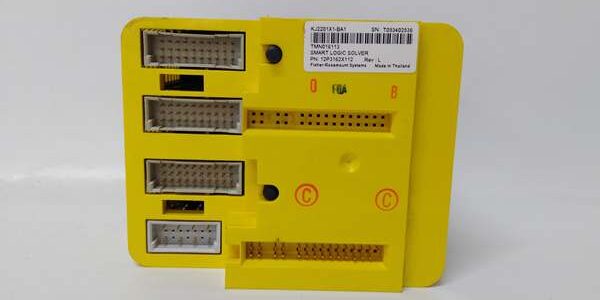
- Model: KJ2201X1-BA1
- Brand: Emerson (DeltaV / EPRO)
- Series: SLS1508 Safety Instrumented System (SIS)
- Core Function: Executes safety logic, interlocks, and voting algorithms to protect critical assets and personnel in hazardous environments.
- Product Type: SIS Logic Solver / Safety Controller
- Key Specs: SLS1508 System | VS3202 Compatible | SIL-Capable | 24VDC
- Condition: New Surplus / Original OEM
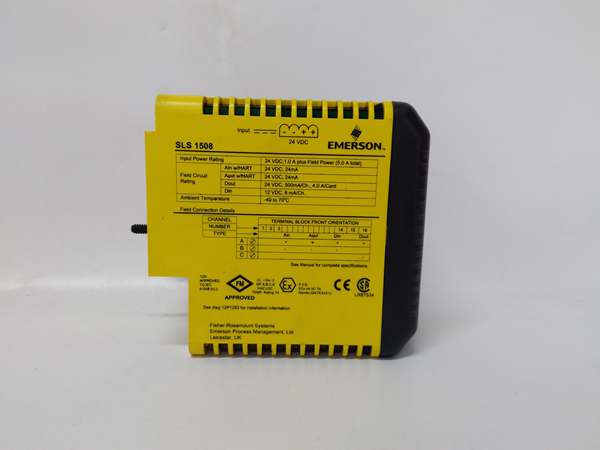
Emerson SLS1508
Key Technical Specifications
- Manufacturer: Emerson
- Part Number:
- Product Category: Safety Instrumented System (SIS) Logic Solver
- System Architecture: Emerson SLS1508 / DeltaV SIS
- Related Model: VS3202
- Input Power: 24 VDC, 1A
- Operating Temp Range: -40°C to +70°C
- Vibration Tolerance: 10G Sine, 5Hz-150Hz
- Environmental Compliance: ISA-S71.04 G3
- Humidity: 5% to 95% (Non-condensing)
- Compliance: API 670 / CE / CSA / IECEx
Product Introduction (No Fluff)
son is the core logic solver for the SLS1508 Safety Instrumented System, designed to execute critical safety functions, emergency shutdown (ESD) logic, and high-integrity voting schemes. It operates as a dedicated safety layer, independent of the basic process control system (BPCS), to ensure machinery and plant safety even during control system failures.
This module is engineered for harsh industrial environments, featuring wide temperature tolerance (-40°C to +70°C) and G3-level pollution resistance. Sourcing this exact OEM replacement prevents safety system bypasses and maintains SIL compliance during critical failures or system expansions.
QA & Testing SOP (Dynamic & Transparent)
Safety logic solvers demand zero-tolerance validaery undergoes a rigorous certification process:
- Anti-Counterfeit Inspection: Verify Emerson/DeltaV factory labels, PCB silkscreen, and component lot codes against OEM baselines.
- Backplane Communication Test: Mount on a dedicated test rack to validate handshake, I/O scanning, and network redundancy.
- Logic Execution Verification: Inject simulated safety inputs to verify correct voting logic (e.g., 2oo3), alarm generation, and trip relay actuation within specified response times.
- Power Stress Test: Apply 24VDC at nominal and ±10% limits to confirm stable operation and brownout recovery.
- Burn-In: 4-hour continuous operation under full load to identify marginal components.
- Packaging: Shipped in dual-layer ESD shielding with a printed QA test report.
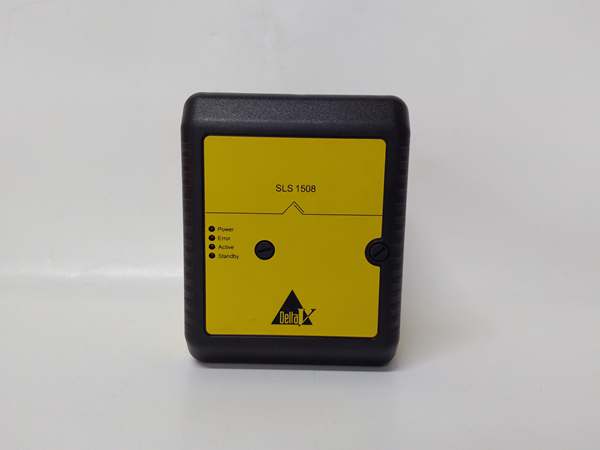
Emerson SLS1508
Installation Pitfalls & Guide (Engineer to Engineer)
❗ Safety Integrity Level (SIL) Compliance: This module is part of a certified safety system. Never substitute with a non-SIL-rated controller or modify firmware without Emerson approval. Doing so voids the SIL certification and exposes the plant to unquantified risk.
❗ Voting Logic Configuration:The supports complex voting (e.g., 1oo2, 2oo3). Misconfiguring the voting scheme in the safety logic solver can lead to spurious trips or, worse, failure to trip on demand. Always verify the logic against the Safety Requirements Specification (SRS) before commissioning.
❗ Power Supply Redundancy: SIS logic solvers typically require redundant 24VDC supplies. Ensure both power sources are active, properly fused, and monitored. A single power supply failure should not compromise the safety function.
❗ Grounding & Isolation: Safety systems are sensitive to ground loops. Ground the chassis to the safety ground bar using a short, wide strap. Do not rely on DIN rail grounding. Floating grounds can corrupt safety signals and cause nuisance trips.
Replacement Protocol:
- Pre-Install: Obtain a safe work permit. Verify the process is in a safe state or that bypasses are properly managed per MOC procedures. Lock out the SIS rack power. Verify 0 VDC at the backplane.
- Removal: Release the front panel retaining screws. Extractled straight out. Inspect the backplane connector for bent pins or corrosion.
- Install: Align the new module with the guides. Seat it firmly and secure the faceplate screws. Reconnect all safety-rated I/O and communication cables.
- Power-on Test: Restore rack power. Verify the “OK” and “Run” LEDs. Use the safety configuration software to verify module recognition, check for zero fault codes, and validate the last-known logic state. Perform a partial stroke test or functional test per the SRS before returning to service.
Technical FAQ
the maintains complete backward compatibility with existi508 racks and VS3202 systems. It offers the same safety logic execution and integrates seamlessly with DeltaV SIS configuration software. You can swap it directly without re-certifying the entire safety loop, provided the firmware version is compatible.
Why is this listed as “New Surplus” instead of factory-new?
This is genuine Emerson stock that was never deployed in a process plant. It has been stored in climate-controlled inventory rather than exposed to harsh industrial environments. You receive the exact same MTBF and SIL performance as a factory-fresh unit, typically at a significantly lower cost and without the 16-20 week OEM lead time.
Can I hot-swap this logic solver while the SIS rack is live?
No. Safety logic solvers are not hot-swappable. Removing this module under power will cause an immediate loss of safety protection for the associated process unit. Always schedule this replacement during a planned shutdown or with proper bypasses and risk mitigation in place.
What is the warranty coverage on this part?
We provide a standard 12-month functional warranty. If the module fails to execute safety logic, loses communication, or exhibits hardware defects under normal operating conditions within that window, we replace it. Our QA testing proves the module passed all safety logic and communication tests before it left our bench.
Not necessarily. Before rethe , check the backplane connectors for loose pins or corrosion. Verify the redundant power supplies are within spec. Communication faults can also be caused by a failing network switch, cabling issues, or a faulty I/O module on the same rack. Only replace the logic solver if diagnostic tools confirm an internal processor or backplane interface failure.