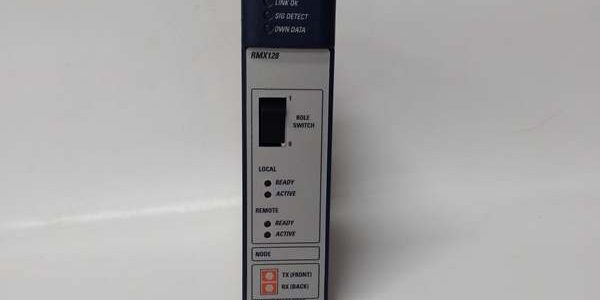
Product Core Brief
- Brand: GE Fanuc / Emerson Automation
- Model: IC695RMX128
- Series: PACSystems RX3i
- Core Function: Dual-purpose reflective memory module supporting two operating modes; dedicated high-speed fiber link for bumpless hot standby synchronization between primary/secondary IC695CRU320 redundant CPUs, or general-purpose node on multi-node reflective memory networks for inter-PLC deterministic data sharing
- Type: Single-slot RX3i universal backplane specialty communications module
- Condition: New Original (New Surplus)
- Status: ⚠️ Discontinued OEM active production; limited surplus inventory
- Key Spec Highlights: 128 MB shared reflective memory, single-mode LC fiber interface, 2.12 Gbaud transfer rate, hot-swap capable, supports up to 300m inter-rack fiber distance
Key Technical Specifications
- Onboard User Memory: 128 MB reflective SDRAM
- Fiber Interface: Single-mode LC duplex fiber connector
- Raw Data Rate: 2.12 Gbaud
- Maximum Fiber Span: 300 meters between redundant racks
- Backplane Power Draw: 580 mA @ 3.3 VDC; 220 mA @ 5 VDC
- Supported Operating Modes
- Redundancy Sync Mode: Two-node dedicated ring for RX3i hot standby CPU pairs; no extra network nodes permitted
- General Reflective Memory Mode: Multi-node daisy-chain ring network, maximum 256 compatible nodes
- Compatible CPU: IC695CRU320 / IC695CRU320QP redundant high availability CPUs
- Feature Support: Hot-swap replacement, built-in link error diagnostics
- Operating Temperature: 0 °C to +60 °C
- Ambient Humidity: 5%–95% non‑condensing
- Form Factor: Standard single-slot RX3i module
- Certifications: UL, CE
- Programming Environment: Proficy Machine Edition
Product Introduction
Mission-critical power, chemical and water treatment control systems require bumpless controller switchover without process disruption. GE delivers high-speed reflective memory synchronization for RX3i redundant CPU architectures, continuously mirroring register, tag and state data between active and standby controllers.
This unit can alternatively be deployed as a general reflective memory node for deterministic peer data exchange across multiple distributed RX3i racks. Duplex single-mode fiber eliminates electrical noise common with copper cabling, and hot-swap capability allows planned module replacement without full rack shutdown. The standardized RX3i single-slot footprint enables direct drop-in spare exchange during maintenance windows.
Key Selling Points & Differentiators
- GE enables low-latency state synchronization required for bumpless hot standby failover on RX3i CRU320 redundant CPU systems.
- Dual-mode functionality allows deployment either for dedicated CPU redundancy links or multi-node shared reflective memory networks, simplifying site spare standardization.
- Every unit completes full bench validation on an RX3i test chassis; fiber link initialization, redundancy synchronization and diagnostic functions verified prior to shipment. Signed test documentation available on formal request. Warranty runs 12 months post delivery.
- Hot-swap supported, reducing system downtime during planned spare module replacement.
- Not recommended for RX7i, Series 90‑70 or Series 90‑30 racks. Designed exclusively for RX3i universal backplane architecture.
- Single-mode LC fiber provides superior EMI immunity and up to 300-meter inter-rack reach compared to short-distance copper synchronization links.
Quality Transparency SOP
- Incoming Verification: Serial traceability validation, anti-counterfeit visual inspection, LC fiber port integrity and latch hardware cross-check.
- Live Bench Test: Dedicated RX3i test rack, power-on self-test, fiber link handshake validation, redundancy synchronization simulation, continuous 24-hour thermal soak cycling.
- Electrical Tests: Backplane power rail tolerance testing, chassis ground continuity verification.
- Hardware Verification: Confirm link diagnostic indicators operate per datasheet; no unauthorized component rework performed.
- Final QC & Packaging: Anti-static shielding, shock-dampened transit carton, signed QC Pass label. Test images and logs available on request. No zero-failure performance guarantee.
Technical Risk Avoidance Section
Mode Topology Violation Risk Risk: Adding extra reflective memory nodes into a two-node redundancy fiber ring breaks CPU synchronization and disables automatic failover. Prevention: Redundancy mode must use an isolated two-node fiber ring; separate physical fiber networks for general reflective memory applications. Field note: Multiple power plant auxiliary control systems experienced failed CPU switchover after technicians merged redundancy links with other reflective memory nodes.
Fiber Polarity Risk Risk: Transmit/receive fiber crossover miswiring results in permanent link-down status. Prevention: Verify Tx/Rx pairing between paired modules before powering up redundant CPUs.
ESD Damage Risk Risk: Unprotected handling damages fiber transceiver circuits without immediate visible fault indicators. Prevention: Use grounded wrist straps; keep the module sealed inside anti-static packaging until rack insertion.
CPU Firmware Compatibility Risk Risk: Mismatched CRU320 CPU firmware revisions create synchronization drift or link establishment failures. Prevention: Standardize firmware revisions on primary and standby CPUs prior to installing replacement RMX hardware.
Critical Summary: Confirm intended operating topology before procurement. cannot operate within RX7i or legacy Series 90‑70 racks, and it cannot be directly substituted with IC695CMX128 without network configuration review.