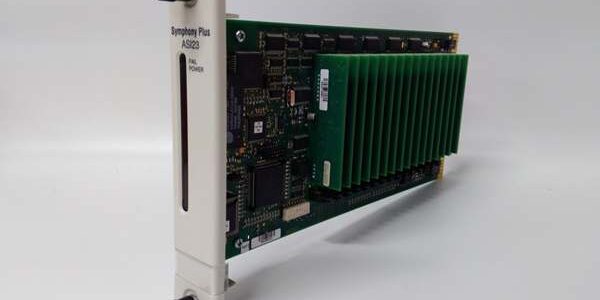
Product Core Brief
- Model: SPASI23
- Full OEM Part Number: 3BSE013232R1
- Brand: ABB Bailey (ABB Hitachi Energy)
- Series: Symphony Plus / Bailey Harmony legacy distributed control system high-density analog input slave module
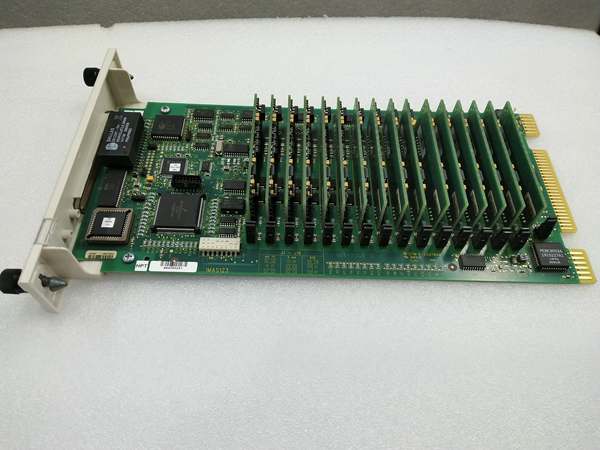
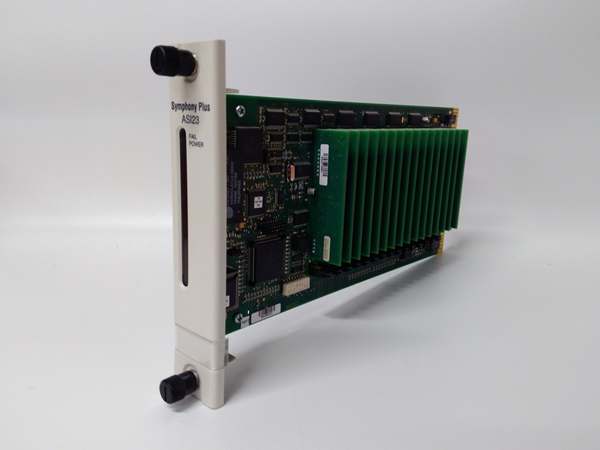
- Core Function: High-density rack-slotted analog input slave board designed to collect multi-channel continuous analog process signals from field transmitters, pressure/flow/temperature sensors and valve positioners. It converts raw 4–20mA current or bipolar/unipolar voltage signals into standardized digital data and transmits measured values to the Symphony Plus master controller via the proprietary Symphony fieldbus. Each channel carries independent galvanic isolation to eliminate ground loop interference and suppress industrial EMI noise from MCC, drives and breakers. Built-in channel-by-channel hardware protection prevents module burnout from field short-circuit, reverse polarity and overvoltage faults. The front panel integrates dedicated FAIL and POWER LED indicators for rapid on-site fault diagnosis without software tools.
- Product Type: Symphony Plus rack-mounted 16-channel isolated analog input slave PCB
- Key Specs: 16 fully independent differential analog input channels; universal signal compatibility: 4–20mA, 0–5V, 0–10V, -10V~+10V; 16-bit high-precision ADC sampling; channel-wise 1500VAC galvanic isolation; built-in overcurrent, reverse polarity, short-circuit auto-lockout protection; Symphony proprietary backplane bus communication; powered via rack backplane 24VDC logic supply; ISA G3 anti-corrosion conformal coating; standard Symphony Plus rack slot installation; front FAIL / POWER diagnostic LEDs
- Note: The Symphony Plus Bailey DCS platform is fully end-of-life. Only remaining factory-sealed original assemblies and fully cyclic load-tested surplus boards are supplied as maintenance spares for thermal power plants, chemical processing facilities, pulp & paper mills and municipal distribution substations. One replaces multiple low-channel I/O modules to reduce cabinet space and spare parts inventory quantity. Cannot operate standalone; must be installed on a Symphony Plus rack backplane paired with master controller hardware.
smart
Key Technical Specifications
| Parameter | Value |
|---|---|
| Full OEM Article Code | 3BSE013232R1 |
| Number of Analog Input Channels | 16 differential isolated channels |
| Supported Field Signal Types | 4–20mA current, 0–5V, 0–10V, ±10V bipolar voltage |
| Analog-to-Digital Resolution | 16-bit precision ADC conversion |
| Channel Isolation Rating | 1500 VAC functional isolation per channel between field and backplane logic |
| Input Impedance | Current input ~250Ω; voltage input >1MΩ high impedance |
| Accuracy | ±0.1% of full scale at 25°C nominal operating temperature |
| Built-in Channel Protection | Reverse polarity blocking, constant current limiting, auto-recovery short-circuit shutdown |
| Backplane Communication | Symphony proprietary parallel fieldbus to master controller |
| Logic Power Supply | 24 VDC ±10% fed directly from rack backplane, no external wiring required |
| Front Panel Indicators | Green POWER LED (normal supply); Red FAIL LED (channel fault / communication loss) |
| PCB Surface Protection | ISA 71.04 G3 conformal coating for high-humidity, mild salt fog industrial environments |
| Mechanical Installation | Standard dedicated slot insertion inside Symphony Plus control rack |
| Continuous Operating Ambient Temp | -10 °C ~ +60 °C sealed cabinet; storage: -40 °C ~ +85 °C |
| Humidity Tolerance | ≤75% RH non-condensing indoor control room rated |
| Overall Module Dimensions | 272 mm D × 130 mm W × 25 mm H |
| Net Weight | Approx. 0.77 kg |
| Compliance Standards | IEC 60255 process control equipment standard, IEC 61010 safety, CE certified |
Product Introduction
The (3BSE013232R1) is the standard high-density analog input slave module for all ABB Symphony Plus DCS control rooms, solving two major limitations of older low-channel I/O layouts: insufficient signal collection capacity and poor noise immunity from multi-field ground loops.
Three Core Functional Advantages
- 16 High-Density Isolated Analog Input ChannelsEach board collects 16 separate process analog signals simultaneously, cutting cabinet I/O rack quantity by half compared to 8-channel modules. All channels support both industry-standard 4–20mA transmitters and bipolar voltage feedback signals without jumper modification at the factory, simplifying spare part inventory for multi-section process plants.
- Independent Per-Channel Galvanic IsolationMost generic multi-channel I/O boards share a single isolation barrier for all channels, causing cross-channel signal interference when field grounds mismatch. equips every individual channel with its own 1500VAC isolation transformer to fully block ground loop surge voltage, eliminating measurement drift and random DCS data flickering in multi-drive industrial environments.
- Continuous On-Board Self-DiagnosisThe front FAIL LED independently monitors each of the 16 input loops. If a field transmitter wire breaks, short-circuits or suffers polarity reversal, the fault indicator illuminates and records the exact faulty channel number in the controller event log, allowing maintenance engineers to locate defective field wiring without scanning all 16 channels one by one.
The full conformal coating treatment extends service life in coastal distribution substations and chemical workshops with corrosive vapor. Typical application scenarios include boiler steam temperature/pressure sampling, chemical reactor flow monitoring, paper machine tension feedback and generator auxiliary cooling water process signal collection. Without a functional , all 16 connected field analog sensors lose data visibility and plant closed-loop control logic cannot execute automatic regulation.
QA & Testing SOP (Transparency Building)
- Incoming Visual Inspection: Cross-check full part number 3BSE013232R1 and serial number against ABB Symphony Plus spare parts database to reject mismatched low-channel I/O modules; inspect front POWER/FAIL LED indicators, rear backplane gold-plated connector pins, field terminal block and conformal PCB coating for oxidation, discoloration or pin bending damage; record serial numbers and production batches for full maintenance traceability.
- Full Multi-Channel Linkage Bench Test: Mount into standard Symphony Plus rack test backplane, connect 16-channel analog signal generator load banks; supply stabilized 24VDC rack logic power, run 24-hour cyclic testing including full-range 4–20mA / ±10V signal sampling accuracy, individual channel short-circuit fault trigger, isolation crosstalk simulation, verify stable digital data transmission to Symphony master controller without measurement offset.
- Electrical Insulation Test: Use insulation resistance tester to confirm ≥ 10 MΩ isolation between each field signal channel and rack backplane logic circuits; test chassis protective earth continuity resistance below 0.5 Ω.
- Hardware Record Backup: Photograph front LED fault status definitions and rear backplane slot mounting rules for field cabinet wiring reference.
- Final QC Packaging: Wipe module housing with anti-static microfiber cloth, cover all field terminal blocks and rear backplane connector with insulating dust caps, place the board into independent ESD shielding bag, attach unified printed QC test tag with full 24-hour multi-channel cyclic test runtime timestamp, then pack into foam shockproof carton for long-distance power plant transportation.
Installation Pitfalls & 4-Step Replacement Guide
Common Installation Hazards
❗ Residual DC Surge Risk: Before extracting the module, fully lock out the cabinet 24VDC auxiliary power supply feeding the DCS rack, wait for internal backplane capacitor complete discharge to avoid signal surge damaging controller CPU.❗ Channel Polarity Reversal Damage Risk: Every analog input terminal must follow positive/negative field transmitter wiring sequence; reversed polarity will activate channel protection lockout and cut off signal collection for that loop.❗ ESD PCB Damage Prevention: Mandatory anti-static wrist strap for all disassembly and installation work; bare finger contact with internal ADC sampling chips permanently impairs analog measurement accuracy and isolation circuit performance.❗ Slot Alignment Installation Rule: Insert the module straight into the dedicated analog input rack slot; forced skewed insertion will scratch gold-plated backplane pins and create permanent intermittent channel contact loss.❗ Over-Load Channel Prohibition: Do not connect more than 16 field transmitters to one unit; exceeding designed channel quantity will break backplane signal bus balance and trigger rack communication failure.
4-Step Rack I/O Module Replacement Guide
- Pre-install Preparation: Lock out and tag out the 24VDC cabinet auxiliary power supply for the Symphony Plus DCS rack, wait for capacitor full discharge, wear ESD wrist strap, photograph rear backplane slot position and front field analog terminal wiring connected to 16-channel transmitters.
- Removal Operation: Unplug all field analog signal wires from front terminal blocks one by one following photographed records, release front module latch, slide the old board fully out of the rack backplane slot.
- Installation & Wiring: Align new module with the analog input rack slot rail, slide fully inward until front latch clicks locked; re-terminate all 4–20mA / voltage field wires strictly matching photographed polarity sequence, tighten terminal screws to ABB standard torque values.
- Power-on Commissioning Test: Restore cabinet 24VDC auxiliary control power, observe front green POWER LED steady on with red FAIL LED off; inject nominal analog signals to all 16 channels, verify accurate continuous process data upload to plant SCADA system without measurement drift, simulate single-channel wire breakage to confirm red FAIL LED triggers and fault channel number logs correctly.
FAQ
Q: What is the difference between and 8-channel analog input modules?Standard 8-channel analog input boards only support half the signal quantity of , requiring twice as many rack slots for identical field sensor layouts. features exclusive per-channel independent galvanic isolation while most low-density modules share a single isolation barrier across all channels, leading to higher interference susceptibility in industrial environments. The two cannot be cross-replaced without recalculating total cabinet I/O channel capacity.
Q: Can operate without connecting to a Symphony Plus master controller?No. is a passive slave I/O board without independent data processing logic. It relies entirely on the rack backplane Symphony bus to exchange sampled analog data with the master CPU; without a matched master controller, all 16 channels cannot convert or transmit field signals.
Q: Can be hot-swapped with rack 24VDC auxiliary power energized?Strictly prohibited. The module mates directly with the live Symphony rack backplane logic bus; live extraction will generate signal surge voltage and permanently damage CPU backplane communication circuits. Full auxiliary DC power lockout is mandatory before replacement.
Q: What warranty applies to stocked 3BSE013232R1 boards?Factory-new original legacy DCS analog input modules carry a 12-month official ABB manufacturer warranty covering all 16-channel signal acquisition circuits, per-channel isolation transformers, ADC sampling chips and front diagnostic indicators. Bench-tested surplus units provide a 6-month functional warranty; damage caused by field polarity reversal, live hot-swap disassembly or ungrounded ESD handling voids all warranty terms.
Q: Has ABB discontinued production?Yes, the entire ABB Symphony Plus Bailey DCS platform including I/O modules is fully end-of-life. New industrial and power plant process control DCS projects adopt ABB Ability 800xA systems with S800 remote I/O modules without separate SPASI series rack-slotted analog input boards. is only available as limited stock maintenance spare parts for legacy Symphony control room renovation.
Q: What typical faults indicate a defective module?Common failure symptoms: Permanent red FAIL LED alarm with intact field transmitter wiring, random single-channel analog data loss without field cable damage, severe analog measurement drift across multiple channels, loss of galvanic isolation leading to cross-channel signal crosstalk, failure to record channel fault numbers in DCS event logs, front POWER LED fails to illuminate after rack auxiliary power restoration.