Product Core Brief
- Model: REF615A_E HAFAABAAABE1BCA1XE (complete withdrawable assembly including matching dedicated draw-out baseplate)
- Brand: ABB
- Series: Relion® 615 REF615 Feeder Protection & Control IED (A_E hardware platform generation)
- Core Function: Mid-range draw-out intelligent feeder protection device for radial/loop/meshed 3–36kV distribution networks, delivering directional overcurrent, sensitive earth fault, breaker bay control, power metering, disturbance recording and IEC 61850 substation automation without redundant PRP Ethernet architecture.
- Product Type: Standard Draw-out Feeder Protection IED (Plug-in Unit + Hardwired Draw-out Baseplate)
- Key Specs: H-type 100–240V AC/DC universal auxiliary supply | 17 Digital Inputs /13 Configurable Output Relays | Single 10/100Mbps Ethernet IEC 61850 GOOSE | Dual 1A/5A software-selectable CT inputs
- Note: Active OEM production; factory sealed new full assemblies and fully bench load-tested surplus stocked for utility distribution substation new build and emergency maintenance retrofits.
Key Technical Specifications
| Parameter | Value |
|---|---|
| Full Order Code | REF615A_E |
| Auxiliary Power Variant (H) | 100–240 VAC / 48–250 VDC wide-range universal supply; peak 21W power draw |
| CT Input Hardware (F) | Phase & neutral CT software selectable 1A / 5A secondary current rating |
| Analog Measurement Channels | 9 galvanically isolated CT/VT inputs for three-phase current, neutral current, three-phase voltage |
| Binary I/O Layout (AAB full expansion) | 17 galvanically isolated digital status inputs; 13 programmable power relay outputs (fast trip, breaker control, alarm, trip circuit supervision) |
| Core ANSI Protection Function Suite | 50/51 multi-stage phase overcurrent, 67 directional phase OC, 51N/67N sensitive directional earth fault, 46 negative sequence unbalance, 49 cable thermal overload, 50BF breaker failure, 79 multi-shot auto-reclose, 27/59 under/overvoltage, HIZ high impedance ground fault |
| Onboard Communication Interfaces | Single 10/100M RJ45 Ethernet (IEC 61850 Ed2.0, GOOSE, MMS, SNTP time sync); rear RS485 serial port (Modbus RTU / DNP3.0); front optical SPA service port; IRIG-B time sync input |
| Data Recording Capacity | 450 SOE timestamped event logs; 8 full-cycle fault disturbance waveform records; continuous load profile trending non-volatile storage |
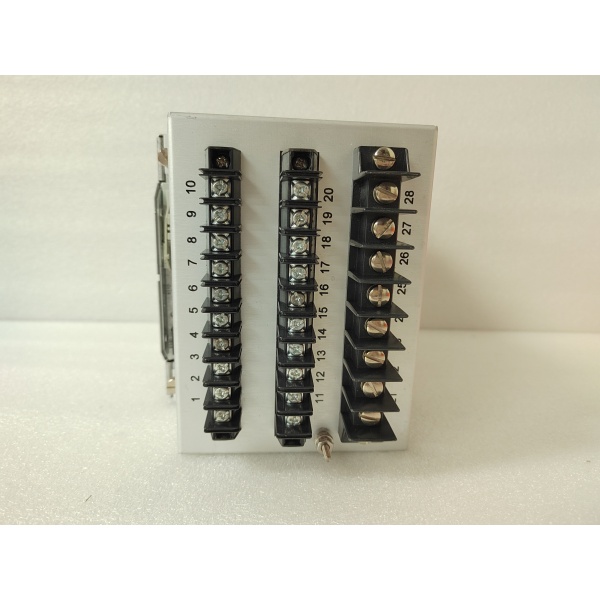
| Draw-out Mechanical Design | Hot-pluggable plug-in unit; baseplate integrated built-in CT shorting links to eliminate lethal CT open-circuit hazards during unit swap |
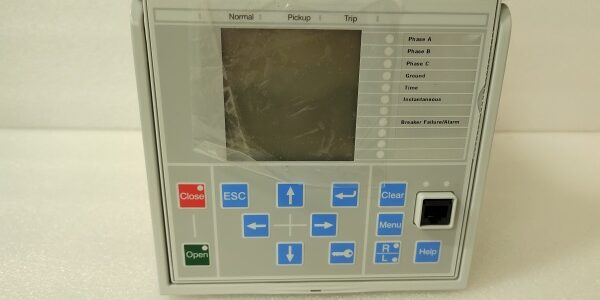
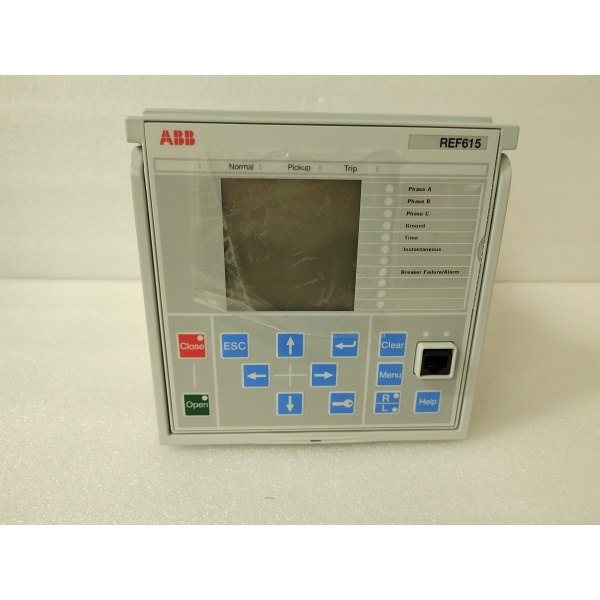
| HMI Interface | Full graphical multi-language LCD, 11 configurable LED status indicators, local breaker open/close pushbuttons |
| Front Panel Enclosure Rating | IP54 flush cabinet mount; rear baseplate terminal compartment IP20 |
| Operating Ambient Temp | -10 °C to +55 °C continuous rack operation; short-term storage -40 °C ~ +70 °C |
| Humidity Resistance | <95% RH non-condensing, ISA 71.04 G3 corrosion resistant conformal PCB coating |
| Mechanical Form Factor | 4U half-width 19-inch draw-out assembly |
| Full Assembly Dimensions | 177 mm W × 177 mm H × 155 mm D |
| Net Assembly Weight (IED + Baseplate) | 3.4 kg |
| Compliance Standards | IEC 60255, IEC 61850, UL508, KEMA type-tested, RoHS, SIL2 capable with certified protection logic |
Product Introduction
This standard single-Ethernet REF615A_E variant is configured for conventional single-bus distribution substations that do not require PRP redundant network architecture, balancing full directional feeder protection functionality and cost efficiency compared to dual-Ethernet premium REF615 models. The ordering string unlocks full directional earth fault, high-impedance ground fault and multi-shot auto-reclose factory licenses without extra option modules.
The withdrawable baseplate integrates dedicated CT shorting links, removing dangerous CT open-circuit risks during unit replacement—only the plug-in IED is extracted while cabinet CT/VT and control wiring remain permanently terminated on the fixed baseplate. Single Ethernet port supports high-speed GOOSE interlocking between bay IEDs and central SCADA without redundant switch infrastructure.
Embedded programmable signal matrix logic replaces external auxiliary relay racks for custom bay interlocks, overhead line auto-reclosing and load shedding schemes. Disturbance recorders capture pre-fault and post-fault analog waveforms to accelerate post-outage root-cause analysis for overhead and underground distribution feeders. The front SPA optical port enables laptop parameterization without opening live cabinet low-voltage wiring terminals.
QA & Testing SOP (Transparency Building)
- Incoming Inspection: Cross-reference full long order code and matching IED/baseplate serial numbers against OEM spare registry to reject mismatched assemblies; inspect graphical LCD, Ethernet RJ45 port, baseplate CT shorting links and conformal PCB coating for scratches, salt corrosion or moisture residue; log serial batches for full traceability records.
- Live Full Assembly Testing: Mount IED + baseplate to standard 4U test rack, supply stabilized 220V AC/DC auxiliary power, inject 1A/5A switchable CT simulated fault signals, run continuous 24-hour protection element cycling, Ethernet communication stress testing and full event/disturbance log recording validation.
- Electrical Testing: Use Fluke 115 multimeter and insulation resistance tester to verify chassis ground resistance below 0.5Ω and isolation resistance above 10MΩ separating auxiliary power, analog CT/VT and binary control circuit groups; validate mechanical CT shorting link continuity.
- Firmware/Config Backup: Record exact embedded firmware revision via PCM600 configuration tool, photograph baseplate Ethernet DIP address jumpers and RS485 bus switches, export complete protection setting groups, auto-reclose sequences and custom logic to encrypted offline storage.
- Final QC & Packaging: Clean front LCD surface with anti-static microfiber cloth, cap SPA optical port and Ethernet RJ45 port with dust protective plugs, separate plug-in IED and baseplate into individual ESD shielding bags, attach unified printed QC test tag with technician ID and full 24-hour runtime timestamp before foam-lined shock-resistant transit carton packaging.
Installation Pitfalls & Guide (Engineer to Engineer)
❗ Firmware Version Mismatch: Firmware builds newer than site PCM600 software block full directional fault protection upload and disable Ethernet GOOSE communication; cross-check OEM software compatibility matrix before downloading parameter sets.❗ CT Open-Circuit Safety Hazard: Always engage baseplate built-in CT shorting links before pulling the plug-in IED out; unshorted CT terminals generate lethal high secondary voltage and arc flash hazards during disassembly.❗ Single Ethernet Port Miswiring: Only one RJ45 port is functional on this variant; unused secondary port shell has no internal transceiver, cabling it creates phantom network fault alarms.❗ RS485 Bus Address Conflicts: Duplicate bay node addressing floods substation Modbus/DNP3 serial bus with broadcast traffic; capture high-resolution photos of baseplate communication DIP jumpers prior to unit removal.❗ Auxiliary Supply Underrating: The full assembly draws peak 21W during simultaneous trip output actuation; shared cabinet DC power supplies with multiple IEDs trigger voltage sag and incomplete relay boot sequences.❗ ESD Dangers: Unwristed technician contact with rear exposed PCB traces corrupts flash-based protection settings and real-time clock backup circuits; field service logs show ungrounded handling destroyed this assembly with over $3,600 in hardware and substation outage labor costs.
4-step draw-out assembly replacement guide
- Pre-install: Lock out and tag out substation auxiliary supply, engage baseplate CT shorting links, fit certified anti-static wrist strap, photograph CT/VT wiring, binary DI/DO terminals, single Ethernet cabling and RS485 communication jumper positions.
- Removal: Unlatch draw-out unit locking handle, pull the plug-in IED fully out of the fixed wired baseplate (baseplate remains permanently terminated to cabinet wiring). Retain baseplate if undamaged; replace full assembly only if baseplate terminals show corrosion or burn damage.
- Install: If reusing original baseplate: slide new plug-in IED fully into baseplate rail and lock mechanical handle, replicate original Ethernet/RS485 DIP bus address jumpers. If replacing full kit: mount new baseplate to cabinet panel frame, reterminate all CT/VT, control and communication wiring, replicate bus address jumpers, then insert and lock the new IED unit.
- Power-on Test: Restore auxiliary supply power, disengage CT shorting links, upload matching firmware and full protection setting groups, inject simulated phase/earth fault signals to validate trip output operation, verify event logging and stable SCADA GOOSE data exchange over single Ethernet channel.
FAQ (Frequently Asked Questions)
Q: What core difference separates REF615A_E from dual PRP Ethernet REF615 HBFEAEAGNDA1ABA1XG?A: This variant uses a single Ethernet port without PRP redundant network hardware, lower I/O count (17DI/13DO vs 18DI/13DO) and excludes factory arc flash detection license. It targets single-bus substation layouts without redundant communication requirements, with lower hardware cost.Q: Can the plug-in IED be hot-swapped while baseplate auxiliary power remains energized?A: Mechanical draw-out design permits unit extraction with auxiliary power live only after fully engaging CT shorting links. Never pull the IED without shorting CT circuits—this creates lethal arc flash hazards and permanent CT winding damage. Full cabinet lockout/tagout is recommended for complete baseplate replacement.Q: What warranty coverage applies to stocked full draw-out assemblies with baseplate?A: Factory-new OEM IED kits carry a 12-month manufacturer warranty covering plug-in processing unit, baseplate terminal assembly, Ethernet transceivers and all protection logic functions. Bench-tested surplus full assemblies ship with a 6-month functional warranty; physical damage from CT open-circuit transients, miswiring, arc flash or ungrounded ESD handling voids all coverage terms.Q: Has ABB issued formal EOL documentation for the REF615A_E platform?A: No formal end-of-production notice exists; OEM maintains active mass production for cost-sensitive single-bus substation projects and legacy plant retrofit spare demand. Older REF610 series is fully EOL and commonly replaced with REF615A_E variants.Q: Will protection setting groups, auto-reclose logic and custom bay interlock code persist after swapping the plug-in IED onto the existing baseplate?A: All trip curves, fault thresholds and programmable logic reside in the plug-in IED’s internal flash memory. Back up the full project database from the old unit before removal and re-download to the new IED post-install; firmware mismatches corrupt parameter upload sequences and disable directional fault protection algorithms.Q: What communication accessories are compatible with the rear RS485 and single Ethernet ports?A: Ethernet supports IEC 61850, Modbus TCP, DNP3 TCP/IP without PRP redundancy; terminal supports Modbus RTU and DNP3.0 serial protocols. Optional media converters support fiber optic Ethernet for long-distance substation bus runs; cross-reference the REF615 hardware manual for maximum cable distance and baud rate limits.Q: Can this IED be deployed for transformer differential or high-voltage transmission line primary protection?A: Native protection suite is optimized for medium voltage distribution feeder applications only. Transformer differential and high-resolution distance line protection require ABB REF630 series IEDs; this REF615A_E model is suitable for feeder primary protection and backup protection for distribution transformers.