Component Snapshot At-a-Glance
- Model: DSRF197, full factory part number 3BSE019297R1
- Alt. P/N: DSRF190 (6-slot compact half-size S100 subrack, smaller backplane bus capacity)
- Product Series: ABB S100 I/O, Advant OCS, Advant MasterPiece 200, AC450 legacy DCS platform
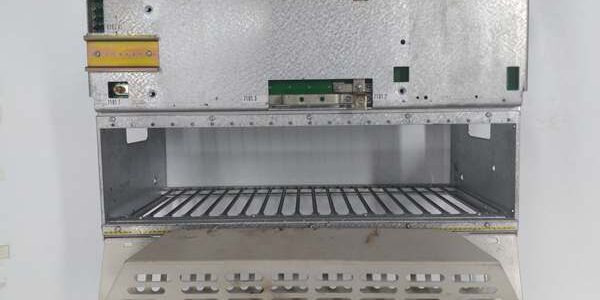
- Hardware Type: Full-size metal 12-slot passive I/O subrack chassis, integrated parallel backplane bus, internal 24VDC power distribution busbars
- Key Feature: 12 universal card slots with factory-terminated bus traces, built-in bus impedance termination and distributed rack power rails
- Primary Field Use: House full banks of analog, digital, bus extender and pulse counter I/O modules for remote distributed subracks separated from main controller chassis
Hard-Numbers: Technical Specifications
- Protocol Support: Proprietary parallel system backplane bus, compatible with all series plug-in I/O boards
- Port Count: 12 standard single-width card slots, rear bus extension header for DSBC176 bus extender connection
- Baud/Data Rate: Matches native bus 1 Mbit/s synchronous scan timing synchronized to Advant Master controller
- Operating Temperature: -25°C to +60°C cabinet operational; -40°C to +85°C storage, non-condensing 5–95% RH
- Isolation Rating: Backplane power and signal traces separated by grounded shielding to block cross-slot crosstalk
- Power Draw Capacity: Supports combined module load up to 120W, fed external 24VDC rack power supply via terminal busbar
- Slot Compatibility: All single-width I/O modules (DSAI, DSDI, DSDO, DSDP, DSBC series) fit every slot with no position restrictions
- Bus Termination: Fixed factory bus termination resistors pre-installed on far end backplane to eliminate signal reflection
- Physical Weight: 8.1 kg fully assembled empty chassis, dimensions 283.5 × 418.5 × 238.5 mm
- Certifications: CE, UL/cUL, IEC 61010-1 industrial cabinet safety standard, IP20 cabinet-only rating
The Real-World Problem It Solves
Compact 6-slot DSRF190 half-size racks limit total I/O point density for large MCC and boiler subracks; stacking multiple small racks creates extra bus extension cables and additional cabinet mounting hardware that crowds limited panel space.Custom unpopulated metal frames lack factory-calibrated bus termination. Missing termination resistors create signal reflection noise, triggering intermittent I/O register timeouts and random module fault logs during high-load production shifts.Separate external power distribution terminal blocks add extra wiring junctions prone to loosening from cabinet vibration, introducing voltage drop across dense I/O layouts.Where you’ll typically find it:
- Fossil power plant Advant OCS boiler remote MCC subracks housing temperature RTD, valve AO and breaker DI modules
- Refinery legacy DCS cabinet layouts for reactor and tank farm distributed analog/digital I/O banks
- Pulp mill process line remote I/O cabinets for encoder pulse counters, hydraulic valve solenoid outputs and machine safety contactsThis 12-slot full-size passive subrack consolidates maximum I/O hardware into a single chassis, integrates factory bus termination and built-in power busbars, and eliminates extra cable and terminal hardware for large distributed control layouts.
Hardware Architecture & Under-the-Hood Logic
This is a fully passive backplane chassis with no onboard processing chips; it only distributes 24VDC power and parallel bus signal traces between all installed plug-in I/O modules.
- External 24VDC power supply connects to dedicated chassis busbar terminals, distributing regulated power evenly to every slot’s backplane power pins.
- Continuous copper bus signal traces run the full length of the backplane, linking all 12 card slots in parallel synchronous bus topology.
- Pre-soldered termination resistor network at the far right end of the backplane absorbs bus signal reflections to stabilize waveform integrity on long DSBC176 extended bus runs.
- Integrated metal shielding partitions between adjacent slots reduce cross-talk interference between high-speed pulse counter boards and low-level analog RTD input modules.
- Rear edge bus header provides a dedicated tap point for DSBC176 bus extender cables, linking the entire 12-slot subrack back to the main controller master rack.
Field Service Pitfalls: What Rookies Get Wrong
Installing DSRF190 6-Slot Compact Racks To Replace Full-Size Chassis
Junior techs swap half-size subracks without counting total I/O card slots required. Half the planned I/O modules cannot fit, forcing last-minute cabinet rework and incomplete control point commissioning.
- Field Rule: Deploy for layouts requiring 7+ I/O cards; reserve DSRF190 6-slot racks for small auxiliary local I/O groups only.
Removing Factory Pre-Installed Bus Termination Resistors From Backplane
Maintenance staff strip internal termination resistors to test spare boards on bench. Unterminated bus signals develop severe reflection noise, creating constant sporadic I/O dropout faults that do not appear during offline bench testing.
- Quick Fix: Never modify backplane internal resistor networks; use factory DSBC176 bus extender cards for all remote subrack cable runs.
Mixing High-Current DO Solenoid Cards Beside Low-Level RTD Analog Input Cards Without Slot Spacing
Techs pack relay/solid-state DO modules directly adjacent to sensitive DSAI RTD temperature boards without blank filler slots. Inductive switching noise bleeds across backplane traces, generating steady temperature measurement offset drift.
- Field Rule: Separate analog temperature/RTD cards from digital output boards with at least one empty filler slot to reduce backplane cross-talk interference.
Commercial Availability & Pricing Note
Please note: The listed price is for reference only and is not binding. Final pricing and terms are subject to negotiation based on current market conditions and availability.