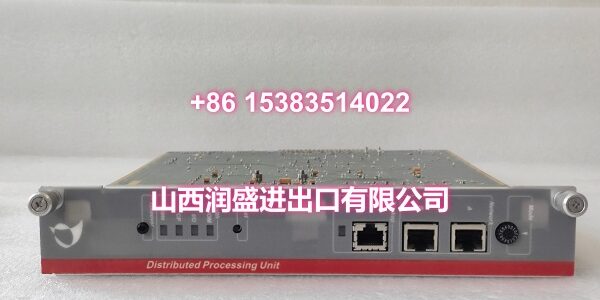
Product Core Brief
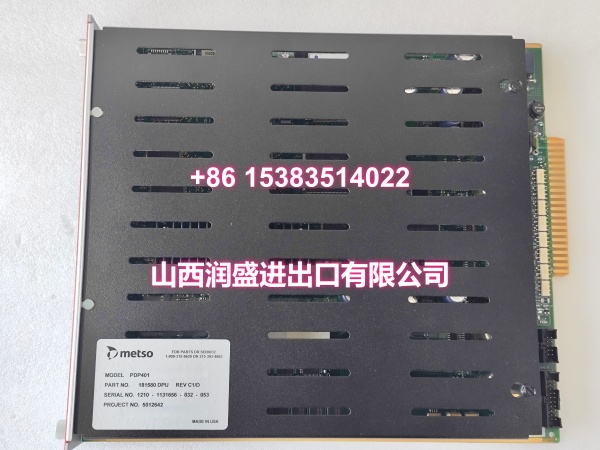
- Model: PDP401
- Brand: Metso
- Series: DL401 Series DPU Product Line
- Core Function: Collects, processes, and analyzes field sensor data to execute real-time industrial control strategies.
- Product Type: Distributed Processing Unit (DPU)
- Key Specs: 32-bit RISC Processor | 256 MB SDRAM / 2 GB Flash | IP65 Protection
- Condition: New Original / New Surplus
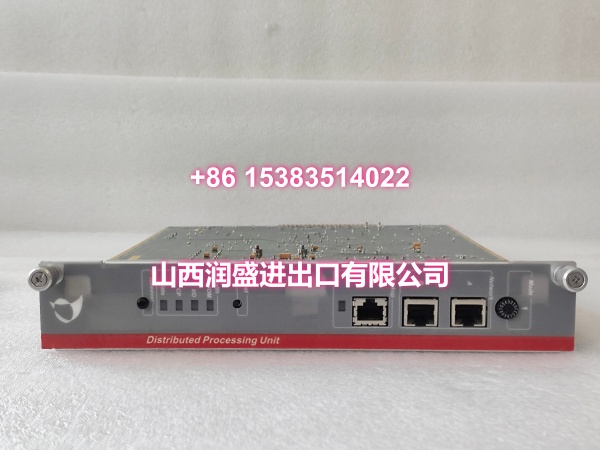
Key Technical Specifications
- Processor: 32-bit RISC
- Memory: 256 MB SDRAM
- Storage: 2 GB Flash
- Communication Interfaces: RS-232, RS-485, Ethernet
- Supported Protocols: Modbus, Profibus, HART
- Operating Temperature: -40°C to +70°C
- Protection Level: IP65
- System Architecture: Redundant hot backup support
- Compliance: IEC 61131-3 Standard
- Management: Remote monitoring and management capable
Product Introduction
Serving as the computational core of the DL401 product line, this distributed processing unit manages complex industrial workflows. It continuously aggregates sensor inputs and executes deterministic control logic for heavy-duty applications ranging from mineral processing to power generation.
Built for harsh environments, the unit features an IP65 enclosure and a wide operating temperature range that eliminates the need for climate-controlled cabinets. Its redundant hot-backup architecture ensures that a single hardware failure never translates into unplanned production downtime.
QA & Testing SOP (Dynamic & Transparent)
Every Metso PDP401 undergoes a rigorous validation protocol before it leaves our bench. We start with a comprehensive anti-counterfeit inspection, verifying the 32-bit RISC processor lot codes and Flash memory integrity against OEM manifests. Next, we run a cold-boot stress test across the -40°C to +70°C thermal envelope to confirm the SDRAM holds data without bit flips during extreme temperature transitions.
Communication stack integrity is validated by establishing live Ethernet and RS-485 links, forcing a primary controller failover to verify the redundant hot-backup syncs in under 50ms. We also inject simulated Modbus and Profibus traffic to ensure the IEC 61131-3 logic executes deterministically. Units ship in anti-static shielding with a signed test report.
Installation Pitfalls & Guide
❗ Thermal Clearance: The -40°C to +70°C rating assumes adequate convection cooling. If you are mounting this DPU in a densely packed control panel, do not stack heat-generating power supplies directly above it. Maintain at least 2 inches of vertical clearance, or the internal Flash memory will throttle and cause logic scan delays.
❗ Redundancy Sync Cabling: The hot-backup feature relies on a dedicated sync link between primary and secondary units. Never route this sync cable parallel to high-voltage VFD output lines. EMI induced on the sync link will cause the backup DPU to constantly think the primary has failed, leading to endless, destructive failover loops.
❗ Grounding the Chassis: This unit carries an IP65 rating, but EMI immunity requires a solid chassis ground. Do not rely solely on the DIN rail for grounding. Use the dedicated grounding lug with a copper braid tied directly to the panel’s star ground point to prevent common-mode noise from corrupting the RS-485 bus.
Replacement SOP:
- Pre-Install: Backup the 2 GB Flash configuration; verify the replacement unit matches the primary’s firmware revision.
- Removal: De-energize the slot; wait 60 seconds for capacitor discharge; release the DIN locking tabs.
- Install: Slide the unit onto the rail; engage the top clip first, then the bottom; reconnect the sync and Ethernet links.
- Power-On: Apply 24VDC; monitor the redundancy status LEDs for 3 minutes to confirm successful data synchronization before enabling I/O.
Technical FAQ
Q: Can I hot-swap this PDP401 while the backplane is live?
A: No. While the DL401 series supports redundant hot-backup at the system level, the physical module itself is not designed for mechanical hot-swapping. Removing a live unit risks an arc across the backplane pins. Always de-energize the specific slot or the entire rack before mechanical extraction.
Q: How much of the 2 GB Flash is usable for user logic?
A: The 2 GB Flash is partitioned. A significant portion is reserved for the real-time operating system, firmware, and redundant shadow copies. Always check the available block space in your engineering software before deploying massive historical data-logging routines locally on the DPU.
Q: Is this unit compatible with newer Metso Valmet controllers?
A: Hardware-wise, the PDP401 belongs to the legacy DL401 series. While it communicates seamlessly over standard Ethernet and Profibus with newer supervisory systems, backplane compatibility is strictly limited to DL401 racks. You cannot drop this into a newer generation Metso Valmet chassis without a gateway.
Q: Why is my redundant backup failing to sync?
A: Check the firmware revision first. The primary and backup Metso PDP401 must have matching OS versions. A mismatched revision will allow the hardware to power up, but the memory shadowing protocol will refuse to sync. Second, verify your sync cable hasn’t been pinched or degraded by vibration.
Q: What happens if the Flash memory degrades over time?
A: Industrial Flash has a finite write-erase cycle limit. If your application writes historical trend data to the local DPU every second, you will burn out the memory cells prematurely. Offload high-frequency trending to a central historian via Ethernet and only use the local 2 GB Flash for critical configuration and fault buffers.