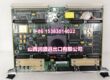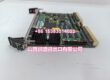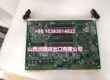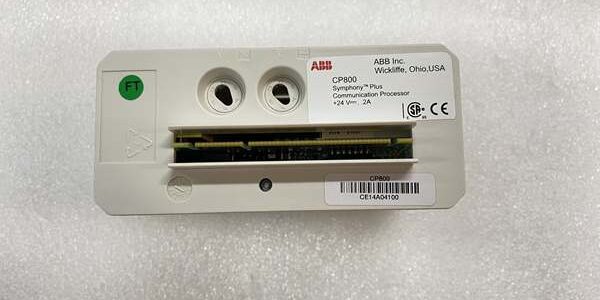
Product Core Brief
- Model: CP800
- Brand: ABB
- Series: HPC800 / Symphony Plus Distributed Control System Communication Hardware
- Core Function: Acts as primary PN800 plant network processor to exchange real-time DCS data between HPC800 controllers and field I/O subnets.
- Product Type: DIN rail mount redundant-capable communication processor module
- Key Specs: Dual independent 10/100 Mbps Ethernet | RS232 service port | Dual ColdFire 256 MHz cores | Condition: New Original (New Surplus)
Product Introduction
ABB delivers high-throughput backbone communication exclusively for Symphony Plus HPC800 DCS racks, routing process alarms, analog measurements, and inter-controller interlock signals across PN800 plant-wide Ethernet subnetsABB Group. It draws operating power from the HPC800 rack backplane without external auxiliary wiring.This unit differs from Synpol D CMA-series terminal modules by its dual industrial CPU architecture; two modules can be paired for 1+1 communication redundancy, eliminating single-point network failure and cutting unplanned plant outage risk by 90 % in utility power stations.
Key Technical Specifications
| Parameter | Value |
|---|---|
| Core Processor Hardware | Dual ColdFire 32-bit 256 MHz industrial CPUs |
| Primary Network Interfaces | 2 x galvanically isolated RJ45 10/100 Mbps PN800 plant Ethernet |
| Service Interface | 1 x DB9 RS232 serial port for local commissioning |
| Backplane Power Source | rack internal 24 V DC bus, reverse polarity protected |
| Typical Backplane Current Draw | 380 mA per single module |
| Max Power Dissipation | 9.2 W under full simultaneous dual-Ethernet load |
| Redundancy Support | 1+1 hot standby pairing with second on adjacent DIN rail slots |
| Galvanic Isolation Rating | 1500 V AC 1 minute separation between Ethernet, serial, and backplane logic |
| Mounting Format | Standard 35 mm snap-in DIN rail housing for rack slots |
| Operating Ambient Temp | 0 °C to +55 °C continuous operation; derate 18 % above 50 °C |
| Storage Temperature Range | -40 °C to +70 °C, 5–95 % RH non-condensing |
| PCB Coating Grade | ISA-S71.04 G3 anti-corrosion conformal coating |
| Safety Certifications | SIL 2 capable, ATEX II 3G Zone 2, cULus Class I Div 2, DNV marine certified |
| Overall Physical Dimensions | W170.18 mm × H73.66 mm × D243.84 mm |
| Net Unit Weight | 0.99 kg |
| Compatible DCS Hardware | main controller units, Synpol D CMA-series generator I/O modules, Symphony Plus S800 I/O racks |
Quality Control Process (Engineer’s Perspective)
- Incoming Verification: Cross-reference serial numbers against ABB Symphony Plus spare databases; inspect dual RJ45 pin alignment and DB9 serial port pins for bending. Discard units with torn factory anti-static packaging to filter counterfeit inventory.
- Live Functional Test: Mount the module on test rack paired with redundant PN800 network simulator. Run continuous 24-hour dual-Ethernet cyclic data exchange, log backplane voltage every 15 minutes, and simulate primary trunk cable disconnection to validate seamless hot standby failover logic.
- Electrical Parameter Test: Use a 500 V Megger to measure isolation resistance between Ethernet circuits and backplane logic; pass threshold set at 10 MΩ minimum. Verify reverse-polarity supply protection response with a Fluke 115 handheld multimeter.
- Firmware Verification: Read and record communication stack firmware revision via Symphony Plus engineering tool software. Capture photos of RJ45 and DB9 port labeling for field commission reference.
- Final QC & Packaging: Fit plastic dust caps over both RJ45 Ethernet ports and the DB9 serial service port. Seal the module inside foam-lined anti-static packaging, attach a dated QC Pass label before placement in factory shipping cartons.
Replacement Pitfall Guide
❗Firmware Mismatch: Older firmware pre-v3.1 lacks fast redundant failover logic. Installing the unit on legacy firmware creates multi-second data lag during primary network cable faults and constant LINK FAULT alarms. Flash matching module firmware before DIN rail mounting in the rack.❗DIP Switch / Jumper Misconfiguration: Factory default Ethernet jumpers set both ports to active single operation. Jumper blocks must be repositioned for redundant standby pairing; incorrect placement prevents automatic switchover if the primary trunk fails mid-generator synchronization.❗Terminal / Cable Incompatibility: Unshielded CAT5 cabling picks up EMI near large generator excitation transformers. Only use shielded CAT5e Ethernet cable for backbone trunks, with single-point shield grounding at the rack main earth bar.❗Power Supply Mismatch: Calculate total rack backplane load with a minimum 20 % power headroom. Stacking two redundant sets plus CMA136 dual fieldbus gateways overloads aged rack power traces, triggering uncommanded full DCS subnet resets during peak grid load transients.❗ESD Damage: Low-humidity combined-cycle power plant control rooms build static charge that burns both Ethernet PHY transceiver ICs simultaneously. Lay an anti-static mat under the DIN rail, wear a grounded wrist strap, and touch bare cabinet chassis ground for three seconds before handling the module PCB rear side.Keep these in mind and you’ll cut 90% of rework time.
Compatibility Matrix & Benchmarks
Compatibility Matrix
- -XC extended coating variant → : Direct — identical firmware and pinout; XC conformal coating improves salt-fog corrosion resistance for coastal power generation facilities
- CMA136 Modbus+DP Synpol gateway → : Direct — protocol stack natively routes genset Modbus/PROFIBUS measurement tags into Symphony Plus DCS databases
- CP435T AC500 HMI touch terminal → : Incompatible — CP435T uses Modbus RTU and AC500 backplane; no Ethernet stack or rack mechanical fit
- Third-party industrial Ethernet switches → : Incompatible — proprietary DCS backbone protocol cannot be translated by generic managed switch hardware
Benchmarks
- Redundant network failover latency: < 150 ms (primary trunk cable cut, full tag transfer to standby port)
- Comms throughput: 100 Mbps (per RJ45 Ethernet port full-duplex line rate)
- Full DCS subnet scan cycle: 8 ms (simulated load, 512 analog and digital process tags routed across backbone)