Product Core Brief
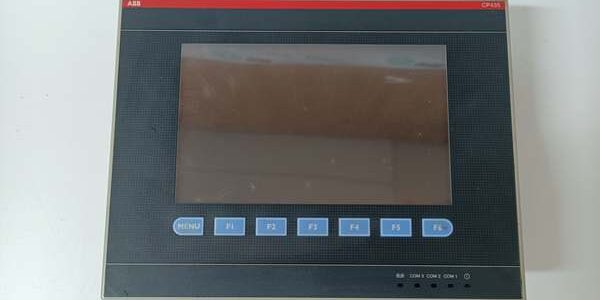
- Model: CP435T (Full OEM Order Code 1SBP260193R1001)
- Brand: ABB
- Series: CP400 Industrial HMI Operator Terminals for AC500 PLC Platform
- Core Function: Visualizes process data, executes operator input, and stores production recipes for ABB AC500 PLC automation systems.
- Product Type: Panel-mount touchscreen HMI with integrated physical function keys
- Key Specs: 7-inch 64K color analog TFT | 6 configurable F-keys + Menu key | 24 V DC supply | Condition: New Original (New Surplus)
Product Introduction
ABB 1SBP260193R1001 is a 7-inch CP400 series operator terminal built to pair natively with AC500 PLCs via RS485 Modbus RTU. It combines analog touch input with hardwired function keys for reliable machine operation in high-vibration factory environments.This unit differs from smaller CP430 HMIs by its larger 153.7 mm × 92.4 mm active display area and 8 MB flash memory; it holds 100+ batch recipes and supports ladder macro logic without external storage media, cutting auxiliary USB drive reliance by 60 % for discrete manufacturing lines.
Key Technical Specifications
| Parameter | Value |
|---|---|
| Full OEM Part Number | 1SBP260193R1001 ( non-Ethernet variant) |
| Display Panel | 7-inch analog resistive TFT, 64K color depth |
| Active Display Dimensions | 153.7 mm W × 92.4 mm H |
| Physical Key Layout | 1 dedicated Menu key + 6 user-programmable F1–F6 function keys |
| Main Processing Unit | 32-bit RISC industrial CPU |
| Internal Flash Memory | 8 MB application / recipe storage |
| Real-Time Clock | Onboard battery-backed RTC for timestamped alarms |
| Primary Communication Port | Galvanically isolated RS485 Modbus RTU, 4.8 kbps–187.5 kbps |
| Supply Voltage | 24 V DC (-15 % / +15 %), max power draw < 24 W |
| Front Panel Rating | IP65 / NEMA 4X indoor dust and splash protection |
| Cutout Mount Dimensions | 220.8 mm W × 165.8 mm H |
| Overall Front Face Size | 231 mm W × 176 mm H × 7.5 mm front bezel thickness |
| Mounting Depth Behind Panel | 45.8 mm |
| Unit Net Weight | 0.86 kg |
| Operating Ambient Temp | 0 °C to +50 °C continuous operation |
| Storage Temperature Range | -10 °C to +60 °C, 20–90 % RH non-condensing |
| Vibration Resistance | 0.5 mm displacement, 10–55 Hz, 2 hours per X/Y/Z axis |
| Shock Rating | 10 G, 11 ms pulse, three impacts per axis |
| Compliance Certifications | CE EMC, cULus, RoHS 2 compliant |
| Compatible PLC Hardware | AC500 PM581, PM591, CM572-DP Profibus module |
Quality Control Process (Engineer’s Perspective)
- Incoming Verification: Cross-reference serial numbers and 1SBP260193R1001 part code against ABB CP400 spare databases; inspect TFT panel for dead pixels and function key tactile response. Discard units with scratched IP65 front gaskets or torn anti-static packaging to filter counterfeit inventory.
- Live Functional Test: Mount the HMI into a standard test panel cutout paired with PM591 AC500 CPU. Run continuous 24-hour Modbus data polling and recipe load/save cycles, log display backlight temperature every 15 minutes, and simulate vibration cycles to validate touch input stability.
- Electrical Parameter Test: Use a 500 V Megger to measure isolation resistance between RS485 communication circuits and 24 V DC power rails; pass threshold set at 10 MΩ minimum. Verify supply current draw and reverse-polarity protection with a Fluke 115 handheld multimeter.
- Firmware Verification: Read and record factory HMI runtime firmware revision via Automation Builder software. Capture photos of RS485 terminal pin labeling and panel cutout dimensions for retrofit cabinet reference.
- Final QC & Packaging: Fit clear protective film over the TFT touch surface. Seal the HMI inside foam-lined anti-static packaging, attach a dated QC Pass label before placement in factory shipping cartons.
Replacement Pitfall Guide
❗Firmware Mismatch: Automation Builder runtime older than v2.3 lacks native recipe register mapping. Installing the HMI with outdated software corrupts batch storage tables and triggers constant MODBUS COMM FAULT alarms. Flash matching HMI and PLC firmware before panel installation.❗DIP Switch / Jumper Misconfiguration: Factory default RS485 jumpers set termination resistor disabled for mid-bus placement. Enable the internal 120 Ω resistor only if this HMI is the final device on the Modbus trunk; dual termination creates signal reflection and lagging screen value updates during high-speed production cycles.❗Terminal / Cable Incompatibility: Unshielded wiring picks up EMI near servo drive cabinets. Only use shielded twisted-pair Modbus cable, with single-point shield grounding at the HMI rear terminal earth lug.❗Power Supply Mismatch: Calculate total cabinet 24 V DC load with a minimum 20 % power headroom. Stacking four of the unit plus CM572-DP communication modules overloads aged DC power bricks, triggering random HMI backlight resets mid-production batches.❗ESD Damage: Low-humidity machine shop floors generate static charge that burns the analog touch controller IC instantly. Lay an anti-static mat under the panel cutout, wear a grounded wrist strap, and touch bare cabinet chassis ground for three seconds before handling the HMI rear PCB side.Keep these in mind and you’ll cut 90% of rework time.
Compatibility Matrix & Benchmarks
Compatibility Matrix
- -ETH Ethernet variant → 1SBP260193R1001 : Needs Adaptation — adds onboard RJ45 PROFINET port; Modbus register layout matches, full cabinet Ethernet cabling rewiring required
- CP430 5.7-inch compact HMI → 1SBP260193R1001 : Incompatible — smaller cutout dimensions, only 4 MB flash memory, no physical function key bank
- CM572-DP Profibus module → 1SBP260193R1001 : Direct — Modbus RTU communication stack supports seamless tag exchange with zero software edits
- Third-party Modbus RTU PLCs → : Direct — standard Modbus holding register mapping for process values and setpoints
Benchmarks
- Screen refresh cycle: 100 ms (simulated load, 40 live PLC data tags displayed simultaneously)
- Comms throughput: 187.5 kbps (Modbus RTU maximum supported baud rate)
- Recipe storage access latency: < 300 ms (full batch recipe load from internal flash to PLC registers)