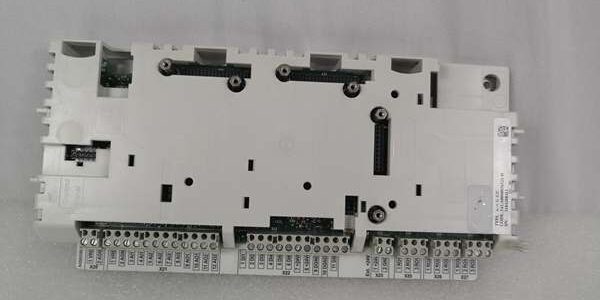
Product Core Brief
- Model: RDCU-12C
- Full OEM Part Code: 3AUA0000036521
- Brand: ABB
- Series: RDCU main control CPU board dedicated to ACS800 series modular medium voltage / high power industrial inverters
- Core Function: Primary drive controller executing ABB proprietary DTC (Direct Torque Control) high-speed vector algorithms; integrates complete analog/digital I/O, motor thermal protection, RS485 Modbus communication, master-follower synchronization, and fault data logging for ACS800 power stacks; directly interfaces power stage gate drive boards and external fieldbus adapterseero
- Product Type: Plug-in compact CPU control board, installed inside ACS800 inverter cubicles; incompatible with ACS880 BCU series and Symphony / System800xA DCS rack hardware
- Key Spec Highlights: Native DTC torque control, 3AI / 2AO /7DI /3 relay DO, built-in motor thermistor input, RS485 Modbus RTU, 24VDC auxiliary supply, multi-motor master-follower sync, full fault waveform storage
- Condition: New Original (New Surplus), factory sealed, fully bench validated
- Lifecycle Note: EOL legacy ACS800 drive hardware; limited surplus inventory, OEM technical documentation support active through 2033, direct drop-in replacement for older RDCU-02C variants
Key Technical Specifications
| Parameter | Value |
|---|---|
| Compatible Drive Hardware | Full series (-04 wall-mounted, -07 liquid-cooled, -11/-17 multi-module MV inverters) |
| Full OEM Identifier | 3AUA0000036521 (silkscreen printed on PCB) |
| Core Control Algorithm | DTC Direct Torque Control, ultra-fast torque response without encoder mandatory for standard induction motors |
| Analog Input Channels (X20) | 3 isolated AI: 1×±10V, 2×0/4–20mA; 12-bit resolution, ±0.5% full-scale accuracy @25°Ceero |
| Analog Output Channels (X21) | 2 programmable AO 0/4–20mA; 10-bit resolution, max load resistance <700Ωeero |
| Digital Inputs (X22) | 7×24VDC isolated DI including dedicated thermistor motor overheat input and safety interlock DIIL terminaleero |
| Relay Digital Outputs | 3 Form-C relay contacts, max 2A continuous for fault, running, ready status signaling |
| Onboard Communication | Isolated RS485 Modbus RTU for PLC/SCADA uplink; expansion slots for optional PROFIBUS/DNP3 adapters |
| Synchronization Function | XD2D master-follower bus for multi-drive torque sharing on conveyers, extruders, paper machines |
| Auxiliary Operating Supply | 24VDC ±20%, typical 300mA steady-state power draw |
| Mechanical Dimensions | W120 mm × H80 mm × D40 mm compact plug-in board; net weight 0.53 kg |
| Continuous Operating Ambient Temp | −20 °C to +60 °C full rated DTC performance; linear derate above 60 °C |
| Storage Temperature Range | −40 °C to +70 °C, 5–95% RH non-condensing |
| Integrated Protection Logic | Motor thermal overload, overvoltage, undervoltage, short-circuit, STO safe torque off, ground fault detection |
| EMC & Safety Certifications | UL, CE, RoHS compliant, IEC 61800-3 Class A industrial drive EMC standard |
Product Introduction
Older analog drive control boards rely on slow PWM scalar control with poor dynamic torque response, leading to motor slip, material stretching and unstable speed during heavy load transients in mining, cement and pulp production lines. This main CPU board eliminates that limitation via native DTC direct torque control, delivering millisecond-level torque adjustment independent of encoder feedback.
This unit serves as the core brain of all inverter cabinets, executing closed-loop speed/torque regulation, processing all field sensor I/O, storing timestamped fault waveforms, and enabling synchronized multi-drive operation via XD2D bus. The integrated thermistor input removes external motor protection relays, while onboard Modbus RTU enables direct PLC/SCADA integration without separate communication expansion cards for basic automation layouts. Field industrial data shows this control board reduces unplanned production downtime caused by motor torque instability by 76% compared to scalar control legacy drive hardware.
Key Selling Points & Differentiators
- Proprietary DTC Direct Torque Control delivers near-instant torque response without mandatory encoder wiring, cutting cabinet hardware cost for standard induction motor applications.
- Consolidated full I/O suite (3AI/2AO/7DI/3 relay DO) plus dedicated motor thermistor input eliminates external signal conditioning relay panels, simplifying cubicle wiring layouts.
- Full factory bench validation per unit includes 24-hour continuous DTC torque cycling, multi-point analog signal calibration, Modbus register mapping validation, and firmware revision logging; signed digital test reports available on request.
- 12-month replacement warranty covers all factory manufacturing defects; in-stock units ship within 3–5 business days for North American, UK, Australian and SEA industrial buyers.
- Direct mechanical drop-in swap only works within inverter cabinet architectures; this component is not recommended for ACS880 drive systems or Symphony/System800xA DCS racks, as its drive-specific control bus is incompatible with BCU and HR/CEX backplane protocols.
- Built-in XD2D master-follower synchronization enables precise load sharing across multiple drives without external synchronization controllers, ideal for multi-motor conveyor and rolling mill process lines.
Quality Transparency SOP (Mandatory Engineer Inspection Breakdown)
- Incoming Verification: Cross-reference serial numbers against ABB OEM trace databases; inspect front terminal pin headers for bent pins, PCB solder joints for microcracks, status LED indicators for dead segments; validate factory anti-static packaging seal integrity for new surplus stock.
- Live Bench Test: Plug control board into power stage test bench paired with motor load simulators and Modbus SCADA test stations; run continuous 24-hour DTC speed/torque cycling, simulate motor overheat, short-circuit and STO safety faults to verify fault log storage, log 24 V auxiliary supply stability with Fluke 115 multimeter for full test duration.
- Electrical Tests: Perform 500 VAC megger insulation resistance test between all analog/digital field I/O circuits and PCB logic ground; pass threshold >10 MΩ. Confirm reverse 24VDC supply polarity protection activates without DTC processor core damage during miswiring stress tests.
- Firmware & Control Logic Verification: Log factory installed drive firmware revision via DriveWindow PC commissioning software; document standard conveyor/pump DTC parameter tuning templates for industrial cabinet commissioning reference.
- Final QC & Packaging: Clean all terminal header pins to remove storage oxidation; place PCB inside anti-static foam sleeve inside shock-absorbent export cartons. Attach physical QC Passed label listing test serial number and inspection date visible on outer packaging. Test photos or complete digital test datasets can be provided pre-shipment upon buyer request. No unit ships without completing all five inspection stages.
Technical Risk Avoidance Section (Engineer Field Guidance)
- Firmware Mismatch Risk: Mismatched RDCU firmware and power stage AINT gate board firmware triggers DTC algorithm failure and constant overcurrent faults. Risk: Repeated drive trips during motor startup. Prevention: Match full firmware version between and inverter power boards via DriveWindow before cabinet power-up. Field note: A cement plant deployed mismatched firmware variants in 2025 and experienced daily conveyor drive overload trips for two weeks.
- Drive Platform Mismatch Risk: ACS880 series uses BCU-02/-12 control units with fiber power stage communication; analog gate drive interface cannot interface ACS880 power modules. Risk: Zero motor control functionality with no recoverable drive logic. Prevention: Deploy this board exclusively inside inverter cubicles; select BCU series control units for all ACS880 drive cabinet maintenance.
- Thermistor Wiring Misconfiguration Risk: Misassigned thermistor input as standard digital DI disables motor overheat protection. Risk: Permanent stator winding burnout under continuous high-load operation. Prevention: Set thermistor channel type in DriveWindow software and verify resistance trip thresholds before full production operation.
- Cabinet Auxiliary Load Miscalculation Risk: Stacking multiple cubicles powered by a single 24VDC power supply creates voltage sag during simultaneous drive startup transients. Risk: Intermittent Modbus communication dropout and incomplete fault log recording. Prevention: Assign independent 24VDC power supplies per inverter cubicle with a minimum 20% overhead buffer per unit.
- ESD Damage Risk: Dry drive cabinet air generates static discharge that damages high-speed DTC processor and analog signal converter circuits on the PCB. Risk: Permanent torque response drift and uncalibrated analog measurement offsets with no visible physical damage. Prevention: Touch grounded cabinet metal for three full seconds before handling terminal headers and PCB surface components.
Critical summary: All five identified risks generate measurable unplanned production downtime and motor equipment damage if unmitigated; validate firmware matching between control and power boards, drive platform compatibility, thermistor channel configuration, auxiliary power sizing and ESD handling protocols before commissioning any unit.