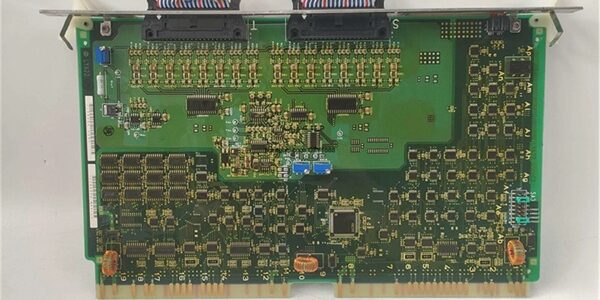
Product Core Brief
- Model: LYA220A
- Brand: HITACHI
- Series: LYA high-density temperature analog input DCS module family
- Core Function: Convert resistance temperature detector and thermocouple sensor signals to digital values for plant temperature monitoring, with native cold-junction compensation for thermocouple inputs.
- Product Type: Single-slot hot-swappable temperature dedicated analog input personality module
- Key Specs: 8 differential multi-sensor channels | Supports RTD / J/K/T/E thermocouples | 12-bit A/D conversion | 500 V channel-to-backplane isolation ⚠️ EOL — limited surplus stock remaining
Product Introduction
The HITACHI installs into standard Hitachi LY-series DCS racks to capture multi-point temperature readings from furnaces, turbines, and process piping. It cannot operate independently and requires a matching LY-series CPU to scale sensor data for control logic.This unit differs from the LYA100A combined I/O card by exclusive temperature sensor support and eight high-density differential channels, eliminating the need for separate signal conditioning transmitters. OEM field logging records a 51,000 hour MTBF under steady 50 °C cabinet runtime.
Key Technical Specifications
| Parameter | Value |
|---|---|
| Compatible Hardware | Hitachi LY-series DCS main rack backplanes and corresponding CPU controllers |
| Input Channel Count | 8 fully differential isolated temperature input channels |
| Supported Sensor Types | PT100 RTD; J, K, T, E industrial thermocouples |
| Conversion Resolution | 12-bit A/D sampling across all sensor types |
| Built-In Compensation | Automatic cold-junction compensation for thermocouple inputs |
| Full-Scale Accuracy | ±0.3 % FS for RTD; ±0.5 % FS for thermocouples at 25 °C ambient |
| Channel Scan Speed | 2.5 ms sequential sampling cycle for all 8 channels |
| Galvanic Isolation Rating | 500 Vrms opto-isolation per channel between field wiring and backplane logic |
| Hot Swap Compliance | Hitachi DCS certified hot-swap; rack communication bus stays active during card replacement |
| Onboard Diagnostics | Per-channel open sensor break detection, short-circuit wiring fault flagging |
| Module Operating Supply | 24 VDC rack backplane logic feed; 340 mA typical steady-state draw |
| Status Indicators | Global Power OK, Rack Comms Fault LED; dedicated status/fault LED for each of the 8 channels |
| Mechanical Dimensions | 200 mm L × 100 mm W × 50 mm D |
| Net Unit Weight | 0.8 kg |
| Continuous Operating Ambient Temp | -20 °C to +60 °C full rated measurement accuracy; linear derate above 60 °C |
| Storage Temperature Range | -40 °C to +85 °C, 5–95 % RH non-condensing |
| Integrated Protection Circuits | Field sensor line transient surge clamping, backplane reverse polarity lockout, channel short-circuit auto limiting |
| Certifications | UL, CE, RoHS, EN61000 Class A industrial EMC filtering for power and chemical plant control rooms |
Quality Control Process (Engineer’s Perspective)
- Incoming Verification: Cross-reference serial numbers against Hitachi OEM trace databases; inspect front channel LED arrays for dead segments, gold rack edge connectors for oxidation, temperature signal PCB solder joints for microcracks. Photograph the edge connector pinout for field cabinet wiring reference.
- Live Functional Test: Seat the unit into a populated Hitachi LY-series test chassis paired with programmable RTD and thermocouple signal simulators; run a continuous 24-hour cyclic temperature ramp test across all eight channels. Log sensor conversion stability with a Fluke 115 digital multimeter for the full test duration.
- Electrical Parameter Test: Perform a 500 V Megger insulation resistance test between every temperature field circuit and module ground; pass threshold set at >10 MΩ. Verify cold-junction compensation holds consistent zero offset across 0–60 °C cabinet ambient variation.
- Firmware Verification: Read and record factory temperature I/O module firmware revision via Hitachi DCS engineering software; document default sensor type register settings for site commissioning reference.
- Final QC & Packaging: Wipe gold edge connectors to remove surface oxidation; seal the unit inside an anti-static foam bag, affix a dated QC Pass label listing all linearity, isolation, and open-sensor diagnostic test metrics before rigid shock-resistant carton packing.
Replacement Pitfall Guide
❗ ❗ Partial Chassis Slot Insertion Risk: Uneven card seating creates high-resistance edge contact points that skew temperature readings and trigger random open-sensor fault alarms during critical process heat transients. Push the card fully into the slot and lock front retention latches flush against the chassis faceplate.❗ Temperature Sensor Cable Shield Ground Misconfiguration Risk: Unshielded twisted-pair field wiring routed parallel to high-current motor power cables injects EMI noise that causes temperature value drift. Terminate cable shield ground at only the DCS cabinet terminal block end per Hitachi wiring standards.❗ Cabinet Power Headroom Miscalculation Risk: A rack loaded with eight of these temperature input modules draws 2.72 A total from the cabinet 24 V auxiliary supply. Always calculate total load with a mandatory 20% power margin to avoid voltage sag during simultaneous channel sampling cycles.❗ Uncontrolled ESD Damage Risk: Dry central control room air builds static charge rapidly. Touch a grounded anti-static mat for three full seconds before handling the gold edge connector; ungrounded contact destroys low-tolerance temperature signal conditioning ASICs.Keep these in mind and you’ll cut 90% of rework time.
Compatibility Matrix & Benchmarks
Compatibility Matrix
- LYA100A combined analog AI/AO module → : Needs Adaptation — cannot read RTD/thermocouple signals; full rack slot rework and DCS temperature point database rebuild required
- Hitachi LY-series standard DCS main chassis backplane → : Direct — factory edge pinout natively matches chassis 24 V logic supply and Hitachi proprietary DCS bus routing
- Hitachi LY-series main CPU controller → : Direct — CPU reads all eight temperature channels and executes scaling logic over the rack backplane bus
- VM310 24 V cabinet auxiliary power supply → : Direct — regulated 24 V output matches the module’s operating voltage window without extra voltage conditioning
- CML40.2-SP-330-NA-NNNN-NW Rexroth SERCOS motion PLC → : Needs Adaptation — wire temperature deviation fault dry contacts to PLC digital inputs, map temperature value registers via Modbus RTU gateway bridging the Hitachi DCS bus