Product Core Brief
- Model: SST-PFB3-VME-2
- Brand: Molex Woodhead SST (BradCommunications)
- Series: SST-PFB VME PROFIBUS scanner card family
- Core Function: Host two fully independent galvanically isolated PROFIBUS DP master channels with dedicated on-board co-processors; exchange cyclic I/O and acyclic diagnostic data between VME host CPUs and PROFIBUS field devices including Rexroth servo drives and tightening controllersManualsLib.
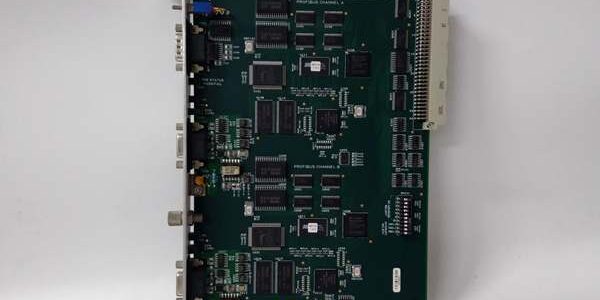
- Product Type: Single-slot VME64 Eurocard rack module with dual front D-SUB9 PROFIBUS ports and RS232 local service port
- Key Specs: Two isolated PROFIBUS channels | 512KB RAM / 512KB flash per channel | Max 122 DP slaves per port | 9.6 kbps–12 Mbps baud rate | VME IRQ 1–7 configurable via DIP switch | Condition: Refurbished Load-Tested Surplus
- Suffix breakdown: PFB3 = 3rd-gen PROFIBUS processor; VME = VME bus form factor; 2 = dual independent PROFIBUS network channels (SST-PFB3-VME-1 = single channel only)ManualsLib
Product Introduction
inserts into standard VME64 chassis to run two separate PROFIBUS DP networks simultaneously, offloading all PROFIBUS protocol handling from the VME host CPU via dedicated channel co-processors. It connects VME-based machine controllers to Rexroth HCS, HMD, SE311, and LT304 PROFIBUS slave hardware without shared bus bandwidth contention.This unit differentiates from single-channel SST-PFB3-VME-1 variants by supporting two physically separated PROFIBUS trunks for segregated safety and motion control networks. OEM datasheet field logging places its rated MTBF above 100,000 operating hours under continuous 24/7 cabinet runtime at 40 °C ambient.
Key Technical Specifications
| Parameter | Value |
|---|---|
| VME Bus Compliance | VME64 single slot A24/D16/D32 addressing; 16 MB configurable VME memory window |
| VME Backplane Power Draw | 800 mA @ 5 V DC primary rail; 12 mA @ 24 V auxiliary sense input |
| Per-Channel Onboard Memory | 512 KB shared cyclic data RAM; 512 KB non-volatile flash for firmware and network config |
| PROFIBUS Physical Interface | Dual galvanically isolated RS485 D-SUB9 female ports; separate isolation per channel |
| Service Debug Port | Front RS232 9-pin D-SUB for local firmware flashing and offline network editing |
| Supported PROFIBUS Modes | DP-V0 Class1/Class2 Master; DP-V1 Class1/Class2 Master; single channel can run master + slave concurrently |
| Per-Channel Network Capacity | Maximum 122 PROFIBUS DP slave nodes; 244 input / 244 output bytes cyclic I/O mapping per slave |
| Host Interrupt Control | VME IRQ levels 1 through 7, fully configurable via on-board S1 DIP switch bank |
| Diagnostic Indicators | Two dedicated LED banks (OK / COMM / FAULT) for channel A and channel B independent status reporting |
| Mechanical Dimensions | VME single slot 6U × 1TE form factor; net unit weight 0.5 kg |
| Continuous Operating Ambient Temp | 0 °C to +60 °C full rated throughput; linear performance derate above +60 °C |
| Storage / Transport Temperature | -40 °C to +85 °C, non-condensing 5–95 % RH humidity range |
| Integrated Protection Circuits | RS485 bus short-circuit clamping, channel-to-chassis galvanic isolation, reverse VME power polarity lockout |
| Compliance Certifications | CE, UL Class 1 Div 2 hazardous location qualified, RoHS, EN61000 Class A industrial EMC filtering |
| Supported Commissioning Software | SST PROFIBUS Configuration Tool, VME host driver libraries for VxWorks / Linux real-time OS |
Quality Control Process (Engineer’s Perspective)
- Incoming Verification: Cross-reference serial number against Molex Woodhead OEM part databases; inspect dual front D-SUB9 and RS232 port pins for bending, VME backplane edge connector for oxidation, and status LEDs for dead segments. Photograph front port pinout and DIP switch layout for field rack wiring reference.
- Live Functional Test: Insert card into VME64 test chassis paired with real-time VME host CPU and simulated Rexroth PROFIBUS slave drive stacks; run 24 hour cyclic I/O data exchange profiles at maximum 12 Mbps baud rate on both channels simultaneously. Use a Fluke 115 signal logger to track VME backplane current draw and dual-channel data transfer latency consistency.
- Electrical Parameter Test: 500 V Megger insulation test between each PROFIBUS RS485 circuit and module chassis ground (pass threshold >10 MΩ); verify galvanic isolation holds across both independent channels with no cross-talk leakage.
- Dual Channel & Firmware Verification: Flash factory standard firmware to each channel via RS232 service port; upload separate PROFIBUS network maps for Channel A and Channel B, retain full slave configuration tables over a 12 hour VME chassis power-off cycle to validate flash memory retention.
- Final QC & Packaging: Clean VME backplane edge connector contacts during refurbishment cycles; fit plastic protective caps over all three front D-SUB ports, seal unit in anti-static PE foam bag, apply dated QC Pass label listing dual-channel throughput, isolation resistance, and independent fault detection test metrics before rigid carton shipping.
Replacement Pitfall Guide
❗ Single/Dual Channel Hardware Mismatch Risk: Single-channel SST-PFB3-VME-1 cards only support one PROFIBUS trunk. Direct substitution breaks segregated safety and motion network isolation; machine control logic will require full PROFIBUS network redesign to consolidate all slaves onto one bus segment. Confirm two physically separate PROFIBUS trunks exist before swapping variants. Photograph original dual D-SUB trunk wiring termination before module removal to preserve 120 Ω bus resistor placement on each network.❗ VME DIP Switch Address & IRQ Conflict Hazard: The S1 DIP switch bank sets VME memory window base address and interrupt level. Unmatched DIP switch settings create bus address collisions that crash the VME host CPU within seconds of power-up. Record all original DIP switch positions before extracting the module from the rack.❗ Dual Channel Bus Termination Miswiring Risk: Each PROFIBUS channel requires independent 120 Ω termination resistors enabled only at the two physical cable ends of each trunk. Shared termination between Channel A and Channel B creates signal reflection noise that triggers intermittent slave dropout at baud rates above 500 kbps.❗ VME Chassis Condensation Short-Circuit Risk: Cold-stored modules moved into warm humid control enclosures form PCB trace condensation within two hours. Allow minimum four-hour temperature acclimation before inserting into powered VME racks to prevent flash memory corruption and RS485 transceiver permanent failure.❗ ESD Co-Processor Circuit Damage: Onboard flash memory and PROFIBUS ASIC circuits carry low electrostatic discharge tolerance. Always rest the unit on a grounded anti-static mat during VME rack insertion or front port cable rewiring, especially in low-humidity cleanroom production environments.Keep these in mind and you’ll cut 90% of rework time.
Compatibility Matrix & Benchmarks
Compatibility Matrix
- SST-PFB3-VME-1 single-channel PROFIB : Needs Adaptation — split single PROFIBUS trunk into two isolated networks, reconfigure VME host OS driver to register dual independent channel data buffers
- CML40.2-SP-330-NA-NNNN-NW Rexroth SERCOS mot : Direct — PROFIBUS DP slave mode enables bidirectional motion setpoint and fault data exchange via either Channel A or Channel B trunk
- HCS02.1E-W0028-A-03-NNNN integrated serv : Direct — native PROFIBUS DP slave port on drive connects to either isolated D-SUB trunk without external signal conditioning
- SE311 Rexroth tightening control E : Direct — onboard PROFIBUS interface maps torque-angle fastening recipe data to VME host shared memory buffers