Product Core Brief
- Model: MVME51105E-2161
- Brand: Motorola Computer Group (Artesyn / Emerson Embedded)
- Series: Enhanced PowerPlus II VME64 Single Board Computer family
- Core Function: Secondary distributed VME subsystem controller for Lam TCP9400 / Kiyo 300mm etch tools, handling remote Modbus node polling, auxiliary thermal/RTD telemetry, and low-priority valve sequencing workloads
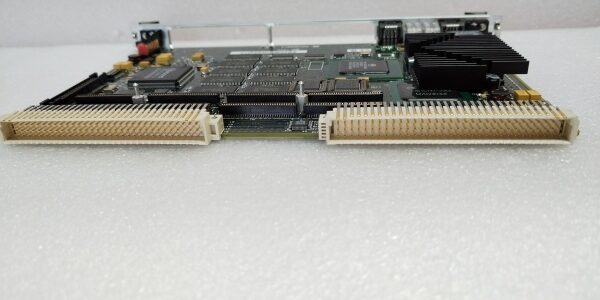
- Product Type: 6U Eurocard VME64x SBC, factory-new or fully tested refurbished hardware with IEEE standard metal ejector latches
- Key Specs: 400MHz MPC7410 PowerPC G4 with entry AltiVec | 512MB ECC SDRAM expandable to 1GB | Dual 10/100BASE-TX Ethernet | Dual 66MHz PMC expansion slots
- Note: OEM manufacturing discontinued; limited factory-new surplus and refurbished inventory available, original 12-month OEM warranty applies to unopened factory-new units.
Key Technical Specifications
- Processor: MPC7410 PowerPC G4 at 400MHz, integrated AltiVec SIMD coprocessor, 100MHz system frontside busManualsLib
- Cache: 32KB L1 Instruction / 32KB L1 Data on-die cache, 2MB dedicated L2 SRAM backside cache
- Memory: 512MB soldered PC100 ECC-protected SDRAM; RAM500 mezzanine extends total capacity to 1GB, single-bit error correction active during all runtime states
- Non-Volatile Storage: 17MB combined boot + application Flash memory; 32KB battery-backed NVRAM + M48T37 RTC for sensor calibration and fault log retention
- VME Bus Controller: Tundra Universe II ASIC supporting VME64x / 2eSST block transfers, maximum 120MB/s burst throughput, auto-detect VME system arbitration logic
- PCI Expansion: Two independent 32/64-bit 66MHz PMC slots, fully compatible with IPMC712 / IPMC761 rear transition I/O assemblies
- Front Panel I/O: Dual isolated 10/100BASE-TX RJ45 Ethernet ports; dual multi-mode RS232/422/485 16550 UART serial channels
- Power Consumption: 13–18W steady full-load draw from standard VME backplane +5V / ±12VDC rails
- Mechanical: 6U VME Eurocard form factor, fanless passive aluminum heat sink, IEEE metal dual ejector latches, single-slot footprint even with dual PMC mezzanines installed
- Operating Temperature: 0°C to +55°C standard cleanroom cabinet operation; conformal coated rugged variant rated -40°C to +70°C
- Compliance Standards: CE, UL, SEMI S2 certified for front-end semiconductor wafer manufacturing equipment
Product Introduction
This enhanced VME SBC acts as a dedicated auxiliary rack controller to offload low-priority telemetry and valve sequencing tasks from flagship master CPUs on Lam TCP9400 and Kiyo etch hardware. It eliminates periodic Modbus polling latency observed on older MVME2432 auxiliary hardware.Dual PMC expansion and dual fast Ethernet ports add redundant communication paths for remote gas and thermal subracks, while basic AltiVec vector logic cuts analog sensor scan cycle time to 0.7ms for consistent background process monitoring.
QA & Testing SOP (Transparency Building)
- Incoming Inspection: Cross-reference serial numbers against OEM vital product data databases to reject counterfeit PCB assemblies; visual scan for cracked traces, swollen electrolytic capacitors, or bent IEEE ejector latches. All jumper pin positions photographed for post-test restoration reference.
- Live Bench Testing: Mount the device to a full VME64x backplane chassis with a Fluke 115 multimeter tracking rail voltage stability; run continuous 24-hour load test executing synthetic auxiliary telemetry workloads matching Lam TCP9400 runtime profiles.
- Electrical Testing: Megger insulation tester verifies all field I/O isolation exceeds 10MΩ; ground loop resistance measured below 0.1Ω to reduce plasma RF induced signal distortion.
- Firmware & Config Backup: Flash validated PPCBug firmware version matching customer’s tool PCS release level; dump full NVRAM calibration tables and store encrypted copies for post-replacement recovery workflows.
- Final QC & Packaging: Re-seat all loose edge connectors, wrap in anti-static foam, affix printed QC tag with test timestamp and measured voltage tolerances before sealed factory ESD bag packaging.
Installation Pitfalls & Guide (Engineer to Engineer)
❗ Firmware Rev Mismatch Risk: PPCBug builds compiled for PCS v6.0 trigger VME64x 2eSST handshake delays. Load PPCBug v1.8 or newer before chassis power-up to avoid 8–15 second communication timeouts with remote node I/O boards.❗ Jumper Mapping Error: J4, J11, J22 control Ethernet link modes and PMC slot enable states. Capture high-resolution photos of jumper positions on the old controller before removal; misconfigured jumpers fully disable one Ethernet port.❗ Rear IPMC Pinout Incompatibility: IPMC761 transition boards use distinct analog signal pin assignments compared to MVME2400-series hardware. Cross-check the OEM datasheet before terminating RTD sensor cables to prevent shorted thermal input circuits.❗ Power Draw Headroom Check: This unit draws 2–5W more power than an MVME2432. Verify the VME chassis +5V supply holds 8A minimum rated output to avoid voltage sag during recipe initialization sequences.❗ Catastrophic ESD Damage Risk: Ungrounded technicians regularly damage the dual Ethernet PHY ICs on this PCB; a certified wrist strap and grounded anti-static mat are mandatory before touching edge connectors or exposed circuit traces.4-Step Replacement Guide:
- Pre-install: Export full auxiliary chamber calibration parameter set via the tool HMI; execute SEMI S2 lockout-tagout to disable RF generators and vent chamber vacuum.
- Removal: Release IEEE ejector latches evenly on both sides to avoid bent P1/P2 backplane pins; place the old unit directly on ESD foam after extraction.
- Install: Align the module parallel to the backplane for even seating, restore jumpers to photographed positions, reattach all IPMC rear signal cables.
- Power-on Test: Apply standby low voltage first, validate PPCBug POST completes without memory errors, run a 30-minute background telemetry cycle to confirm remote node communication stability.
FAQ (Frequently Asked Questions)
Q: Can this unit fully replace an MVME2434 as a primary full-load chamber master?A: Hardware slot form factor matches standard VME racks, but the 400MHz MPC7410 processor lacks sufficient throughput to handle synchronized multi-axis robot + ESC indexer parallel motion workloads. It only qualifies as an auxiliary rack controller; full production master duty requires an MVME2434 or MVME5500 series unit. Full VME address remapping and chamber software tuning are still required for any cross-model swap.Q: Does this unit support hot-swapping while the chamber remains pressurized and RF power active?A: The VME64x backplane includes electrical hot-swap protection, but plasma RF fields generate transient voltage spikes that overwrite battery-backed NVRAM calibration data. Full lockout of RF supplies and complete chamber vacuum venting is required before extraction to avoid permanent loss of remote sensor offset values.Q: What warranty coverage differentiates factory-new surplus hardware from refurbished equivalents?A: Factory-new surplus stock carries the original 12-month OEM industrial warranty covering PCB trace, memory, and flash storage failures. Refurbished variants only offer a 3–6 month limited warranty, which excludes long-term RF noise immunity validation guarantees due to reused electrolytic capacitors with reduced thermal service life.Q: Will removing the existing controller erase stored auxiliary chamber sensor scaling and valve interlock thresholds?A: All secondary process tuning data, remote sensor offsets, and peripheral safety trip limits reside in the board’s battery-backed NVRAM flash bank. Export a full auxiliary parameter backup via the tool HMI before disassembly. If the onboard backup battery has aged during long-term shelf storage, NVRAM data may not persist through full power cycles post-installation.Q: Can this hardware run Lam PCS v8.2+ software built for MVME5500 high-speed gigabit architectures?A: It cannot execute unmodified PCS v8.2+ releases that rely on gigabit Ethernet and higher VME64x DMA throughput. A Wind River VxWorks BSP patch matching the MPC7410 architecture must be applied, and all VME I/O address ranges remapped in the auxiliary rack configuration before production monitoring operation.Q: What expected service window applies to factory-new vs refurbished stock in a 24/7 high-volume fab environment?A: Factory-new units target replacement at 42,000 operating hours, with zero accumulated thermal fatigue on semiconductors. Refurbished variants drop to 35,000 hours; reused flash and memory ICs develop gradual ECC bit-error drift that degrades telemetry stability under continuous cabinet heat and 13.56MHz plasma RF exposure.Q: Is this module cross-compatible with MVME5100 base Scanbe ejector variants without full auxiliary rack reconfiguration?A: Core CPU, memory, and bus registers are fully cross-compatible; only the physical ejector hardware differs. Direct swap requires no software remapping, though minor revalidation of Ethernet link failover logic is recommended post-install to eliminate rare polling timeout events.