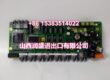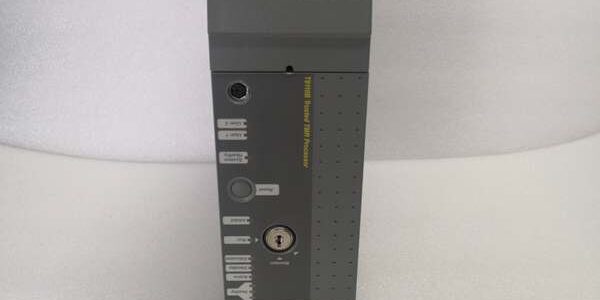
Product Core Brief
- Model: T8110B
- Brand: ICS Triplex (Rockwell Automation)
- Series: Trusted TMR Safety Control Series ⚠️ EOL — limited new surplus stock remaining
- Core Function: Execute triplicated safety logic with 2oo3 hardware voting to run ESD, F&G and BMS safety instrumented systems
- Product Type: Chassis-mount triple modular redundant central processor (CPU) module
- Key Specs: Triple synchronized 32-bit RISC cores | IRIG-B time sync support | Hot-swappable without program reload | Condition: New Original Surplus
Product Introduction
The ICS Triplex acts as the primary safety CPU for Trusted SIS chassis, running three parallel synchronized logic cores with hardware majority voting to eliminate single-point process failure. It pairs with all Trusted series I/O modules including the T8451 digital output card and T8850 output FTA.This unit upgrades the older T8110A with expanded event buffer storage and native IRIG-B 122 signal decoding. OEM reliability testing records a 124,000 hour MTBF at steady 40 °C cabinet operating temperature.
Key Technical Specifications
| Parameter | Value |
|---|---|
| Processing Architecture | Triple Modular Redundant (TMR), 2-out-of-3 hardware voting |
| Processor Hardware | Three synchronized 32-bit RISC cores, ECC error-correcting RAM |
| Max Supported I/O Points | 4096 mixed analog / digital input/output |
| Event Buffer Capacity | 1,000 on-board timestamped SOE events; 4,000 system-wide buffer |
| Time Synchronization | IRIG-B 002 / IRIG-B 122 external clock input |
| Backplane Supply Voltage | Dual redundant 20 VDC to 32 VDC chassis power |
| Fault Switch Latency | <10 ms core failover without process interruption |
| Safety Relays | Dual independent Form C Fault / Fail dry contact outputs |
| Programming Compliance | Full IEC 61131-3, TRISTATION 1131 configuration software |
| Hot-Swap Behavior | Retains loaded application logic; no program re-download required post swap |
| Operating Ambient Temp | -10 °C to +60 °C; storage -25 °C to +70 °C |
| Safety Certification | IEC 61508 SIL 3, TÜV, UL/cUL, CE, IP20 cabinet-only |
| Physical Dimensions | 305 mm H × 30 mm W × 310 mm D; net weight 2.94 kg |
| Self-Diagnostic Coverage | >99% continuous hardware fault detection across all three cores |
Quality Control Process (Engineer’s Perspective)
- Incoming Verification: Cross serial numbers against Rockwell OEM batch logs to filter counterfeit aftermarket units. Visually inspect front panel key lock, LED lenses, and backplane gold edge pins for bending or scratching.
- Live Functional Test: Insert module into a Trusted test chassis with dual redundant 24 VDC Fluke 115 power supplies, load a sample SIS application. Run a 24-hour soak cycle, trigger simulated single-core faults hourly to validate 10 ms failover latency.
- Electrical Parameter Test: Use a 500 V Megger to measure insulation resistance between internal core circuits and chassis ground; pass threshold is >10 MΩ. Verify continuity on both Fault and Fail relay contact paths.
- Firmware & Configuration Verification: Read and record CPU firmware revision via TRISTATION 1131. Photograph front-panel access key state and external IRIG-B port jumper settings for site reference records.
- Final QC & Packaging: Place the full CPU assembly inside a static-dissipative poly bag. Affix a dated QC Pass sticker listing measured insulation resistance and total soak test runtime before palletized storage.
Replacement Pitfall Guide
❗ Firmware Mismatch Risk: firmware v7.0+ cannot hot-swap with chassis running v6.2 or older without full project recompile. Unmatched firmware versions trigger persistent core vote mismatch critical faults.❗ IRIG-B Jumper Misconfiguration Risk: Factory default jumper disables external time sync. Leaving jumpers unmodified in GPS-synchronized sites creates 1 ms timestamp skew that corrupts SOE fault reporting.❗ Backplane Power Redundancy Loss Risk: This CPU requires dual redundant chassis power feeds. Removing one supply rail drops voltage below 20 VDC and forces a controlled safety shutdown of all logic execution.❗ I/O Module Compatibility Miscalculation Risk: The supports all Trusted I/O cards, but older T8400 series analog modules require separate calibration parameter upload after CPU swap.❗ ESD Damage Risk: Exposed backplane edge pins remain unprotected during hot-swap removal. Use a grounded anti-static mat in low-humidity cabinet spaces; static discharge corrupts ECC RAM and generates random core vote errors.Keep these in mind and you’ll cut 90% of rework time.
Compatibility Matrix & Benchmarks
Compatibility Matrix
- T8110A (Legacy TMR CPU) → : Functional Replacement — Chassis slot fit identical, firmware upgrade and IRIG-B jumper reconfiguration required
- T8451 (40-Ch Digital Output Module) → : Native Compatible — Direct backplane communication, no signal adapter hardware needed
- AADvance T8430 Modern CPU → : Incompatible — Different backplane bus architecture, chassis and I/O hardware cannot intermix
Benchmarks
- Full 4096-point mixed I/O logic scan cycle: 120 ms (nominal 24 VDC dual redundant power supply)
- Core failover transition delay: 7.8 ms (simulated single RISC core power fault, OEM bench measurement)
- Continuous power consumption: 38 W average under full 4096 I/O loaded chassis configuration