Customer Value & Operational Benefits
CPU Offloading for Deterministic Response
The main value of the is taking the high-speed math away from the CPU. If you try to count a 50 kHz encoder with standard %I inputs in ladder logic, the CPU scan time dictates your accuracy—you will lose counts. This module catches every edge hardware-wise. It allows the CPU to focus on sequence logic, communications, and HMI updates, while the APU handles the time-critical tallying. This results in a more stable scan time and prevents “Scan Time Overflow” faults in dense logic programs.
Integrated Output Control (Presets)
You don’t need intermediate relays or complex compare logic in the CPU to trigger actions. The has 4 built-in outputs that can be mapped to “Preset” conditions (e.g., “Turn Output 1 ON when Counter 1 Accumulator >= 5000”). This creates a hardware-level response loop. For instance, stopping a conveyor or firing a reject pusher happens at the millisecond the count hits, not whenever the CPU gets around to reading the register. This reduces latency and simplifies the ladder logic required for high-speed packaging or cut-to-length systems.
Flexible Counting Architectures
Depending on the wiring and software config, one can act as four independent simple counters (Type A), two quadrature encoder interfaces (Type B), or a single differential counter measuring the delta between two flow meters (Type C). This versatility means you often only need one slot to handle multiple high-speed tasks that would otherwise require two or three separate cards in other PLC platforms.
Field Engineer’s Notes (From The Trenches)
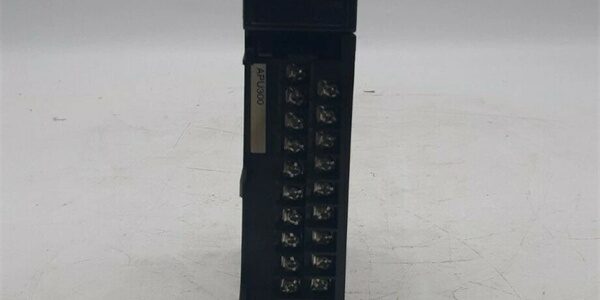
The TSEL Jumper (Terminal Select) on the removable terminal block is the #1 gotcha. If you are wiring 24VDC PNP sensors (10-30V range), that jumper must connect the TSEL pin to the INCOM (common) pin. If it is left open or jumpered incorrectly, the module will not recognize the 24V high-state as a valid logic 1, and you will get zero counts despite good voltage at the terminal.
Also, Shielding. Do not use unsheilded pair for encoder cables running across VFD trays. The is fast, so it sees noise as counts. Use twisted pair, shield drained to the 90-30 rack ground at one end only (within 6 inches of the module). I’ve seen sites where the count drifted +5% at 100 kHz because they used generic alarm cable; switching to Belden 8761 (shielded twisted pair) fixed it instantly.
Lastly, Fuse. The 3A pico fuse protects all 4 outputs. If Output 1 shorts, all 4 stop working. Check the fuse with a meter if outputs are dead but the “Board OK” LED is green.
Real-World Applications
- Turbine Flow Metering (Liquid/Gas): The (Configured as Type A) counts the K-factor pulses from a turbine meter (e.g., 1000 pulses per gallon). The PLC reads the accumulated %R register every second to calculate GPM. The APU handles the 50-100 kHz pulse train reliably, which the CPU %I scan would miss during high processor load.
- Cut-to-Length (Converting/Wood): Configured as Type B (Quadrature), the module tracks a linear encoder on a flying shear. Output 1 is set to “Preset = 2400″ (inches). When the accumulator hits 2400, Output 1 goes high, triggering the shear solenoid. The register resets (or rolls over), and the next 2400 inch cycle begins immediately, maintaining +/- 0.05” accuracy at 500 FPM line speed.
High-Frequency Troubleshooting FAQ
The module is powered and passed internal diagnostics, but the configuration data in the PLC program (e.g., %AI registers defining mode, presets, input voltage) does not match what the module expects, or the config block is missing. Open your programming software (Proficy ME / LM90), go to the Hardware configuration for the slot, and ensure the “High Speed Counter” tab is filled out (Mode A/B/C, Input Voltage 5/24V, etc.) and downloaded to the PLC. A power cycle of the rack usually forces a re-transfer of the config.
Not directly in a Series 90-30 rack. The IC694APU300 is for the RX3i (PACSystems) platform and has a different backplane edge connector (Universal Backplane vs. 90-30 Bus). To replace an , you must use another (any revision -A through -K). The -K revision is the most recent and recommended for 90-30 systems.
My counter counts, but the value is double the actual (Quadrature Mode)?
You likely have the A/B inputs wired to A/A- (both positive legs) instead of A/A- and B/B- (differential). In Quadrature (Type B), if you only wire A to Input 1 and B to Input 2 (both referenced to common), and leave A-/B- floating, the module may still count, but it sees 2 edges per cycle (both rising and falling of the single-ended signal) instead of 4 edges (A rise, A fall, B rise, B fall). Ensure you are using differential wiring (A to A, /A to A-, etc.) if your encoder supports it, or adjust the “X1 / X2 / X4” resolution setting in the config if using single-ended.
No. The Series 90-30 platform does not support hot-swapping of I/O or option modules. You must power down the 90-30 rack before removing or inserting the . Failure to do so can cause backplane bus contention or damage the module’s edge connector interface.
Please note: The listed price is not the actual final price. It is for reference only and is subject to appropriate negotiation based on current market conditions, quantity, and availability.