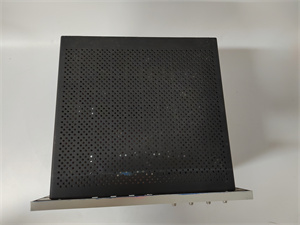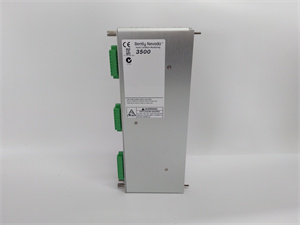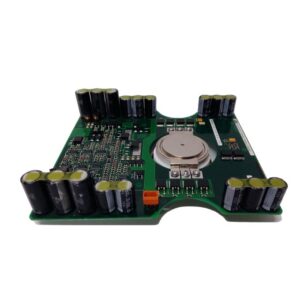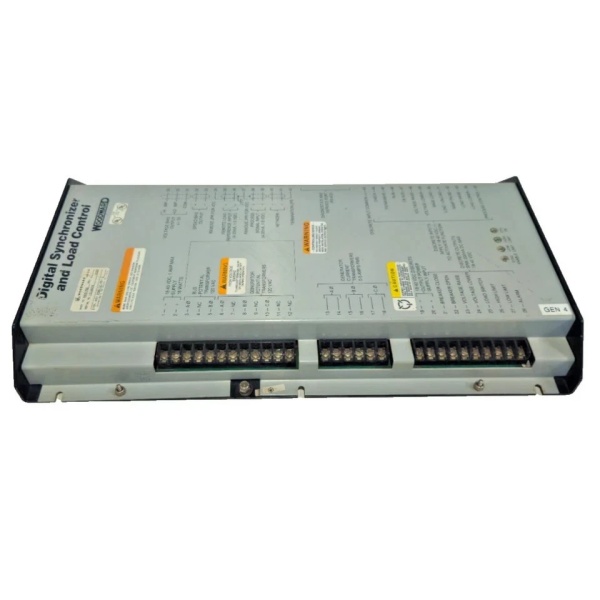
Description
Hard Numbers: Technical Specifications
(Note: The following specifications are compiled from typical 9905-797 operational parameters. Please consult the official Woodward documentation for exact project engineering.)
- Part Number: 9905-797
- Function: Digital Synchronizer, Load Control, Var/PF Control
- Input Voltage: 24 Vdc (Typical), with 900 Vdc transient protection
- Operating Current: Maximum 12 A (with all outputs energized)
- Speed Bias Output: 3.0 Vdc
- Analog Inputs: Multiple channels with 33 kΩ input impedance
- Display: Integrated 24-character LED status display
- Communications: Local Operating Network (LON) for multi-unit load distribution
- Operating Temperature: -40°C to +70°C (-40°F to 158°F)
- Storage Temperature: -55°C to +105°C (-67°F to 221°F)
- Enclosure Type: Durable Sheet Metal
- Physical Dimensions: H 461 mm × W 265 mm × D 59 mm (approx. 18.1″ × 10.4″ × 2.3″)
- Weight: 3.1 kg (6 lbs 14 oz) approx.
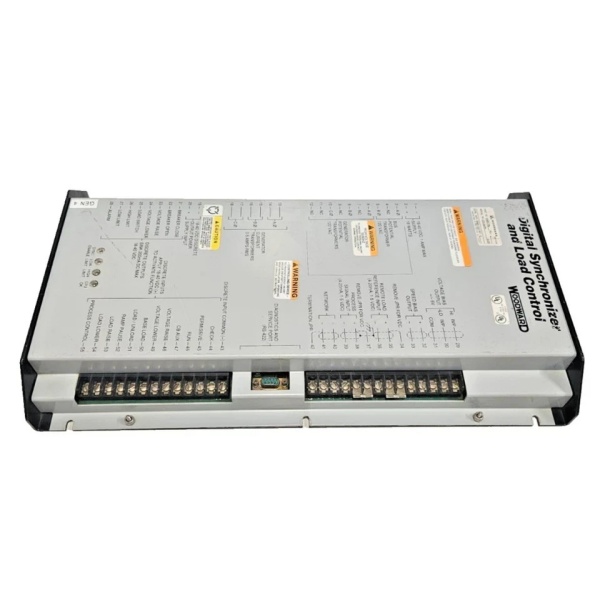
Woodward 9905-797
The Real-World Problem It Solves
Imagine you are running a microgrid on an offshore oil rig or bringing a massive ship’s generator online. You cannot just flip a switch and connect a spinning generator to the main busbar—the voltages must match, the frequencies must align perfectly, and the phases must be synchronized down to a hair’s breadth. If you mess this up, the result is a blackout, blown fuses, or severe mechanical damage to the alternator.
The Woodward 9905-797 is the “air traffic controller” that handles this delicate dance. It constantly monitors the generator’s RPM, voltage, and phase angle against the busbar. Instead of relying on slow, imprecise mechanical relays, this digital module calculates the exact millisecond to close the breaker (automatic synchronization). Furthermore, once online, it ensures that your generator pulls its fair share of the load. If you have four generators running in parallel, the 9905-797 communicates via the LON network to make sure no single engine is sweating while another is idling, preventing costly overloading and ensuring fuel efficiency .
Where you’ll typically find it:
- Prime Power Generation: Utility-grade power plants requiring multiple large generators to sync flawlessly to the national grid .
- Marine & Offshore: On ocean-going vessels and oil rigs where power stability is a matter of life, death, and millions of dollars in equipment .
- Industrial Microgrids: Factories or data centers with multiple backup gensets that need to share the load dynamically without tripping offline .
Hardware Architecture & Under-the-Hood Logic
Unlike simple automatic voltage regulators (AVRs) that only look at electrical output, the 9905-797 is a comprehensive engine and alternator manager.
- High-Speed DSP Processing: At its core, a high-speed digital signal processor samples the incoming three-phase voltage and current waveforms hundreds of times per second. It uses Fourier analysis to instantly calculate RMS voltage, frequency, phase angle, and power factor .
- Phase-Locked Loop (PLL) Synchronization: The module uses a Phase-Locked Loop algorithm to gently nudge the generator’s speed (via the speed bias output to the engine governor) until the generator frequency perfectly matches the busbar. It then waits for the phase angles to align and fires the breaker closure command at the exact zero-crossing point to ensure a “bumpless” transition .
- Cross-Unit LON Communication: In a multi-generator setup, each 9905-797 module acts as a node on a Local Operating Network (LON). They broadcast their current load status to each other. If the total factory demand suddenly spikes, the modules autonomously calculate the new load setpoints and adjust their respective generators’ fuel racks to distribute the extra load proportionally .
- Closed-Loop VAR/PF Control: The module continuously compares the generator’s reactive power output against the desired setpoint. If the power factor drifts (e.g., due to a change in inductive motor loads), the 9905-797 adjusts the excitation system to bring the VARs back into line, maintaining grid stability .
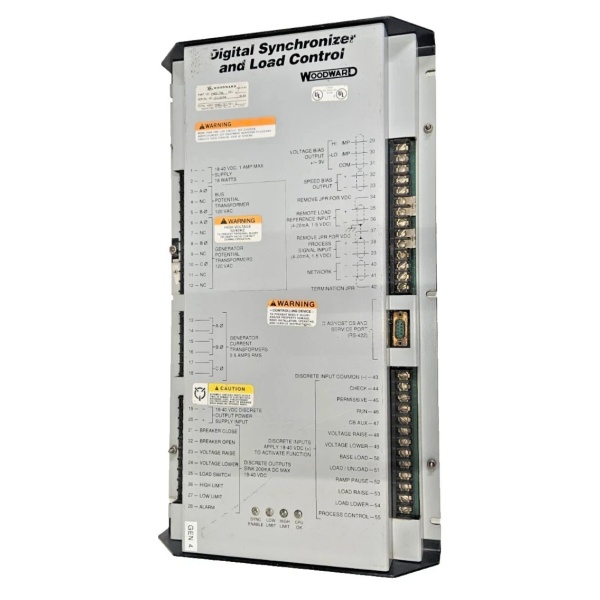
Woodward 9905-797
Field Service Pitfalls: What Rookies Get Wrong
The “Phasing” Reversal (The 180° Catastrophe)
When wiring the PT (Potential Transformer) and CT (Current Transformer) inputs to the 9905-797, rookies often treat it like a standard voltmeter, ignoring the polarity marks (H1/H2, X1/X2).
- The Glitch: If you reverse the polarity on just one phase of the CT input, the module will calculate the total power as negative. When you try to parallel the generator, the 9905-797 will think the machine is absorbing power instead of producing it. It will then drive the governor to maximum speed, trying to “push” power into the grid, often resulting in an immediate overspeed trip or a violently out-of-phase breaker closure .
- Field Rule: Always perform a “polarity check” with a handheld phase sequence meter before energizing the 9905-797. Tag your CT secondary wires rigorously (e.g.,
A-phase Non-Polar/Polar) and double-check the terminal block connections against the wiring diagram. Never assume polarity is correct “because it was working before.”
Improper CT Burden & Sizing (The Saturation Trap)
Rookies often reuse old Current Transformers (CTs) from decommissioned panels or undersize the wiring to the 9905-797 to save a few bucks on copper.
- The Danger: The 9905-797 relies on accurate current sensing for its VAR/PF control. If the CTs are undersized for the generator’s full load current, or if the resistance of the interconnecting wire (burden) is too high, the CT core will saturate during peak loads. The waveform distorts, and the 9905-797 receives garbage data .
- Quick Fix: Calculate the total burden (resistance of the wire + the 9905-797’s 33 kΩ input impedance) before installation. Ensure your CT secondary current (usually 5A) can drive this burden without exceeding the CT’s rated VA capacity. If in doubt, use larger gauge wire (e.g., 10 AWG instead of 14 AWG) for CT runs longer than 50 feet.
Ignoring the “Dead Bus” Logic Jumper Settings
The 9905-797 can be configured to either wait for a synchronization command or automatically close the breaker if it senses the busbar is dead (no voltage).
- The Consequence: Rookies often leave the “Dead Bus” autoclose feature enabled during commissioning. If a utility worker accidentally cuts power to the busbar for maintenance, or if a fuse blows on the bus PT, the 9905-797 will instantly detect 0 volts, assume it’s safe, and slam the generator breaker closed—potentially back-feeding a deadly live line to linemen or causing a massive explosion if the utility power suddenly returns out of phase .
- Field Rule: During the initial startup and wiring verification of any 9905-797, physically disable the Dead Bus autoclose jumper. Only enable it after the synchroscope has been observed working correctly and all protective relaying (under-voltage, reverse power) has been tested.
Commercial Availability & Pricing Note
Please note: The listed price is for reference only and is not binding. Final pricing and terms are subject to negotiation based on current market conditions and availability.