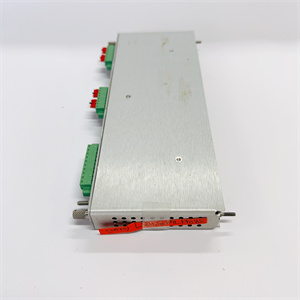
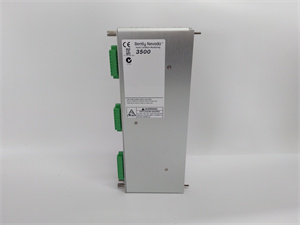
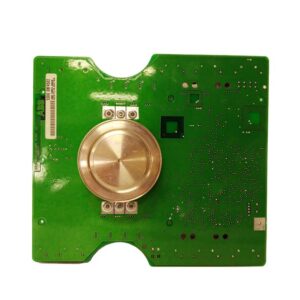
Description
Hard-Numbers: Technical Specifications
- Part Number: 9905-792
- Power Supply: 18 to 40 VDC (Nominal 24VDC), drawing less than 15 Watts
- Speed Sensing Inputs: High-level MPU (1-30 VAC) or 120 VAC line frequency (50/60 Hz)
- Speed Range: 500 to 15,000 RPM (scalable via DIP switches and software)
- Analog Outputs: Configurable 4-20mA or 0-200mA (for driving electro-hydraulic actuators)
- Discrete Outputs: 8 Relay Drivers (sourcing 24VDC) for alarms, trip, and status indication
- Communications: RS-232 / RS-485 (Modbus RTU compatible for gateway integration)
- Operating Temperature: -40°C to +70°C (-40°F to 158°F)
- Mounting: Panel Mount (via standard cutout) or DIN rail adapter
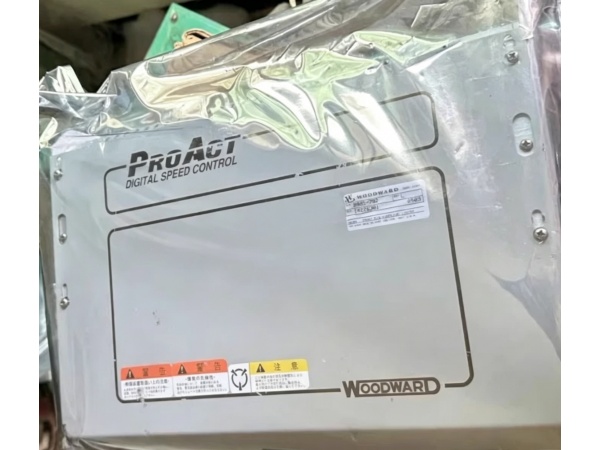
Woodward 9905-792
The Real-World Problem It Solves
Mechanical governors wear out, introduce deadband, and struggle to maintain tight frequency during abrupt load swings. The 9905-792 digitizes the prime mover’s speed control loop, allowing for aggressive PID tuning and bumpless auto/manual transfers. It effectively eliminates “hunting” and provides the deterministic logic required to safely sequence large engines or turbines from crank to full load.
Where you’ll typically find it:
- In the main control console of a multi-unit generator paralleling switchgear, acting as the master speed/load regulator.
- Bolted to the back panel of a skid-mounted gas compressor station, controlling a Waukesha or Caterpillar driver.
- Retrofitted into aging steam turbine panels to replace failed analog 505 controllers, restoring precise RPM control to the valve actuators.
It replaces mechanical lag with mathematical precision.
Hardware Architecture & Under-the-Hood Logic
This unit is a dedicated single-board computer running a hard real-time kernel. It is optimized specifically for motor/speed control algorithms rather than general logic, meaning it executes its PID loops faster than a standard PLC.
- Frequency Tracking: The module simultaneously monitors the MPU signal and, if configured, the AC line frequency. It uses a phase-locked loop (PLL) algorithm to derive an extremely stable RPM value, filtering out the electrical noise common in generator windings.
- Error Calculation: The measured speed is compared against the active setpoint (Local, Remote, or Droop-adjusted). The difference generates a speed error value.
- PID Processing: A high-speed PID block processes the error. The integral and derivative terms are calculated using the module’s internal clock, ensuring consistent control regardless of processor loading.
- Output Generation: The calculated control output is converted to an analog current (4-20mA or 0-200mA) and driven to the actuator. Simultaneously, the discrete relays are evaluated for alarm conditions (Overspeed, Underspeed, Shutdown).
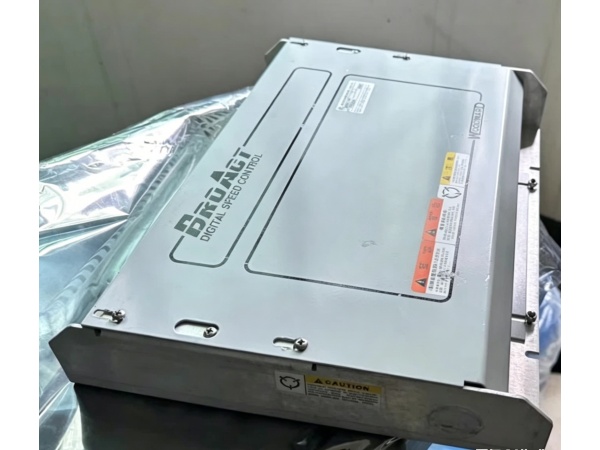
Woodward 9905-792
Field Service Pitfalls: What Rookies Get Wrong
Ground Loops Caused by Improper MPU Shield Termination
A rookie will land the Magnetic Pickup (MPU) wires, connect the shield to the controller’s ground terminal, and wonder why the speed reading fluctuates wildly or causes intermittent shutdowns. The MPU acts as an antenna; if the shield is grounded at both the sensor end and the controller end, it creates a ground loop that injects noise directly into the speed sense circuit.
- Field Rule: Ground the MPU shield at the source (the sensor housing). Leave the shield disconnected at the 9905-792 terminal block. Better yet, use a shielded twisted pair and ground the shield to the engine block within 2 inches of the sensor.
Overlooking the “Line Frequency” DIP Switch Settings
When using the 120VAC line frequency input for speed sensing (common in isochronous generator applications), techs often forget to set the internal DIP switches to match the grid frequency. If the switches are set to 50Hz but the system is operating on a 60Hz bus, the module will calculate the speed incorrectly, leading to severe droop or an inability to synchronize.
- Field Rule: Pop the front cover. Locate the DIP switch bank. Set Switch 1 to match your regional grid frequency (50Hz or 60Hz). Verify the setting by measuring the AC frequency at the terminals with a true-RMS meter before closing the breaker.
Configuring the Actuator Output for the Wrong Load
The 9905-792 can output either 4-20mA (for modern current-to-pneumatic transducers or proportional valves) or 0-200mA (for older Woodward electric actuators). Connecting a 4-20mA valve to a 0-200mA output will instantly fry the valve’s coil; configuring it for 4-20mA when driving an old UG-8 actuator will result in zero movement because the actuator requires the higher current to overcome its internal spring tension.
- Field Rule: Identify the physical actuator tag number and look up its datasheet. Jumper the 9905-792’s output configuration terminals (usually TB-2) to match the actuator’s native input range. When in doubt, measure the loop current with a clamp meter while commanding 50% fuel—it should read exactly 12mA for 4-20mA devices.
Commercial Availability & Pricing Note
Please note: The listed price is for reference only and is not binding. Final pricing and terms are subject to negotiation based on current market conditions and availability.