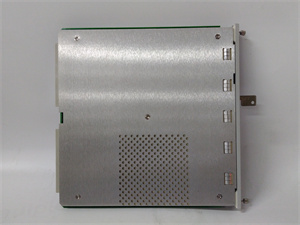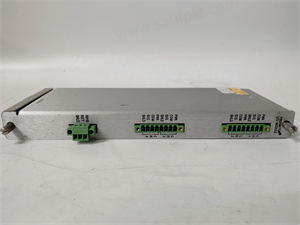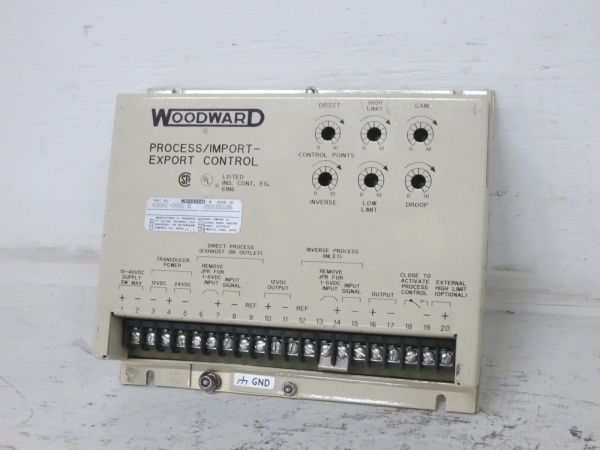
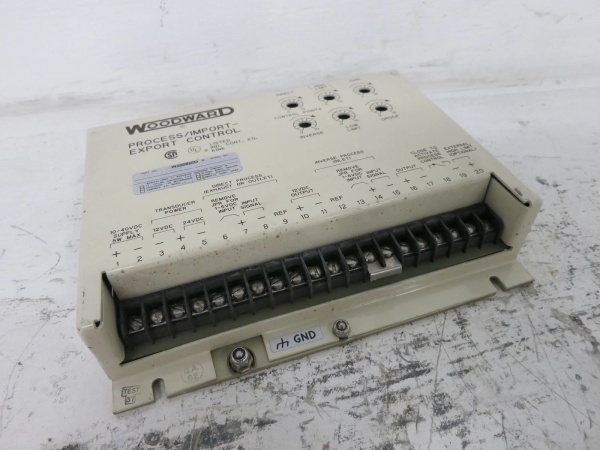
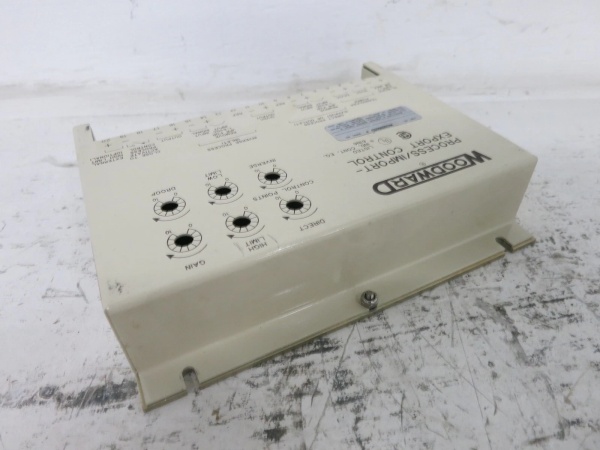
Description
Key Technical Specifications
-
Model Number: 9905-090
-
Manufacturer: Woodward
-
Supply Voltage: 12, 24, or 32 VDC (10 V min – 45 V max)
-
Sensor Feed: 50 mA @ 12 or 24 VDC for external process transmitters
-
Output Options: Low-signal select, load control, speed reference (DIP selectable)
-
Isolation: 500 V input-to-output, opto-coupled
-
Operating Temperature: –40 °C to +71 °C
-
Dimensions: 8.5″ H × 2″ W × 7″ D
-
Connectors: Pluggable 6-position terminal strip (line, load, sensor, common)
-
Accuracy: ±0.5 % of span over temperature
-
Update Rate: 10 ms (analog output follows input in <20 ms)

Woodward 9905-090
Field Application & Problem Solved
Cogeneration sites live or die on import/export control. If the plant feeds too much into the utility you trip the utility relay; suck too much and you pay demand charges. The 9905-090 sits between the utility meter and the Woodward 2301/505 speed control and biases the speed reference so the generator holds a precise kW set-point. I usually mount it in the relay panel, land the utility CT/PT signals on the input terminals, and take the 0–5 V bias output into the 2301A “AUX INPUT.” One rotary switch sets dead-band (0.5–5 %) and another sets gain (0–20 %). Result: the turbine drifts ±1 kW instead of ±50 kW, and the utility never sees a swing big enough to bill demand. You’ll find this card on landfill gas gensets, small steam turbines, and any island-mode system that parallells with the grid.
Cogeneration sites live or die on import/export control. If the plant feeds too much into the utility you trip the utility relay; suck too much and you pay demand charges. The 9905-090 sits between the utility meter and the Woodward 2301/505 speed control and biases the speed reference so the generator holds a precise kW set-point. I usually mount it in the relay panel, land the utility CT/PT signals on the input terminals, and take the 0–5 V bias output into the 2301A “AUX INPUT.” One rotary switch sets dead-band (0.5–5 %) and another sets gain (0–20 %). Result: the turbine drifts ±1 kW instead of ±50 kW, and the utility never sees a swing big enough to bill demand. You’ll find this card on landfill gas gensets, small steam turbines, and any island-mode system that parallells with the grid.
Installation & Maintenance Pitfalls (Expert Tips)
Dead-Band Too Tight = Hunting
Rookies set 0.2 % dead-band thinking tighter is better. The loop oscillates and the actuator wears out. Start at 1 % and open up until the bias line sits flat for ten seconds—then lock it.
Rookies set 0.2 % dead-band thinking tighter is better. The loop oscillates and the actuator wears out. Start at 1 % and open up until the bias line sits flat for ten seconds—then lock it.
Use Shielded Twisted Pair for CT/PT
The 50 mA sensor feed is low-level; run unshielded zip cord and you’ll pick up 60 Hz hash that looks like 5 kW error. I run #18 shielded, ground one end only, and keep it out of the 480 V bucket.
The 50 mA sensor feed is low-level; run unshielded zip cord and you’ll pick up 60 Hz hash that looks like 5 kW error. I run #18 shielded, ground one end only, and keep it out of the 480 V bucket.
Verify Polarity Before You Close the Breaker
If the CT polarity is backwards the control thinks import is export and drives the valve the wrong way. Momentarily bump the generator to 5 kW import—bias voltage should go positive; if it goes negative, flip the CT.
If the CT polarity is backwards the control thinks import is export and drives the valve the wrong way. Momentarily bump the generator to 5 kW import—bias voltage should go positive; if it goes negative, flip the CT.
Check the DIP Switches After Every Firmware Swap
Woodward 505 downloads reset the aux I/O map. If the mini-switch is still set for “low-signal select” but the software now expects “load bias” you’ll chase phantom offsets for hours.
Woodward 505 downloads reset the aux I/O map. If the mini-switch is still set for “low-signal select” but the software now expects “load bias” you’ll chase phantom offsets for hours.
Woodward 9905-090
Technical Deep Dive & Overview
The 9905-090 is an analog summing/selector card built around a low-drift op-amp and an opto-isolated output stage. Two inputs (process and load) feed precision resistors; the DIP array chooses low-signal select, high-signal select, or difference. The winning signal is scaled 0–5 V and sent to the speed control’s auxiliary input. A separate 50 mA current source powers loop-powered transducers so you don’t need an external supply. The whole loop updates every 10 ms—fast enough to catch step changes in load but slow enough to ignore engine firing noise. No pots, no firmware—just set the switches, torque the terminals, and walk away.
The 9905-090 is an analog summing/selector card built around a low-drift op-amp and an opto-isolated output stage. Two inputs (process and load) feed precision resistors; the DIP array chooses low-signal select, high-signal select, or difference. The winning signal is scaled 0–5 V and sent to the speed control’s auxiliary input. A separate 50 mA current source powers loop-powered transducers so you don’t need an external supply. The whole loop updates every 10 ms—fast enough to catch step changes in load but slow enough to ignore engine firing noise. No pots, no firmware—just set the switches, torque the terminals, and walk away.