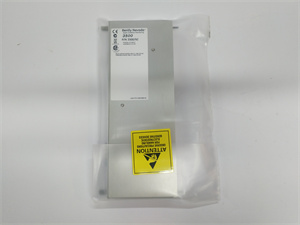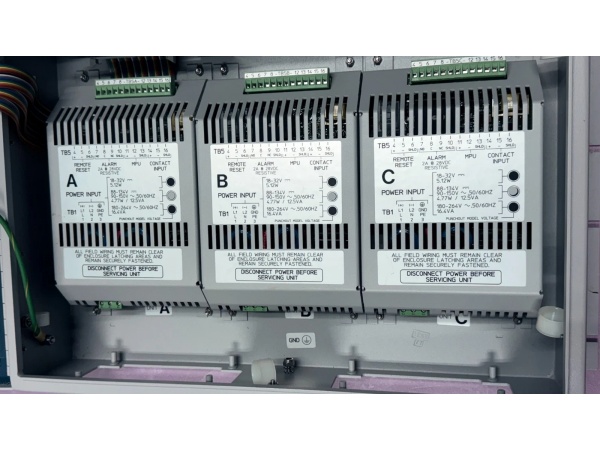
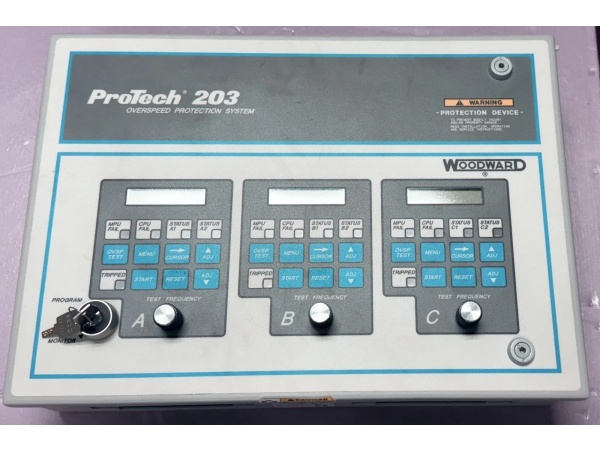
Description
Key Technical Specifications
-
Model Number: 9905-004
-
Manufacturer: Woodward
-
Supply Voltage: 20-40 VDC (low-volt); 88-131 VAC or 90-150 VDC (high-volt) selectable
-
Actuator Output: 0-200 mA into 40 Ω max, forward-acting (increasing current = increasing speed)
-
Speed Reference Input: 1-5 VDC (or 4-20 mA via 250 Ω jumper)
-
MPU Input: 1-30 V p-p, 1 kHz–25 kHz, 0.010–0.040 in. air-gap
-
Load Sharing Input: 0-6 VDC from 5 A CT secondary, gain trim on board
-
Droop Range: 0-10 % via 20-turn pot; isochronous when pot fully CCW
-
Operating Temperature: –40 °C to +85 °C
-
Power Consumption: 8 W typical, 15 W max
-
Isolation: 500 V input-to-output, opto-coupled speed share line
-
Mounting: 8.5″ × 2″ Euro-card, slides in 2301A chassis or DIN clips

Woodward 8200-203
Field Application & Problem Solved
Small gas turbines driving compressors or pumps need rock-solid speed—drift 50 RPM and you trip on surge or vibration. The 9905-004 is the forward-acting heart of the 2301A system: 0 mA at idle, 200 mA at full speed, driving a Woodward PG-PL actuator on the fuel valve. I install it on 3 MW gas-compressor sets in pipeline stations where the unit parallels with the grid or runs island mode. Load-sharing input from a 5 A CT lets the turbine carry base-load while the utility handles swings; droop pot sets 4-5 % so the unit doesn’t fight the grid. One card replaces the mechanical governor, the droop linkage, and a rack of relays. Commissioning is straightforward: set droop, dial null at 0 mA, bump speed until the synchroscope stops drifting. The pipeline gets stable discharge pressure and never babysits the throttle again.
Small gas turbines driving compressors or pumps need rock-solid speed—drift 50 RPM and you trip on surge or vibration. The 9905-004 is the forward-acting heart of the 2301A system: 0 mA at idle, 200 mA at full speed, driving a Woodward PG-PL actuator on the fuel valve. I install it on 3 MW gas-compressor sets in pipeline stations where the unit parallels with the grid or runs island mode. Load-sharing input from a 5 A CT lets the turbine carry base-load while the utility handles swings; droop pot sets 4-5 % so the unit doesn’t fight the grid. One card replaces the mechanical governor, the droop linkage, and a rack of relays. Commissioning is straightforward: set droop, dial null at 0 mA, bump speed until the synchroscope stops drifting. The pipeline gets stable discharge pressure and never babysits the throttle again.
Installation & Maintenance Pitfalls (Expert Tips)
MPU Air-Gap is Critical
Gap over 0.040″ and the card loses the signal—valve snaps shut and you trip on underspeed. Gap under 0.010″ and the pickup grinds the gear. I set 0.025″ cold, check again hot; thermal growth closes it 0.003″.
Gap over 0.040″ and the card loses the signal—valve snaps shut and you trip on underspeed. Gap under 0.010″ and the pickup grinds the gear. I set 0.025″ cold, check again hot; thermal growth closes it 0.003″.
Droop Pot Drifts Under Vibration
The 20-turn pot loosens in 500 hours. After setting 4 % droop, lock it with nail polish or thread-lock. I’ve seen units drop 200 kW because the pot walked to 8 % droop overnight.
The 20-turn pot loosens in 500 hours. After setting 4 % droop, lock it with nail polish or thread-lock. I’ve seen units drop 200 kW because the pot walked to 8 % droop overnight.
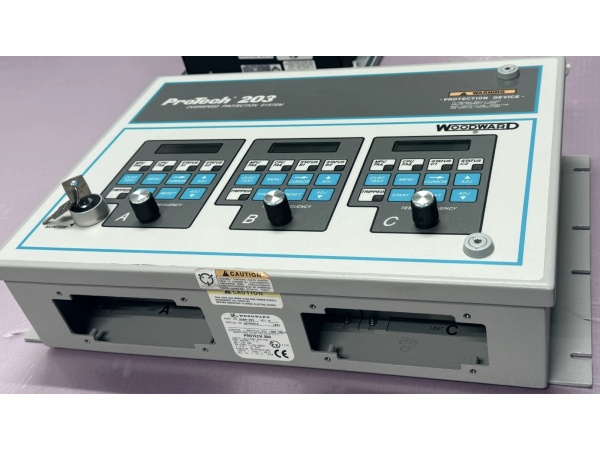
Woodward 8200-203
Current Output Needs 40 Ω—Exactly
Actuator coil is 38 Ω cold, 42 Ω hot—perfect. Parallel two actuators and impedance drops to 20 Ω; the card current-limits at 220 mA and speed hunts ±5 Hz. Use separate cards or add series resistance.
Actuator coil is 38 Ω cold, 42 Ω hot—perfect. Parallel two actuators and impedance drops to 20 Ω; the card current-limits at 220 mA and speed hunts ±5 Hz. Use separate cards or add series resistance.
Verify Speed Reference Polarity
Reverse the 1-5 V wires and the valve drives shut when you ask for 100 %. Bump demand to 10 %—actuator should extend (current rise). If it retracts, swap wires at the terminal strip, not at the DCS, to keep the loop intact.
Reverse the 1-5 V wires and the valve drives shut when you ask for 100 %. Bump demand to 10 %—actuator should extend (current rise). If it retracts, swap wires at the terminal strip, not at the DCS, to keep the loop intact.
Technical Deep Dive & Overview
The 9905-004 is an analog speed/load control on a single Euro-card. A magnetic-pickup zero-cross detector feeds a phase-locked loop; the loop compares shaft frequency to an internal 60 Hz crystal and generates a 0-200 mA error signal. Load-sharing current from the generator CT converts to 0-6 V, sums at the PID junction, and droops via front-panel pot. An on-board 5 V reference feeds the speed-set pot; external 1-5 V or 4-20 mA can override via jumper. Output is current-limited and short-circuit proof; survives reverse battery and 500 V transients. No microprocessor—op-amps and comparators only—boots in 50 ms, never needs firmware.
The 9905-004 is an analog speed/load control on a single Euro-card. A magnetic-pickup zero-cross detector feeds a phase-locked loop; the loop compares shaft frequency to an internal 60 Hz crystal and generates a 0-200 mA error signal. Load-sharing current from the generator CT converts to 0-6 V, sums at the PID junction, and droops via front-panel pot. An on-board 5 V reference feeds the speed-set pot; external 1-5 V or 4-20 mA can override via jumper. Output is current-limited and short-circuit proof; survives reverse battery and 500 V transients. No microprocessor—op-amps and comparators only—boots in 50 ms, never needs firmware.