Description
Hard-Numbers: Technical Specifications
- Part Number: 8440-2165
- Product Code: SPM-D2-11
- Power Supply: 12/24 VDC (Operating Range: 9.5–32 VDC), Max consumption < 8W
- User Interface: Two-line LCD display for operational values, alarms, and status
- Voltage Sensing: Generator & Bus (Two-phase true RMS, Class I accuracy)
- Voltage Input Ranges: 63/110 VAC or 230/400 VAC (Max surge up to 2.5-4.0 kV depending on variant)
- CT Input: Standard …/5 A for load measurement
- Analog I/O: Configurable analog inputs (0/4–20 mA); Analog outputs for Governor (±10V/±20mA) and AVR (±10V/±20mA) bias
- Discrete I/O: Multiple discrete inputs (12/24 VDC) and relay driver outputs
- Communication Ports: CANopen, RS-485, USB (for Toolkit PC configuration)
- Synchronization Modes: Phase match (zero phase diff), slip frequency, and voltage matching
- Mounting Style: Panel Mount
- Environmental Rating: IP66 (front face), Operating Temperature -20°C to +70°C
- Protection Functions: Over/under voltage, over/under frequency, overload, reverse current, soft unloading
WOODWARD 8200-226
The Real-World Problem It Solves
Manually synchronizing a generator with a live busbar or another running gen-set is a high-stress, high-risk task. If the phases don’t align perfectly or the frequencies drift, closing the breaker can cause massive mechanical stress, reverse power flow, or trip the entire power plant. The Woodward 8440-2165 acts as an autonomous “marriage counselor” for generators. It continuously compares the incoming generator’s voltage, frequency, and phase angle against the target bus, sending precise “raise/lower” bias signals to the engine governor and AVR until the conditions are perfect for a bumpless connection.
Where you’ll typically find it:
- Mounted in the control panel of a 500kW diesel generator at a data center, ensuring it picks up the load smoothly during a utility power failure.
- Managing the complex dance of multiple gas generators at a remote mining camp, balancing both kW (real power) and kVAR (reactive power) to prevent any single unit from being overloaded.
- Retrofitted into older power stations to replace obsolete mechanical synchronoscopes, adding USB connectivity and harmonic-resistant True RMS sensing.
Hardware Architecture & Under-the-Hood Logic
The 8440-2165 is a dedicated digital signal processor optimized for the high-speed math required to track AC waveforms and control heavy rotating machinery.
- True RMS Microprocessor Core: Unlike cheaper units that sample peak voltage (and get confused by harmonic distortion from modern VFDs), the 8440-2165 uses Class I accuracy True RMS (Root Mean Square) calculations. It continuously analyzes the sine waves of both the generator and the bus to determine the exact phase angle difference and slip frequency.
- Closed-Loop Governor & AVR Biasing: The module doesn’t just flip a breaker; it actively steers the engine. By outputting analog bias signals (or PWM/raise-lower pulses), it nudges the Woodward governor and Automatic Voltage Regulator (AVR) until the generator frequency is slightly higher than the bus (for islanding) or perfectly matched (for grid-tie), and the voltages are equalized.
- Dual Analog Load Share Bus: Once synchronized, the SPM-D2-11 communicates with other Woodward load share modules via two dedicated analog lines (typically 4-20mA). This allows the gensets to proportionally share the total facility load, automatically adjusting engine throttle and excitation as large motors start and stop.
- USB-Configurable Architecture: Gone are the days of soldering jumpers or decoding DIP switches. Technicians can plug a standard USB cable into the front of the 8440-2165 and use Woodward’s Toolkit software to set parameters, view real-time trends, and update firmware.
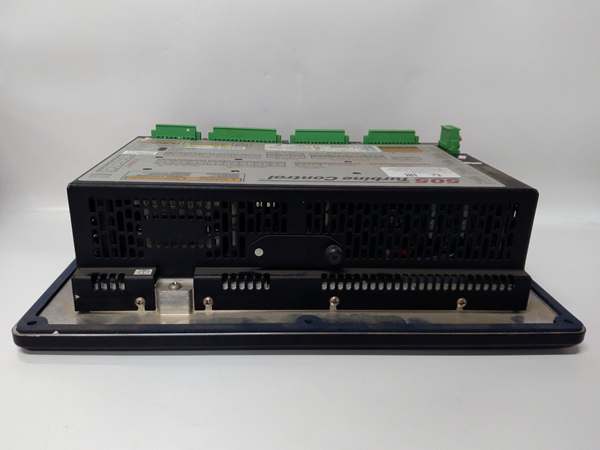
WOODWARD 8200-226
Field Service Pitfalls: What Rookies Get Wrong
The “Reverse Power Trip” Caused by Incorrect CT Polarity
A technician installs a new 8440-2165 and performs a successful sync. However, as soon as the generator takes on a small load, the breaker trips on “Reverse Power.”
- Field Rule: Current Transformer (CT) polarity is absolute. If the CTs feeding the 8440-2165 are wired backward (S1 and S2 swapped), the controller thinks the generator is exporting negative kW, which triggers a reverse power fault to protect the engine from motoring. Always verify CT polarity by briefly loading the generator and checking the kW reading on the 8440-2165 display before closing the main breaker.
“Hunting” Due to Aggressive PID Settings on the Governor
After installing the 8440-2165, the generator syncs perfectly, but once loaded, the RPM and kW output oscillate wildly (hunt), causing the voltage to fluctuate.
- Field Rule: The -11 is only half the equation; it relies on the engine governor’s response. If the synchronizer is constantly adjusting the speed bias but the governor is tuned too tightly (high gain), the system will fight itself. When commissioning, set the 8440-2165’s output ramp rates to a conservative (slower) setting, and ensure the governor’s PID loops are tuned for stable, slightly damped responses rather than aggressive snapping.
Commercial Availability & Pricing Note
Please note: The listed price is for reference only and is not binding. Final pricing and terms are subject to negotiation based on current market conditions and availability.