Description
Field-Tested SEO Titles (Select One)
- WOODWARD 8404-2037 | UG25 Actuator Mixing Valve for Engine Governors
- Woodward 8404-2037 | UG25 Fuel-Air Ratio Control Valve
- WOODWARD 8404-2037 | UG25 Actuator Mixing Valve for Marine & Industrial Engines
- Woodward 8404-2037 | UG25 Servo Actuator for Turbine Control
- WOODWARD 8404-2037 | UG25 Actuator Mixing Valve for Generator Sets
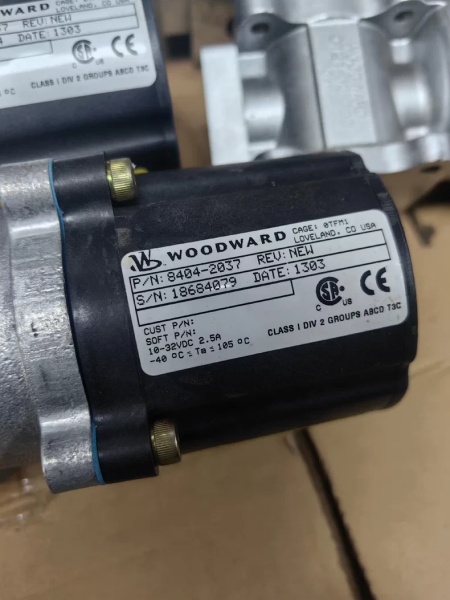
WOODWARD 8404-2037
Component Snapshot At-a-Glance
- Model: 8404-2037
- Manufacturer: Woodward
- Product Series: UG25 (Universal Governor)
- Hardware Type: Actuator Mixing Valve / Servo Actuator
- Key Feature: High-precision positioning for accurate fuel-air ratio control.
- Primary Field Use: Regulating fuel or air-fuel mixture flow in engine governing systems and marine propulsion.
Hard-Numbers: Technical Specifications
- Part Number: 8404-2037
- Rated Voltage: 24 VDC (typical operating range 18-32 VDC)
- Control Signal: 4–20 mA analog position control
- Power Consumption: Approx. 40–60 W (peak transient < 3.5 A at 18 V)
- Operating Temperature: –20°C to +70°C (–4°F to 158°F)
- Response Time: Approx. 50–100 ms (full stroke)
- Enclosure Rating: Industrial grade (IP56 dust and water-resistant)
- Mounting: Direct flange coupling with M8 hardware
- Physical Dimensions: Approx. 280 × 180 × 200 mm (L×W×H)
- Unit Weight: Approx. 8–12 kg (17-26 lbs)
The Real-World Problem It Solves
Getting an old diesel or gas engine to maintain a steady RPM under a swinging load is like herding cats. Without a precise mixing valve, the fuel-air ratio goes out of whack, leading to wet stacking, excessive smoke, or a runaway overspeed condition.
Where you’ll typically find it:
- Bolted directly to the fuel rack of a large marine propulsion engine or generator set.
- Integrated into the air-fuel ratio control loop of an industrial gas turbine package.
- Serving as the primary final control element in a retrofit.
This valve takes the guesswork out of fuel metering, providing the mechanical muscle to translate a milliampere control signal into precise throttle position.
Hardware Architecture & Under-the-Hood Logic
The 8404-2037 is a heavy-duty electro-hydraulic or electric actuator built to take the vibration and thermal cycling of a running engine room. It doesn’t guess; it moves the fuel rack to the exact position commanded by the governor or PLC.
- Analog Signal Acquisition: The unit receives a 4–20 mA command signal from the main engine governor or speed controller.
- Positioning Motor/Drive: An internal motor or torque motor converts the electrical signal into physical torque. A gear train or lead screw translates this rotation into linear travel (stroke).
- Mechanical Linkage Output: The actuator physically pushes or pulls the engine’s fuel injection pump rack or throttle butterfly valve, directly controlling the fuel volume delivered to the cylinders.

WOODWARD 8404-2037
Field Service Pitfalls: What Rookies Get Wrong
The “Fighting Governor” Hunt
A rookie installs a refurbished 8404-2037, and as soon as the engine loads up, the RPM oscillates wildly—hunting between rich and lean. The rookie assumes the actuator is faulty.
- Field Rule: Check the linkage compliance. If there is too much slack or “deadband” in the physical connection between the actuator arm and the fuel rack, the governor will constantly overshoot trying to find the sweet spot. Tighten the linkage and perform a proper stroke calibration before blaming the hardware.
Ignoring the Kill Switch during Calibration
A technician tries to calibrate the actuator span (0-100%) using the service tool, but the engine is running. The actuator suddenly drives to full stroke, causing a massive overspeed trip or slamming the fuel off.
- Field Rule: Never attempt actuator calibration or stroke testing unless the engine is shut down and the mechanical stops are verified. Use a clamp ammeter on the actuator supply wire to confirm it’s idle before sending software commands.
Commercial Availability & Pricing Note
Please note: The listed price is for reference only and is not binding. Final pricing and terms are subject to negotiation based on current market conditions and availability.