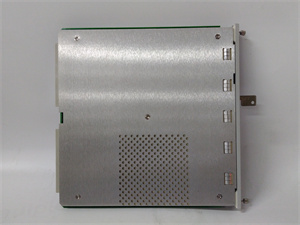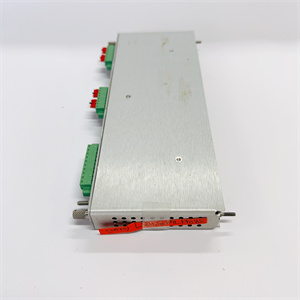
Description
Hard Numbers: Technical Specifications
(Note: Specific public datasheets for the 8270-1019 variant are limited. The following specs represent typical parameters for the Woodward 8270 series digital controllers. Please consult the official manual for exact project requirements.)
- Part Number: 8270-1019
- Operating Voltage: 18–32 VDC (24 VDC nominal)
- Speed Sensor (MPU) Input: 2 channels, 50–20,000 Hz frequency range
- Analog Inputs: 4–20 mA (configurable for load, temperature, or pressure sensing)
- Analog Outputs: 0–10 VDC / 4–20 mA (for actuator drive or metering)
- Discrete I/O: Multiple configurable relay outputs (10A @ 250VAC / 30VDC typical) and digital inputs
- Control Accuracy: ±0.25% isochronous speed regulation
- Response Time: <50 milliseconds for full processing cycle
- Communication Interfaces: RS-232, RS-485, CANbus, Ethernet (Modbus RTU/ASCII/TCP supported)
- Operating Temperature: -40°C to +70°C (-40°F to 158°F) typical
- Protection Rating: IP20 (chassis mount) / NEMA 4 (panel mount front face) typical
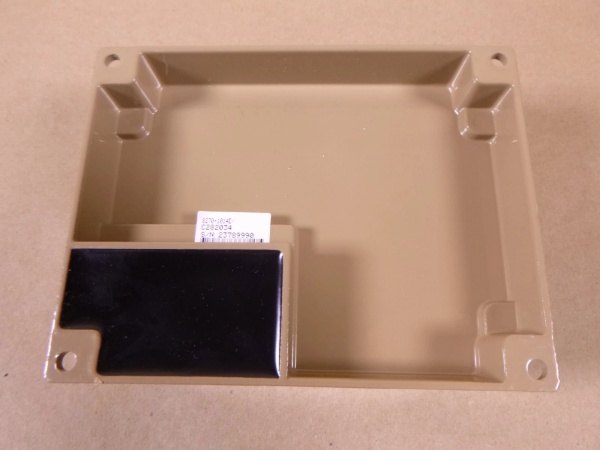
Woodward 8270-1014
The Real-World Problem It Solves
In mission-critical power generation and heavy industrial propulsion, maintaining a perfectly stable rotational speed (Hertz) while the electrical load wildly fluctuates is a monumental challenge. When a massive compressor kicks on in an industrial plant, or a ship hits a rogue wave, the load on the diesel engine or gas turbine can spike in milliseconds. A standard mechanical governor simply cannot react fast enough, leading to “droop” (speed sag), frequency deviation, and potentially tripping the entire facility offline.
The Woodward 8270-1019 acts as the high-speed digital brain of the powertrain. It continuously samples the engine’s speed (via the MPU) and compares it against the target setpoint. When a load change occurs, its internal 32-bit processor executes complex PID (Proportional-Integral-Derivative) algorithms in milliseconds, sending a precise corrective signal to the fuel actuator. Furthermore, in multi-engine setups, it orchestrates load sharing, ensuring that if one engine fails, the others instantly pick up the slack to prevent a blackout [based on typical 723PLUS/EASyGen functionalities].
Where you’ll typically find it:
- Marine Main Propulsion: Precisely governing the throttle of large marine diesels to maintain exact propeller speeds under varying sea conditions .
- Peak-Load Power Plants: Managing the ramp-up and synchronization of gas turbines, ensuring they lock into the grid frequency seamlessly .
- Oil & Gas Gathering Stations: Controlling natural gas engines that drive compressors, where precise speed control directly dictates pipeline pressure and flow rates .
Hardware Architecture & Under-the-Hood Logic
While the exact PCB layout of the 8270-1019 is proprietary, it follows the robust architectural principles of Woodward’s 723PLUS and EASyGen series.
- High-Speed Processing Core: Unlike older analog controllers that rely on op-amps and capacitors, the 8270-1019 uses a high-speed RISC CPU. This allows it to process floating-point math for complex equations (like calculating watts, VARs, and power factor) in real-time .
- Dual-Channel Metering: The module simultaneously monitors two independent MPU signals. This isn’t just for redundancy; it allows the controller to detect a “flywheel tooth missing” error or a faulty sensor and automatically switch to the backup sensor without causing a system trip .
- Configurable Logic Engine: Hard-wired relays are a thing of the past. The 8270-1019 uses software-defined logic (configured via Woodward Workbench or EasYgen software). This means the controller can be programmed to handle complex start/stop sequences, fault masking, and alarm cascading entirely in the microprocessor, eliminating the need for external PLCs .
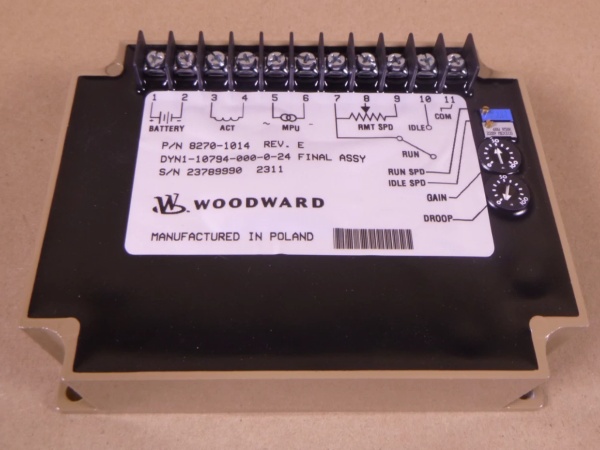
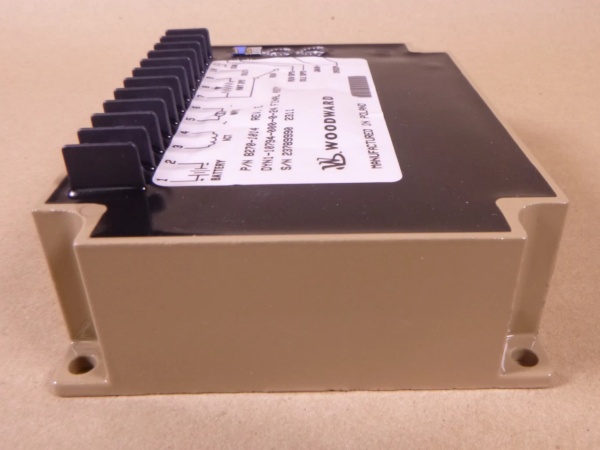
Woodward 8270-1014
Field Service Pitfalls: What Rookies Get Wrong
Misunderstanding “Droop” vs. “Isochronous” Modes (The Frequency Fight)
Rookies often assume that setting the speed knob to 1800 RPM means the engine will alwaysspin at exactly 1800 RPM. They fail to understand the concept of Droop (where the speed naturally sags slightly as load increases) versus Isochronous (where the speed is locked rigidly regardless of load).
- The Glitch: If you set a generator to “Isochronous” while it is running in parallel with a stiff utility grid, the controller will fight the grid. Since it cannot change the grid’s frequency, it will max out its fuel rack trying to “correct” a frequency error that doesn’t exist, eventually tripping on overspeed or overloading the engine.
- Field Rule: When paralleled with a utility grid (infinite bus), always configure the 8270-1019 for Droop mode. Only use Isochronous mode when the generator is running standalone (island mode) .
Ignoring MPU “Missing Tooth” Configuration (The Phantom Overspeed)
Modern engines often use a 60-2 (58 tooth) or 36-1 reluctor wheel. The 8270-1019 needs to know exactly how many teeth are passing the magnetic pickup to calculate RPM accurately. Rookies often count the physical teeth visually but forget to subtract the missing tooth in the software configuration.
- The Danger: If the tooth count is off by even one, the controller’s RPM reading will be slightly skewed. More dangerously, if the “Missing Tooth” detection feature is enabled but configured incorrectly, the controller might interpret a normal crankshaft revolution as a sensor failure, triggering a false overspeed trip and shutting down the entire plant.
- Quick Fix: Always use a handheld strobe tachometer to verify the actualengine speed against the displayedRPM on the controller’s HMI. If they don’t match, your teeth-per-revolution math is wrong .
Poor Analog Grounding (The “Ghost” Actuator Movements)
The 8270-1019 relies on extremely low-voltage analog signals (4-20mA or 0-10V) to talk to the Woodward actuator. Rookies often bundle these delicate signal wires in the same cable tray as the high-voltage, high-current starter motor cables.
- The Result: Electromagnetic interference (EMI) from the starters induces phantom voltages on the signal wires. The operator will see the engine throttle randomly “jitter” or “hunt,” even when no one is touching the controls.
- Field Rule: Always use shielded twisted-pair (STP) cabling for all analog I/O. Connect the shield drain wire to earth ground at the controller end only(to avoid ground loops), and keep signal cables physically separated (at least 12 inches) from any AC power wiring .
Commercial Availability & Pricing Note
Please note: The listed price is for reference only and is not binding. Final pricing and terms are subject to negotiation based on current market conditions and availability.