Description
Hard Numbers: Technical Specifications
(Note: The following specifications are compiled from typical 8270-1014 operational parameters. Please consult the official Woodward documentation for exact project engineering.)
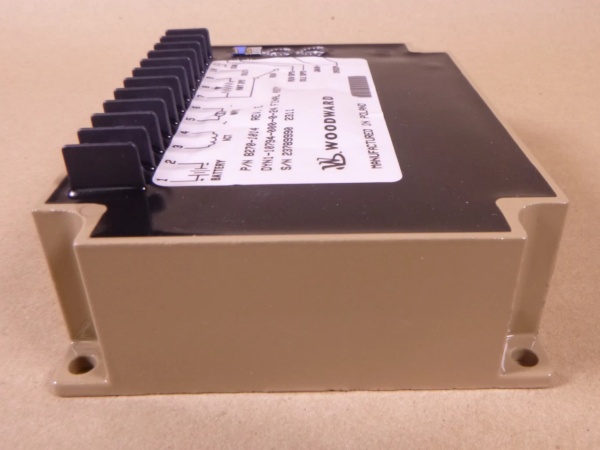
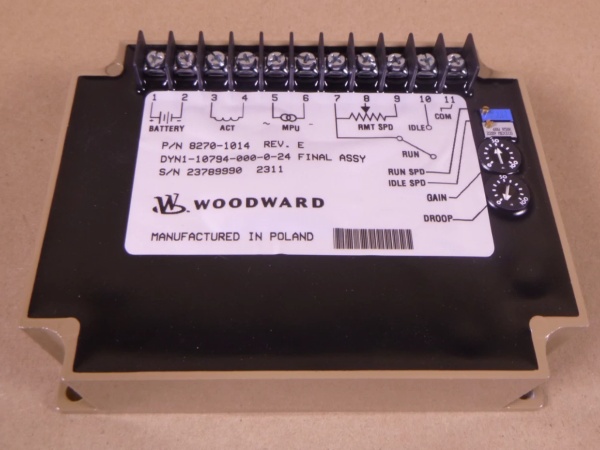
- Part Number: 8270-1014
- Speed Control Range: 100 – 10,000 RPM
- Control Accuracy: ±0.2% of rated speed
- Input Signals: 2-channel Magnetic Pickup (MPU), 4–20 mA analog input
- Output Signals: 0–10 VDC proportional output, Relay contacts (250V AC / 5A)
- Communication Interface: RS-485, supporting Modbus RTU protocol
- Power Supply: 24 VDC (±10% tolerance, max consumption ≤15W)
- Operating Temperature: -40℃ to +85℃ (-40°F to 185°F)
- Protection Rating: IP20 (designed for chassis/cabinet mounting)
- Vibration Resistance: 5–2000 Hz, 2g acceleration
Woodward 8270-1014
The Real-World Problem It Solves
Imagine a data center backup generator kicking in during a blackout. The massive inrush current from servers booting up causes the electrical load to spike violently. A standard mechanical or cheap electronic governor would cause the engine to “bog down” or surge, potentially leading to a drop in Hertz that crashes the servers anyway.
The Woodward 8270-1014 acts as the unshakeable digital brain preventing this disaster. By utilizing an advanced digital PID (Proportional-Integral-Derivative) control algorithm, it samples the engine’s speed hundreds of times per second. When a load is applied or removed, it instantly calculates the exact corrective fuel adjustment needed and fires that command to the actuator. It ensures the engine stays locked at exactly 1800 or 3600 RPM, regardless of whether the generator is powering a single lightbulb or a massive industrial chiller . Furthermore, its ruggedized design means it won’t flinch in harsh environments like offshore oil rigs or desert power stations, where heat, humidity, and constant vibration would cripple standard electronics .
Where you’ll typically find it:
- Data Center Backup Power: Ensuring seamless frequency stability during utility-to-generator transitions .
- Marine Propulsion: Providing precise throttle control for main propulsion engines battling rolling seas and shifting loads .
- Oil & Gas Turbine Drivers: Rapidly adjusting gas fuel valves to maintain shaft speed on compressors and pumps in remote gathering stations .
Hardware Architecture & Under-the-Hood Logic
Unlike older analog governors that rely on fragile op-amps and drift-prone capacitors, the 8270-1014 is built around a robust microprocessor core.
- High-Speed Arithmetic Core: The CPU crunches floating-point math to execute the PID loop. It doesn’t just say “speed is low, add fuel”; it calculates the rate of changeand predicts how much fuel is needed to smoothly return to the setpoint without overshooting .
- Dual-Channel Metering: It actively monitors two separate MPU (Magnetic Pickup) inputs. This isn’t just for redundancy; it allows the module to instantly detect a failed sensor or a “missing tooth” on the flywheel and seamlessly switch to the backup sensor without tripping the engine .
- Integrated Communications Engine: Built-in RS-485 drivers and Modbus RTU framing allow the module to act as a slave device on a SCADA network. This means the governor can be monitored and tuned remotely, eliminating the need for technicians to manually turn potentiometer screws on the front panel .
Woodward 8270-1014
Field Service Pitfalls: What Rookies Get Wrong
The “Ground Loop” Nightmare (Analog Signal Interference)
The 8270-1014 outputs a highly sensitive 0-10V analog signal to drive the Woodward actuator. Rookies often bundle this thin signal wire right next to the heavy 480VAC starter cables for the generator. The massive electromagnetic fields (EMI) from the power cables induce phantom voltages on the signal wire.
- The Symptom: The engine speed will randomly “hunt” or surge, even when no one is touching the controls.
- Field Rule: Always route analog signal wires (0-10V) in shielded, twisted-pair cable, kept at least 12 inches away from AC power lines. Connect the shield drain wire to earth ground at the controller end onlyto prevent ground loops .
MPU “Blind Spots” (Incorrect Sensor Gap)
The Magnetic Pickup (MPU) sensor must be positioned extremely close to the flywheel gear—usually leaving about 0.020 to 0.040 inches of clearance. Rookies often tighten the mounting bolt before checking the gap, crushing the sensor against the gear teeth.
- The Consequence: The 8270-1014 will throw a “Loss of Speed Signal” fault and trip the engine offline because it literally cannot “see” the flywheel turning.
- Quick Fix: Always use a standard automotive feeler gauge to set the MPU gap beforetightening the locknut. Spin the engine by hand to ensure the sensor doesn’t catch on a high spot of the gear .
“Copy-Paste” PID Settings (The Accordion Effect)
When replacing an old analog governor with the digital 8270-1014, rookies often load a generic configuration file found online or from another job site.
- The Glitch: Every engine has a different “spring constant” and fuel rack inertia. Using mismatched PID (Proportional, Integral, Derivative) gains will cause the engine to oscillate wildly—speeding up and slowing down like an accordion—until it trips on overspeed or underspeed .
- Field Rule: Never assume default PID values work for your specific prime mover. Perform a controlled “step load” test after installation and tweak the Gain and Stability potentiometers (or software parameters) until the engine recovers smoothly without oscillating .
Commercial Availability & Pricing Note
Please note: The listed price is for reference only and is not binding. Final pricing and terms are subject to negotiation based on current market conditions and availability.