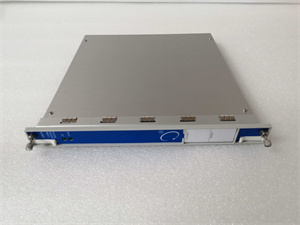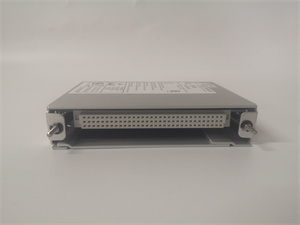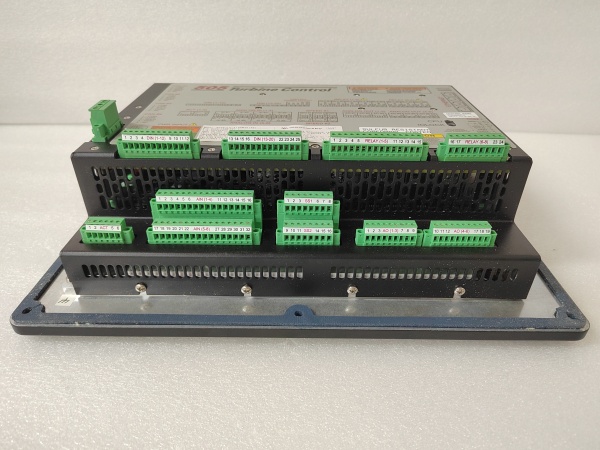
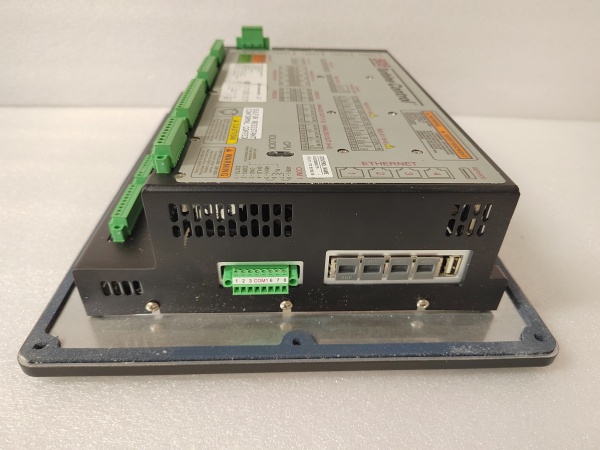
Description
Hard-Numbers: Technical Specifications
- Part Number: 8200-1301
- Power Supply: 88 – 264 VAC or 90 – 150 VDC (Wide range switching power supply)
- Power Consumption: < 73 Watts (Max 1.6A AC / 0.8A DC)
- Display & Interface: 8.5-inch color touchscreen / LCD, 800×600 pixel resolution
- Control Modes: Speed control, Load control, Cascade control, Extraction/Admission control
- Inputs: 6 Speed sensing inputs (MPU/Probes), 16 Analog inputs (4-20mA / 0-5V), 24 Discrete inputs
- Outputs: 4 Analog outputs (4-20mA), 8 Relay outputs, 2 Actuator outputs (4-20mA / 0-200mA)
- Communication: 2x Ethernet (Modbus TCP), 2x Serial (RS-232/485), CANopen
- Operating Temperature: -30°C to +70°C (-22°F to 158°F)
- Enclosure Rating: IP20 (when properly panel mounted)
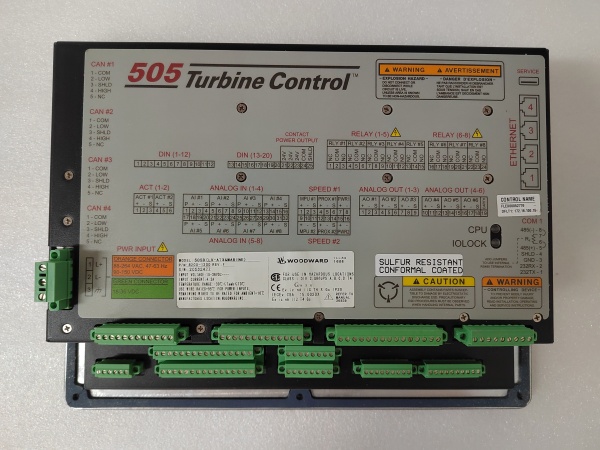
Woodward 8200-1301
The Real-World Problem It Solves
Older mechanical-hydraulic governors on steam and gas turbines are prone to wear, deadband, and temperature drift, making it nearly impossible to maintain tight frequency or pressure control. The 8200-1301 completely digitizes the turbine’s control loop. It replaces racks of analog logic, speed matching modules, and manual synchronizers with a single, menu-driven microprocessor. It is uniquely adept at managing complex turbines, such as those requiring single-valve or split-range actuator control for both steam inlet and extraction.
Where you’ll typically find it:
- Mounted on the control panel of a multi-megawatt steam turbine in a combined heat and power (CHP) plant, managing inlet throttling and extraction pressure for process steam.
- Acting as the primary overspeed and load governor for gas compressor drives in pipeline stations.
- Retrofitted into aging powerhouses to replace obsolete 505E analog units, providing a seamless upgrade path with modern Ethernet connectivity and data logging.
Hardware Architecture & Under-the-Hood Logic
The 8200-1301 is a dedicated, high-speed industrial computer running hard-real-time control algorithms specifically tailored for the thermal and rotational dynamics of prime movers.
- Signal Conditioning & Acquisition: The module constantly scans its 6 high-speed MPU inputs to derive absolute shaft speed, while simultaneously polling analog transmitters for steam pressure, temperature, and generator load.
- Adaptive PID Processing: Unlike standard PLCs, the 505D uses “intelligent/adaptive” control algorithms. It dynamically adjusts its PID gain values based on the current operating region of the turbine (e.g., applying softer gains during startup/critical speed passage and aggressive gains during load sharing).
- Actuator Command Generation: Based on the error calculation (Setpoint vs. Process Variable), the processor determines the exact current command (4-20mA or 0-200mA) required to drive the steam or fuel valve actuators, compensating for valve stiction and hysteresis.
- HMI & Diagnostic Supervision: The onboard RISC processor simultaneously drives the 8.5″ HMI screen, updating valve positions, alarms, and trend graphs in real-time, while the background service layer logs events and handles communications with the plant’s DCS or SCADA.
Field Service Pitfalls: What Rookies Get Wrong
Forgetting to Perform a “Null Balance” After Actuator Replacement
When a rookie swaps out a failed electro-hydraulic actuator or servo valve controlled by the 8200-1301, they often skip the null balance procedure. They simply bolt on the new valve, load the saved configuration, and wonder why the turbine drifts or the valve chatters excessively. Every actuator has slight manufacturing tolerances; without nulling, the controller is fighting against the valve’s mechanical center.
- Field Rule: Whenever physical actuator hardware is changed, navigate to the
Service Mode->Calibrationmenu on the 8.5″ HMI. Execute the automated null balance routine with the turbine shut down and declare the valve. This maps the true mechanical center and ensures 0% demand equals 0% flow.
Mixing Up AC/DC Power Input Polarities During Retrofits
Techs often assume the wide-range power supply (88-264VAC / 90-150VDC) automatically figures out the polarity of the incoming DC battery backup. While the unit is designed for universal input, hardwiring the DC supply backward without checking the terminal block labeling can blow the internal input rectifier diodes instantly.
- Field Rule: Even though the specs say “AC/DC,” always use a multimeter to verify the polarity and voltage level of the incoming DC supply before landing the wires. Ensure the neutral/negative is landed on the designated “N/-” terminal. If converting from an old AC-only unit, double-check that the jumper settings on the power input card (if applicable) match the supplied voltage type.
Overlooking the “I/O Lock” in Configuration Mode
A classic rookie mistake is entering the Configuration Modeto tweak a setpoint (like changing the ramp rate), not realizing that this mode is designed to take the unit offline for major programming changes. Entering this mode forces the hardware into an “I/O Lock,” tripping the turbine or sending all actuator outputs to their inactive/fail-safe state.
- Field Rule: Never enter
Configuration Modeon a running turbine unless you intend to take the unit offline. For minor adjustments (like raising the speed setpoint or toggling a discrete output), always useRun ModeorService Mode. If you must enterConfiguration Mode, ensure all upstream process interlocks are bypassed and the plant is aware of the impending shutdown.
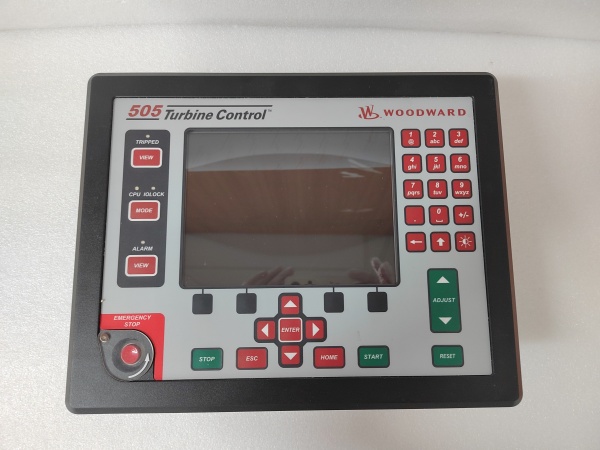
Woodward 8200-1301
Commercial Availability & Pricing Note
Please note: The listed price is for reference only and is not binding. Final pricing and terms are subject to negotiation based on current market conditions and availability.