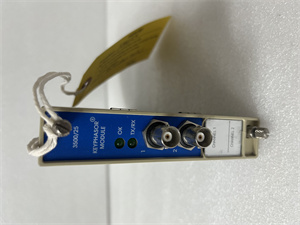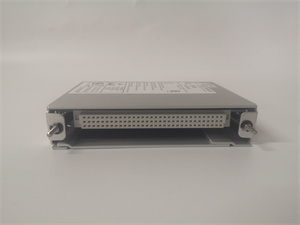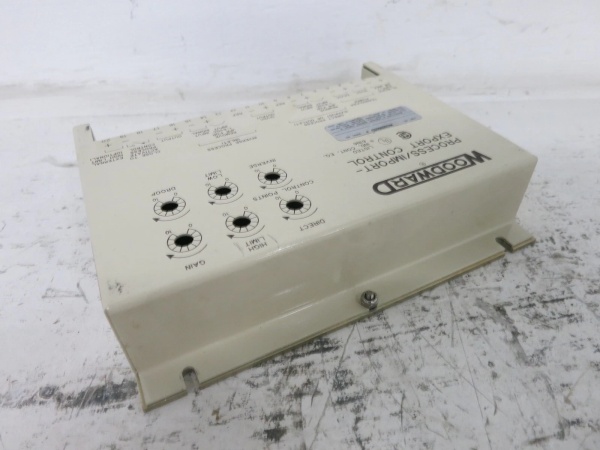
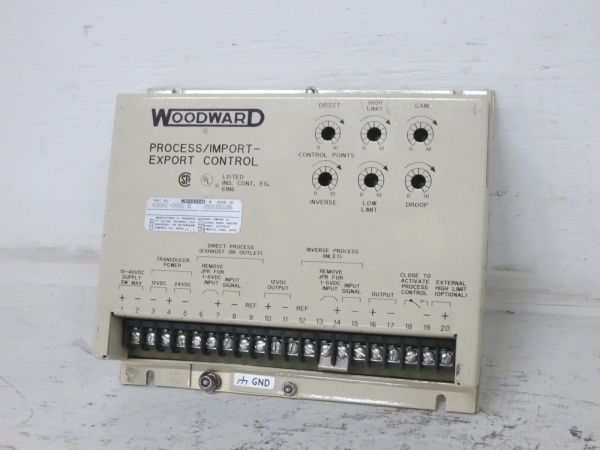
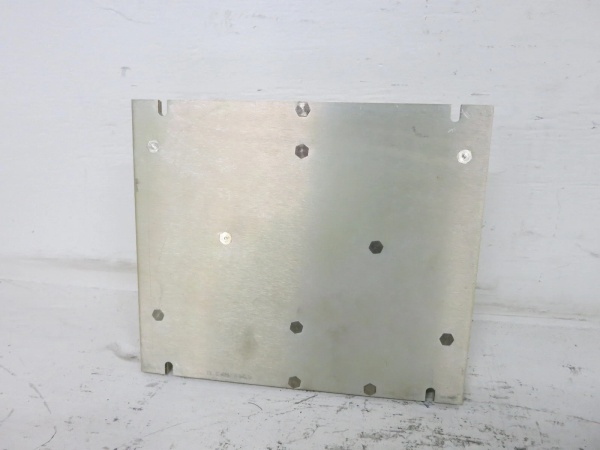
Description
Key Technical Specifications
-
Model Number: 376-104
-
Manufacturer: Woodward Inc.
-
System Compatibility: 505E Digital Governor Platform (replaces mechanical/hydraulic governors)
-
Processor: Industrial-grade ARM Cortex-A9 dual-core, 800 MHz primary clock
-
Memory: 512MB DDR3 RAM, 4GB industrial flash storage for configuration/logs
-
Redundancy: Triple-modular redundant (TMR) CPU voting with <10ms switchover
-
Speed Inputs: 3 channels, accepts MPU (2-120Vrms), proximity probe (Keyphasor), or active speed sensors
-
Analog Inputs: 16 standard, expandable to 32 via remote I/O; 16-bit resolution, ±0.05% accuracy
-
Analog Outputs: 8 standard, expandable to 16; 4-20mA or ±10V configurable, 12-bit resolution
-
Digital I/O: 32 inputs (24VDC), 16 outputs (relay or solid-state), expandable to 64/32
-
Valve Drivers: 4-20mA or 0-200mA outputs for electro-hydraulic converters (EHC) or proportional valves
-
Communication Ports: 2× RS-232/485, 2× 10/100 Ethernet, 1× USB (service), 1× DisplayPort (local HMI)
-
Real-Time Clock: Battery-backed, 10-year life, synchronized via NTP/SNTP
-
Scan Rate: 5ms control loop execution (configurable to 10ms/20ms for complex strategies)
-
Isolation: 1500Vrms I/O to system, 500Vrms channel-to-channel
-
Enclosure: NEMA 4X/IP66 rated when installed in proper cabinet with environmental controls
-
Certifications: SIL 2 capable, UL Listed, CE Marked, ABS/DNV marine approvals

Woodward 9905-090
Field Application & Problem Solved
In the field, the 376-104 solves the fundamental problem of replacing a mechanical governor that hasn’t worked right since 1987 but still “mostly controls” the turbine. I’ve walked into plants where the Woodward PG-PL governor has been “tuned” with a screwdriver and hope for fifteen years. The 376-104 drops in as a digital replacement that actually holds speed steady, responds to load changes predictably, and doesn’t drift with oil temperature.
You’ll find this controller on virtually every modern steam turbine retrofit and most new mechanical drive applications—centrifugal compressors in petrochemical plants, generator drives in paper mills, pump drives in water treatment facilities. The 505E platform has been the industry standard for three decades, and the 376-104 represents the current-generation processor with enough horsepower to handle complex extraction/admission turbine strategies that the old 505D choked on.
The core value is precision control with operational visibility. A mechanical governor might hold speed within ±0.5% under steady load. The 376-104 holds ±0.05%—and that’s not marketing fluff, that’s actual field performance on a 60MW extraction turbine I commissioned last year. More importantly, it gives you data. Speed trends, valve position feedback, alarm history, start-up curves. When the process trips offline, you can pull the fault log and see exactly what happened: “Speed reference stepped from 3600 to 3650 RPM at 14:23:15, valve demand saturated at 100% for 2.3 seconds, overspeed trip initiated at 3960 RPM.” Try getting that from a PG-EG governor.
Where this module distinguishes itself is redundancy. The TMR architecture means three independent processors run the same control algorithm simultaneously. If Processor A calculates a valve demand of 47.2% and Processor B calculates 47.3%, but Processor C calculates 52.1% due to a memory fault, the system votes out C and continues on A/B. The operator gets an alarm, but the turbine never hiccups. I’ve had a processor fail during a critical compressor run—plant didn’t even know until the maintenance shift reviewed the logs. That’s the difference between a control system and a safety instrumented system.
Installation & Maintenance Pitfalls (Expert Tips)
Grounding the 4-20mA Valve Driver: The Isolated Output Trap
The valve driver outputs on the 376-104 are isolated from system ground, which is good—it prevents ground loops. But electro-hydraulic converters (EHCs) often have one side of their coil tied to the turbine skid steel. If you ground the negative side of your 4-20mA output at the controller “for safety,” and the EHC is grounded at the actuator, you’ve created a parallel path. The current splits. Your valve position feedback says 50%, but the actual valve is at 38% because 3mA is leaking to ground through the shield. Always verify EHC grounding with a megger before commissioning. If the actuator is grounded, float the controller output. If the controller is grounded, isolate the actuator. Never both.
MPU Signal Grounding: The Shielded Cable Mistake
The speed inputs accept MPU signals, and the manual says “differential inputs with common-mode rejection.” Technicians read that as “ground the shield at both ends for best noise immunity.” Wrong. The MPU is bolted to the turbine case—ground potential. The 376-104 is in a control cabinet—different ground potential. If you ground the shield at both ends, circulating currents flow through the shield, inducing noise in the signal pair. I’ve seen speed signals with 2-3% ripple from this alone—enough to cause valve hunting. Ground the shield at the 376-104 end only. Use a shielded twisted pair with drain wire, connect drain to the terminal block’s shield pin, leave the MPU end floating. If you need extra noise immunity, use a differential line receiver near the MPU, not better grounding.
Configuration Download: The Running Transfer Risk
The 376-104 supports online configuration changes—you can modify PID gains while the turbine is running. But there’s a trap: major configuration changes (I/O assignment, speed range, valve curves) require a controller restart. If you click “Download” in the Woodward GAP software without checking the “Warm Transfer” option, the controller reboots immediately. On a running turbine, that means 2-3 seconds of no control signal. The valves go to their fail position, the turbine trips on low vacuum or high vibration, and you’re explaining to the plant manager why the powerhouse went dark. Always use “Warm Transfer” for online changes, and even then, have someone at the manual trip lever. Better yet, make major changes during shutdown.
Battery Replacement: The Real-Time Clock Memory
The module has a coin-cell battery (CR2032) backing the real-time clock and some volatile memory. It lasts about 10 years, but when it dies, you lose timestamped event logs and the clock resets to 2000. More critically, some early firmware revisions lose the last-known valve position on power cycle if the battery is dead—meaning the first start after an outage has no reference for valve linearization. The valve stroking routine runs automatically, causing a 10-second delay in speed control pickup. On some turbines, that’s enough to trip on low lube pressure. Check the battery voltage annually. At 2.8V, replace it. It’s a $2 part that prevents a $50,000 forced outage.
Redundancy Switchover Testing: The Forgotten Procedure
Plants with TMR systems get complacent. “We’ve got redundancy, so we’re safe.” But if you never test the switchover, you don’t know if it works. I’ve found failed processors sitting in backup for months, their status LEDs green because they were powered but not participating in the vote. The 376-104 has a built-in test routine—initiate it from the HMI or GAP software. It forces a processor offline and verifies the remaining pair maintain control. Run this quarterly. Document it. When you actually need redundancy, you’ll know it functions instead of hoping.
Ethernet Security: The Default Password Problem
The 376-104 ships with default IP addresses and no password on the web interface. Technicians leave it that way “because it’s on the control network.” But control networks get bridged to business networks, VPNs get misconfigured, and suddenly your turbine governor is accessible from the parking lot. Change the default IP. Enable the password. Restrict Modbus TCP to specific client IPs. I’ve seen a plant where the DCS integrator accidentally mapped the wrong Modbus register and tripped the turbine by writing zero to the speed setpoint. If they’d had write-access restrictions, that couldn’t happen.
Technical Deep Dive & Overview
The 376-104 is the central processing unit of Woodward’s 505E digital governor platform, representing the evolution from the original 505 (1980s) through the 505D (1990s) to the current E-series with modern processing power and networking. It is not merely a speed controller—it is a complete turbine automation system managing start-up sequencing, load control, process optimization, and machinery protection integration.
At its core, the module runs a real-time operating system on a dual-core ARM processor. One core handles the deterministic control loop—speed sensing, PID calculation, valve demand output—executing every 5 milliseconds. The second core manages non-real-time tasks: communication protocols, HMI updates, data logging, and diagnostics. This separation ensures that heavy Ethernet traffic or USB file transfers never impact control stability.
The TMR (Triple-Modular Redundancy) implementation uses three identical 376-104 modules in a voting configuration. Each processor receives the same input signals through independent I/O modules, executes the same control algorithm, and calculates valve demand. A voter circuit compares the three outputs; if all agree within tolerance, the median value drives the output. If one deviates beyond the threshold, it’s flagged as failed and the system continues on the remaining two. The failed processor can be replaced hot—power down, swap the module, power up, and it rejoins the vote automatically after synchronization.
Speed sensing uses three independent channels with programmable input conditioning. Each channel can accept passive MPUs (magnetic pickups), active proximity probes (with -24V bias), or digital speed sensors. The firmware implements a tracking filter—essentially a variable-frequency bandpass filter centered on the current speed estimate. This rejects electrical noise and mechanical vibration that would confuse a simple frequency counter. At low speeds during start-up, the filter widens to capture acceleration; at steady state, it narrows to maximize noise rejection.
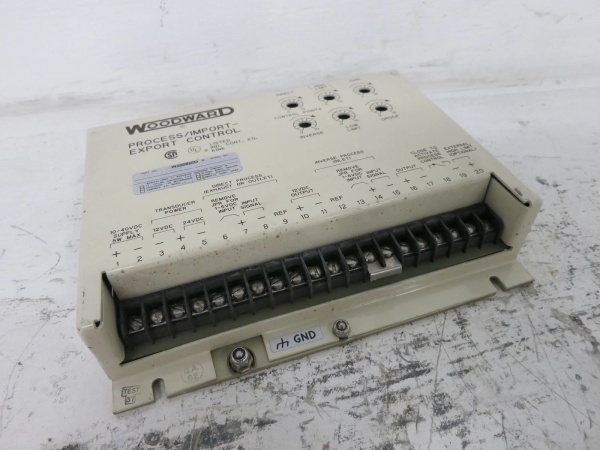
Woodward 9905-090
The control algorithm extends far beyond simple PID. For steam turbines, the 376-104 implements:
-
Valve Linearization: Steam valves are notoriously non-linear—10% lift might give 40% flow due to port geometry. The module stores a 21-point curve mapping valve demand to actual flow percentage, linearizing the control response.
-
Acceleration Limiting: During start-up, the rate of speed increase is capped to prevent thermal stress on rotor and casing.
-
Extraction/Admission Control: For turbines with process steam extraction, the module maintains inlet pressure and extraction pressure simultaneously using decoupled PID loops with feedforward compensation.
-
Load Sharing: Multiple generators on a bus use droop speed control or isochronous load sharing algorithms to maintain frequency while distributing megawatt load proportionally.
Communication capabilities include serial Modbus for legacy DCS integration, Ethernet Modbus TCP and EtherNet/IP for modern control systems, and OPC UA for higher-level plant information systems. The module can act as Modbus master to poll auxiliary devices (seal oil pumps, turning gear status) or as slave to receive remote setpoints from the plant DCS. A built-in web server provides read-only access to live data and historical trends—useful for troubleshooting without specialized software.
The operator interface connects via DisplayPort to a local touchscreen or remotely through the web interface. The 505E HMI displays speed, load, valve positions, and alarm status with a layout familiar to anyone who’s operated Woodward governors. Critical parameters like overspeed test setpoints and emergency trip speed are password-protected to prevent unauthorized modification.
Physically, the 376-104 mounts in a dedicated slot of the 505E chassis. It requires forced-air cooling—do not install in a sealed NEMA 4X enclosure without ventilation or air conditioning. The module draws redundant 24VDC power; loss of one supply continues operation, loss of both initiates a controlled shutdown (valves to fail-safe position). Front-panel LEDs indicate processor health, I/O communication, and redundancy status. A USB port allows local configuration backup and firmware updates without network connection.