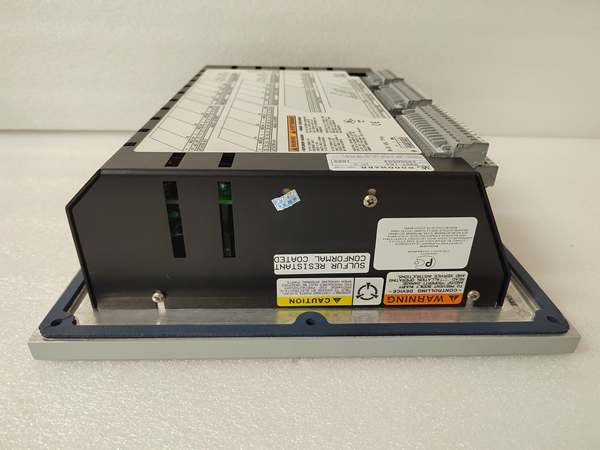
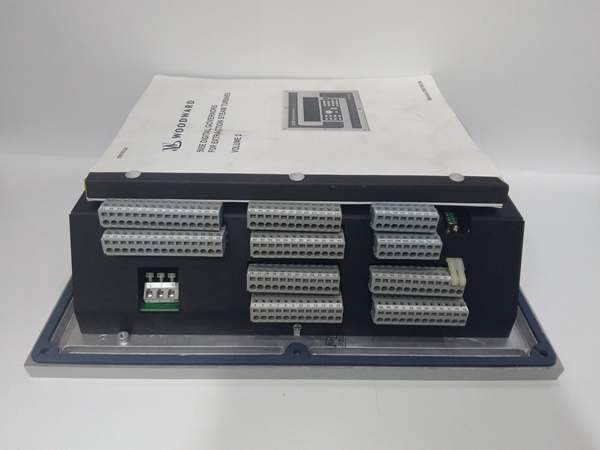
Description
Key Technical Specifications
-
Model Number: 1720-713
-
Manufacturer: Woodward Inc. (Fort Collins, CO / Loveland, CO)
-
System Compatibility: ProTech-GII Overspeed Protection System (Model 8237-1000/2000 series)
-
Input Channels: 2 independent MPU inputs (A and B)
-
Signal Conditioning: Adaptive threshold detection with noise filtering
-
Speed Calculation: Hardware-based frequency-to-voltage conversion with digital validation
-
Relay Outputs: 2 Form-C (SPDT) relays per channel (4 total), rated 5A @ 30VDC / 250VAC
-
Response Time: < 10 ms (relay pickup from speed threshold exceedance)
-
Isolation: 1500Vrms input-to-output, 500Vrms channel-to-channel
-
MPU Voltage Range: 2Vrms to 120Vrms (auto-ranging)
-
Probe Gap Voltage: -24VDC bias for proximity probe compatibility
-
Operating Temperature: -40°C to +70°C (-40°F to +158°F)
-
Storage Temperature: -40°C to +85°C
- Humidity: 5% to 95% non-condensing

WOODWARD 9907-164
-
Certifications: SIL 3 capable (IEC 61508), ATEX/IECEx for hazardous locations (when installed in appropriate enclosure)
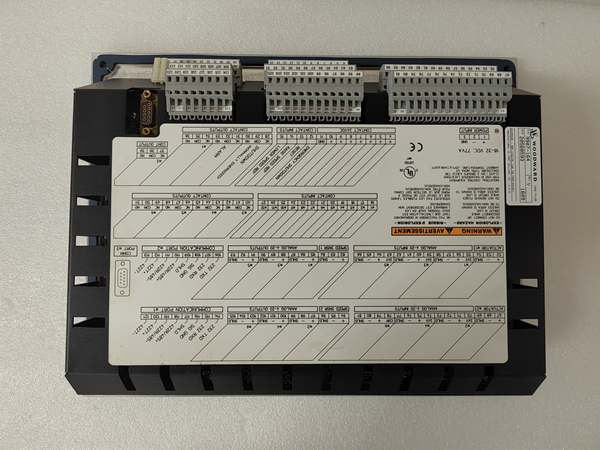
Field Application & Problem Solved
In the field, the single biggest failure point in turbine protection isn’t the controller—it’s the speed signal path. I’ve seen more unnecessary trips and, worse, missed trips because someone didn’t understand how magnetic pickup signals degrade in harsh environments. The 1720-713 exists to solve that exact problem: reliable, deterministic speed detection in the presence of electrical noise, vibration, and long cable runs.
You’ll find this module exclusively in critical rotating machinery protection—steam turbines at power plants, gas turbines in compressor stations, and expanders in cryogenic plants. It’s the front line of the ProTech-GII safety system. The MPU bolts to the turbine case, sensing gear teeth or keyphasor slots. That raw AC signal—often millivolts to tens of volts, riding on top of massive common-mode noise—comes into this module. The 1720-713’s job is to decide, with absolute certainty, “Is the turbine overspeeding?” and trigger a trip relay if yes.
The core value here is hardware redundancy with diversity. Each channel has independent signal conditioning, threshold detection, and relay logic. This isn’t software voting—this is parallel hardware paths. If Channel A’s MPU cable gets severed by a maintenance cart, Channel B maintains protection. If electromagnetic interference from a nearby VFD induces noise on the cable, the adaptive filtering rejects it. The module doesn’t “guess” at speed; it validates zero-crossing detection against historical patterns to eliminate false counts from electrical noise.
Where this saves your skin: Long cable runs. I’ve installed these in plants where the turbine skid is 800 feet from the control room. Standard PLC analog inputs would fail—impedance mismatch, capacitive coupling, ground loops. The 1720-713’s high-impedance differential inputs and active filtering handle those cable runs without external signal conditioners. It also handles the reality of field MPUs—aging coils, varying air gaps, temperature drift. The auto-ranging input means you don’t need to specify “use a 50V MPU” during procurement; it adapts to what you’ve got.
Installation & Maintenance Pitfalls (Expert Tips)
MPU Polarity Matters More Than You Think
Magnetic pickups are passive coils. They output AC voltage, so “polarity” seems irrelevant—but it’s not. The 1720-713 detects zero-crossings to calculate frequency. If you reverse the leads on one of two redundant MPUs, the phase relationship between Channel A and B shifts 180 degrees. During a coast-down, the ProTech-GII’s cross-checking logic may flag this as a discrepancy fault, forcing a nuisance trip. Always verify phase alignment with a dual-trace scope during commissioning. Mark your cables with heat-shrink labels—future you will thank present you.
Shield Grounding: One End Only, Always
This module has internal isolation, but that doesn’t forgive bad shield practices. Run shielded twisted pair (Belden 8761 or equivalent) from MPU to module. Ground the shield at the 1720-713’s terminal block only—never at the MPU end. If you ground both ends, you create a ground loop that turns your cable into an antenna for 60Hz hum. I’ve diagnosed trips where the turbine “appeared” to run at 3600 RPM (60Hz interference) because someone tied the shield to the turbine case. Use a single-point ground. Period.
Relay Contact Loading: Respect the Inductive Kick
The Form-C relays on this module are robust, but they’re not magic. When driving a solenoid valve or breaker trip coil, always use an external interposing relay or a flyback diode. The inductive kick from a 24VDC trip coil can arc-weld the contacts or degrade them over time. I’ve opened failed 1720-713s where the relay contacts were pitted because someone wired directly to a large trip solenoid. Use a slave relay. It’s $50 that saves a $3,000 module and a forced outage.
Gap Voltage Verification for Proximity Probes
If you’re using proximity probes (Bently Nevada style) instead of MPUs, you must verify the -24VDC bias voltage at the probe. The 1720-713 supplies this, but cable capacitance on long runs can sag the voltage. Use a high-impedance voltmeter at the probe end during installation. If you’re below -20VDC, add a proximitor buffer or shorten the cable. Low bias voltage causes amplitude collapse at high vibration, leading to missed speed pulses and—worst case—overspeed non-detection.
Firmware Compatibility with Chassis
The 1720-713 has seen three hardware revisions. Early units (8273-1013) won’t work in ProTech-GII chassis with firmware newer than v4.2. If you’re swapping spares, check the part number decal on the side. If it starts with 8273, it’s legacy. If it’s 1720-713-001 or later, it’s universal. Mixing them causes a “Module Type Mismatch” alarm that won’t clear until you match the firmware or replace the module.
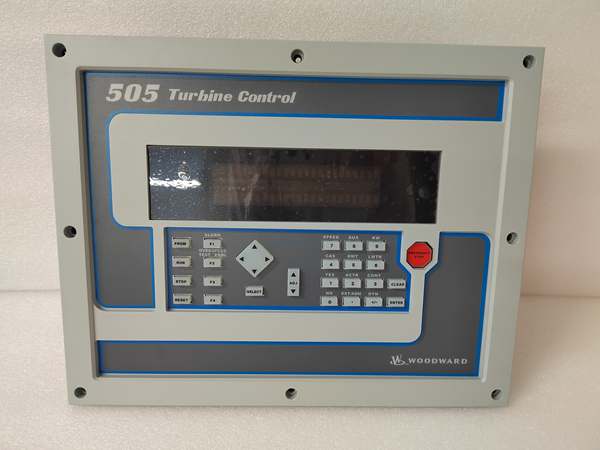
WOODWARD 9907-164
Technical Deep Dive & Overview
The 1720-713 is a dedicated speed-sensing input module for Woodward’s ProTech-GII platform, which is a SIL-capable overspeed protection system. Unlike general-purpose PLC analog inputs, this module contains specialized signal conditioning hardware designed exclusively for frequency-based speed measurement from magnetic pickups or proximity probes.
Each of the two input channels operates independently with its own isolated power supply, amplifier stage, and detection logic. The input stage uses a high-impedance differential amplifier with automatic gain control—this allows it to handle MPU signals from 2Vrms (weak, aged pickup) to 120Vrms (strong, new pickup at close gap) without manual ranging. The AGC circuit tracks signal amplitude over time, compensating for temperature drift and probe wear.
The detection logic uses a zero-crossing discriminator with hysteresis. When the input sine wave crosses zero volts in the positive direction, a comparator triggers a digital counter. The module measures the time between zero-crossings to calculate instantaneous frequency (speed). To prevent false triggering from noise, the hysteresis band requires the signal to exceed ±200mV before a crossing is recognized. There’s also a “missing tooth” detection algorithm—if the turbine has a keyphasor with one missing tooth for phase reference, the module recognizes the extended period and maintains accurate speed tracking without counting the gap as a deceleration event.
The calculated speed value isn’t sent to the CPU as an analog signal—that would introduce conversion delays and software scan time variability. Instead, the 1720-713 makes the trip decision locally in hardware. The module contains programmable frequency threshold comparators. When measured speed exceeds the setpoint (e.g., 110% of rated speed), the hardware comparator energizes the trip relays within 10 milliseconds. The CPU is notified for logging and alarming, but the trip itself is deterministic and independent of software execution speed.
Communication with the main ProTech-GII processor occurs via a proprietary backplane bus. The module reports diagnostic status (signal quality, relay health, internal temperature) and receives configuration parameters (trip setpoints, test modes). However, the safety-critical path—speed input to trip relay output—remains entirely within the 1720-713’s hardware. This architecture ensures that a CPU failure cannot prevent a trip; the module will still open its relays on overspeed even if the backplane communication is severed.
The dual-channel design supports either redundant MPUs on the same gear (2-out-of-2 voting for high reliability) or diverse sensing (MPU on gear, proximity probe on shaft) for common-cause failure protection. Each channel’s relays are wired in series for the final trip circuit, ensuring both channels must agree before the turbine is allowed to run—or either channel can independently trip on overspeed, depending on the configured voting logic.