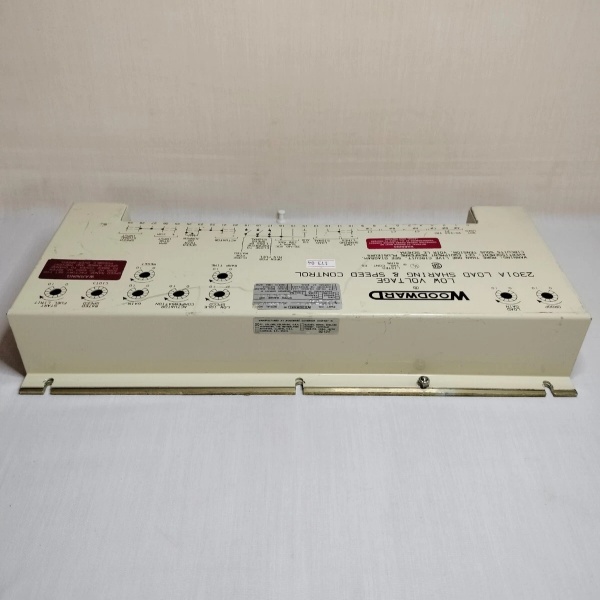
Description
Key Technical Specifications
Model Number: 1720-707
Manufacturer: Woodward Inc.
Product Family: Digital Valve Positioner (DVP)
Power Supply Options: 24 Vdc (+33%/-25%) or 125 Vdc (+20%/-28%)
Current Draw: See specific valve/actuator manual (varies by motor type)
Motor Types Supported: Limited Angle Torque (LAT) or Brushless DC (BLDC)
Position Feedback: Resolver located on valve/actuator
Input Signal Options:
EGD (Ethernet Global Data) – triple redundant
CANopen – dual redundant
Analog: 4-20 mA or 0-5 Vdc
PWM
Communication: RS-232 service port for DVP Service Tool
Heat Dissipation:
With Ethernet: 40W nominal, 70W max
Without Ethernet: 40W nominal, 63W max
Operating Temperature:
With Ethernet: -40°C to +55°C (-40°F to +131°F)
Without Ethernet: -40°C to +70°C (-40°F to +158°F)
Storage Temperature: -40°C to +105°C (-40°F to +221°F)
Humidity: 0-100% non-condensing
Vibration: Woodward RV5 (0.04 G²/Hz, 10-500 Hz, 1.04 Grms)
Shock: Woodward MS2 (30G, 11ms half-sine)
Enclosure Options: IP30 or IP66
Dimensions (IP30): 279 × 272 × 145 mm (11.0 × 10.7 × 5.7 in)
Dimensions (IP66): 483 × 311 × 111 mm (19.0 × 12.24 × 4.38 in)
Weight (IP30): 7.9 kg (17.5 lb)
Weight (IP66): 6.95 kg (15.32 lb)
Certifications: CE, CSA, ATEX, IECEx, Marine (LR, ABS, DNV-GL)
ID Module: Plug-and-play auto-configuration with compatible valves
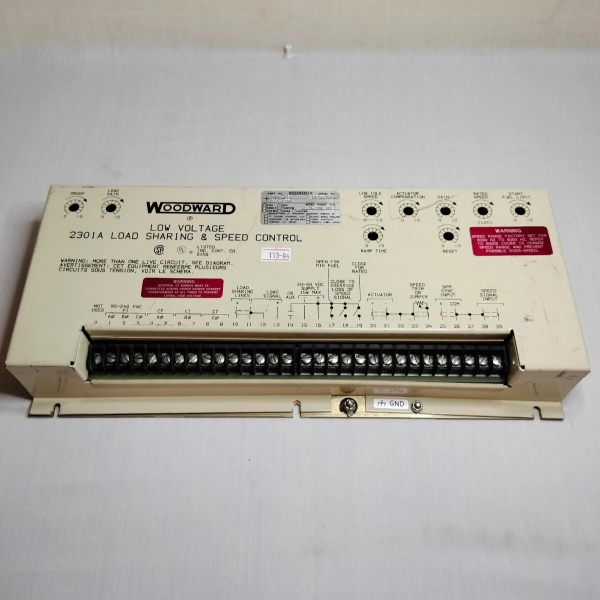
WOODWARD 9905-020P
Field Application & Problem Solved
In the field, the biggest challenge with modern turbine and engine fuel control is precision and repeatability. Traditional hydraulic governors and pneumatic positioners drift with temperature, wear out mechanically, and can’t provide the sub-degree positioning accuracy needed for low-emission combustion control. The 1720-707 solves this by providing microprocessor-based digital position control with resolver feedback—absolute position sensing that doesn’t drift, doesn’t wear, and provides real-time valve position data back to the control system.
You will typically find this driver in gas turbine fuel metering systems, diesel engine electronic fuel injection retrofits, steam turbine valve actuation upgrades, and compressor anti-surge valve control. It’s designed to work with Woodward’s family of electric valves and actuators—LQ25 liquid metering valves, EGMV gas metering valves, EWMV water injection valves, and various actuator types. The plug-and-play ID module feature is critical for field service—when you connect the DVP to a compatible valve equipped with an ID module, it automatically reads valve-specific parameters (travel limits, motor characteristics, calibration data) and configures itself. No manual parameter entry, no calibration sheets to lose, no human error in setup.
Its core value is replacing obsolete hydraulic and pneumatic valve drivers with precise, repeatable, digitally-controlled electric actuation. The triple-redundant EGD Ethernet option provides the safety integrity level needed for critical fuel control in power generation and oil & gas applications. The dual-redundant CANopen option works for less critical applications while maintaining reliability. The analog and PWM inputs allow integration with legacy control systems that don’t have digital communication. The IP66 enclosure option survives outdoor installations and washdown environments, while the IP30 version fits in control cabinets.
Installation & Maintenance Pitfalls (Expert Tips)
ID Module Compatibility is Not Universal
The plug-and-play auto-configuration only works with valves/actuators equipped with ID modules . A common field mistake is assuming all Woodward valves have ID modules. Older valves, third-party actuators, and some special configurations don’t have this feature. If you connect the 1720-707 to a non-ID valve, it won’t auto-configure and will fault. Check the valve part number against Woodward’s compatibility list before ordering. For non-ID valves, you must manually enter all parameters using the DVP Service Tool software—time-consuming and error-prone.
Resolver Wiring is Critical—No Room for Error
The resolver feedback is the heart of this system. Unlike potentiometers that have simple two-wire connections, resolvers have excitation (primary) and signal (secondary) windings with specific phasing. Swap excitation with signal, or reverse phase connections, and the DVP can’t determine position. This causes immediate fault or, worse, erratic valve movement. Follow the wiring diagram exactly—resolver wiring is not intuitive. Use shielded twisted pair for resolver cables, with shield grounded at the DVP end only. Never run resolver cables in the same conduit as power cables—EMI induces position jitter.
Power Supply Selection Affects Temperature Rating
The 1720-707 has two power supply variants: 24 Vdc and 125 Vdc . The temperature rating depends on whether you order the Ethernet option. With Ethernet, maximum ambient is only +55°C . Without Ethernet, it’s +70°C . A common field error is installing the Ethernet-equipped version in a hot turbine compartment where temperatures exceed 55°C. The DVP will overheat, fault, and potentially shut down the turbine. Check your environment before specifying. For hot installations, use the non-Ethernet version with CANopen or analog communication.
Cable Length Limits Are Real and Enforced
The DVP has strict cable length limits: maximum 45 meters between DVP and valve, maximum 100 meters between DVP and engine control system . Exceeding these limits causes signal degradation, position jitter, and communication errors. I’ve seen installations where technicians used 150-meter cables to reach a remote valve, then wondered why the system hunts. Use signal repeaters or relocate the DVP closer to the valve if you exceed 45 meters. For the control system connection, use fiber optic converters if you need more than 100 meters.
EGD Redundancy Requires Proper Network Architecture
The triple-redundant EGD (Ethernet Global Data) option provides three independent Ethernet channels for safety-critical applications. However, these must be connected to three physically separate network switches. A common mistake is running all three EGD cables to the same switch—this defeats the redundancy. Each EGD channel needs its own network path, own switch, and own controller connection. If one network fails, the DVP automatically switches to the next healthy channel. Document your EGD network topology clearly for future maintenance.
Service Tool Software is Required for Diagnostics
The DVP Service Tool software is essential for commissioning, troubleshooting, and parameter changes. It connects via RS-232 . A field pitfall is showing up without a laptop loaded with this software. You cannot properly commission or troubleshoot a 1720-707 without it. Download the latest version from Woodward’s website before going to site. The software includes valve setting files (*.west) required for calibration—don’t lose these files. Store them on your laptop and back them up.
IP66 Enclosure Requires Proper Sealing
The IP66 version is rated for harsh environments, but only if all covers are properly sealed and cable glands are tightened. I’ve seen IP66 units fail because technicians left cover screws loose or used improper cable glands. Use the specified cable entry hardware—conduit options are available for IP66 . Check gasket integrity during maintenance; UV and temperature cycling degrade gaskets over time. Replace gaskets every 2-3 years in harsh environments.
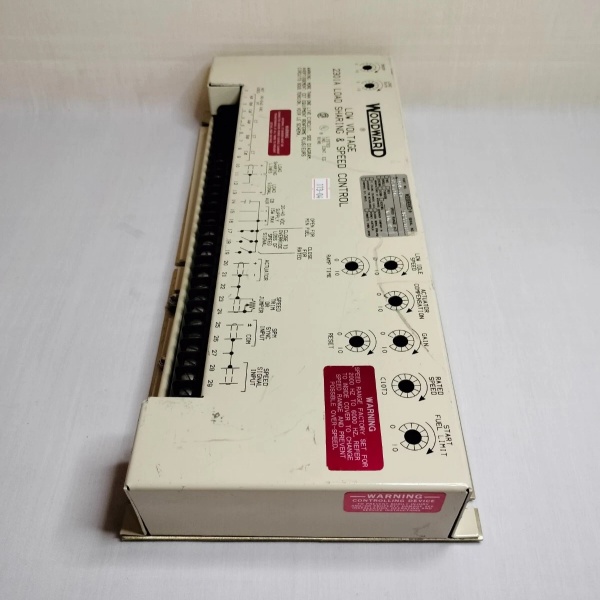
WOODWARD 9905-020P
Technical Deep Dive & Overview
The Woodward 1720-707 is a microprocessor-based digital valve positioner that represents the state-of-the-art in electric valve actuation control. It replaces traditional hydraulic servo systems and pneumatic positioners with precise, repeatable, digitally-controlled electric drive technology.
The control architecture centers on a high-performance microcontroller that implements position control algorithms for either Limited Angle Torque (LAT) or Brushless DC (BLDC) motor types . LAT motors are used for rotary valve applications with limited travel (typically 90 degrees or less), while BLDC motors provide continuous rotation for multi-turn valves. The DVP automatically detects motor type and configures appropriate control parameters when connected to an ID-equipped valve.
Position feedback comes from a resolver mounted on the valve or actuator shaft . Resolvers are absolute position sensors that provide analog signals representing shaft angle. Unlike potentiometers, resolvers are non-contact, wear-free, and immune to electrical noise. The DVP excites the resolver primary winding with a high-frequency AC signal and demodulates the secondary windings to determine precise shaft position. This position information closes the control loop with the demand signal from the turbine controller.
The demand input options provide flexibility for different control system architectures :
EGD (Ethernet Global Data): Triple-redundant Ethernet for safety-critical applications requiring SIL ratings
CANopen: Dual-redundant serial communication for industrial automation
Analog: 4-20 mA or 0-5 Vdc for legacy system integration
PWM: Pulse-width modulation for simple digital interfaces
The ID module technology embeds valve-specific data in a small memory device on the valve. When the DVP connects, it reads calibration data, travel limits, motor parameters, and valve identification automatically. This eliminates manual parameter entry and ensures the DVP is always matched to the specific valve model.
From a system architecture perspective, the 1720-707 functions as a smart valve driver that closes the control loop locally while communicating status to the turbine control system. It receives position demand from the controller, drives the motor to that position using PID algorithms, and reports actual position, alarms, and diagnostics back via the communication network. This distributed control architecture reduces wiring, improves response time, and provides detailed diagnostic information unavailable with analog positioners.