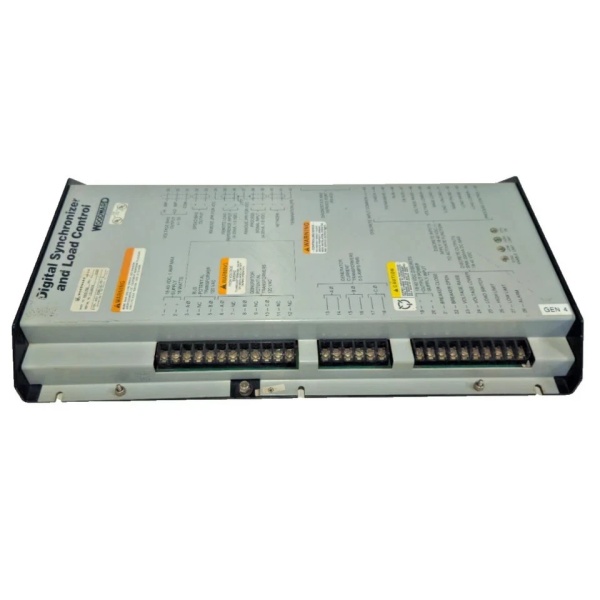
Description
Key Technical Specifications
-
Model Number: 1691-143
-
Manufacturer: Woodward Inc.
-
Product Family: Netcon Distributed Control System
-
Type: Expansion Chassis / I/O Rack
-
Function: Provides additional backplane slots for Netcon I/O modules
-
Compatibility: Woodward Netcon control platform
-
Associated Part: Often referenced with B842 (indicating specific configuration or backplane variant)
-
Construction: Metal chassis with backplane for module insertion
-
Mounting: Panel or rack mounting for control cabinet installation
-
Dimensions: Standard 19-inch rack compatible (typical for Netcon series)
-
Weight: Approximately 2-5 kg (depending on configuration)
-
Operating Temperature: -20°C to +60°C (typical for Netcon hardware)
-
Storage Temperature: -40°C to +85°C
-
Environmental Rating: IP20 (control cabinet installation required)
-
Power Supply: Derived from Netcon main chassis or external 24Vdc
-
Communication: Backplane connection to Netcon main controller
-
I/O Capacity: Expands system I/O by 8-16 slots (depending on chassis variant)
-
Module Support: Digital input/output, analog input/output, communication modules

Woodward 9905-796
Field Application & Problem Solved
In the field, the biggest challenge with large turbine or generator control systems is I/O capacity. A single steam turbine or complex genset installation can have hundreds of discrete inputs (limit switches, pressure switches, breaker status), analog inputs (temperatures, pressures, flow rates), and outputs (solenoids, actuators, indicator lights). The main Netcon controller chassis fills up quickly. The 1691-143 solves this by providing a modular expansion chassis that connects to the main Netcon controller, effectively doubling or tripling your I/O capacity without adding another complete controller.
You will typically find this chassis in large steam turbine installations (power plants, refineries, paper mills), complex cogeneration facilities with multiple auxiliaries, and marine propulsion systems where the Netcon platform manages not just the prime mover but the entire powertrain and auxiliary systems. It’s often mounted in the same control cabinet as the main Netcon chassis, connected via a high-speed backplane or communication cable. The “B842” designation
typically indicates a specific backplane configuration or communication module that interfaces with the expansion chassis.
Its core value is scalability without complexity. Instead of installing multiple independent controllers that need to communicate with each other (creating network latency and synchronization issues), the 1691-143 expansion chassis operates as an extension of the main Netcon processor. I/O modules in the expansion chassis appear to the main controller as local I/O, with deterministic response times and no communication protocol overhead. This is critical for safety systems and fast-acting control loops where milliseconds matter.
Installation & Maintenance Pitfalls (Expert Tips)
Expansion Chassis Addressing is Critical
The most common field mistake is improper addressing of the expansion chassis. In Netcon architecture, the main chassis and each expansion chassis must have unique addresses set via DIP switches or jumpers. If you install a 1691-143 and forget to set the address, or set it to conflict with an existing chassis, the system won’t recognize the I/O modules or will see “ghost” I/O from the wrong chassis. Always check the address switches before powering up, and document the addressing scheme on the cabinet drawing. The “B842” reference
often relates to the backplane address—verify this in the Netcon configuration manual.
Power Supply Sequencing Matters
The 1691-143 expansion chassis typically derives power from the main Netcon chassis or a dedicated 24Vdc supply. A common pitfall is powering up the expansion chassis before the main controller, or vice versa. This can cause backplane communication errors, module initialization failures, or corrupted I/O configurations. The proper sequence is: main controller first, wait for full initialization (usually 30-60 seconds), then power up expansion chassis. Some configurations require simultaneous power-up—check your specific Netcon manual. Never hot-swap the backplane power connector.
Module Insertion Requires Proper Seating
I/O modules for the Netcon system slide into the 1691-143 chassis on guide rails and connect to the backplane via edge connectors. A frequent rookie error is not seating modules fully, resulting in intermittent connections, erratic I/O behavior, or complete module failure. You should feel a distinct “click” when the module locks into place, and the retaining clips should snap securely. If a module feels loose or the clips won’t engage, check for bent pins or foreign objects in the backplane connector. Never force a module—bent backplane pins can ruin the entire chassis.
Grounding and Shielding Are Non-Negotiable
The 1691-143 expansion chassis must be solidly grounded to the same earth ground as the main Netcon controller. I’ve seen installations where the expansion chassis was mounted on isolated vibration dampers (common in marine applications) without a ground strap, creating a ground potential difference. This causes communication errors, analog I/O drift, and in extreme cases, backplane damage. Use a heavy gauge ground strap (minimum 6 AWG) between the main chassis and expansion chassis, bonded at a single point to plant ground. Shielded cables for analog I/O must have shields grounded at the chassis end only.
Cable Length Limits Are Real
The communication cable between the main Netcon chassis and 1691-143 expansion chassis has strict length limits—typically 3 meters maximum for standard cables, up to 10 meters with shielded twisted pair. Exceeding these limits causes signal degradation, resulting in intermittent I/O updates or complete communication loss. Route cables away from high-voltage power cables, VFD output cables, and radio equipment. If you must cross power cables, do so at 90-degree angles to minimize inductive coupling. Never coil excess cable—cut to length or use a figure-8 pattern to avoid creating inductive loops.
Firmware Compatibility Across Chassis
The I/O modules you install in the 1691-143 must have firmware compatible with the main Netcon controller’s software version. A common field issue is mixing old I/O modules (pulled from spare parts) with a new controller, or vice versa. Symptoms include modules not being recognized, incorrect scaling on analog inputs, or spontaneous I/O shutdowns. Check the firmware revision on each module (usually labeled on the side) and verify compatibility with the controller’s software version. Woodward’s Netcon software tools can display firmware versions for all installed modules—use this during commissioning.
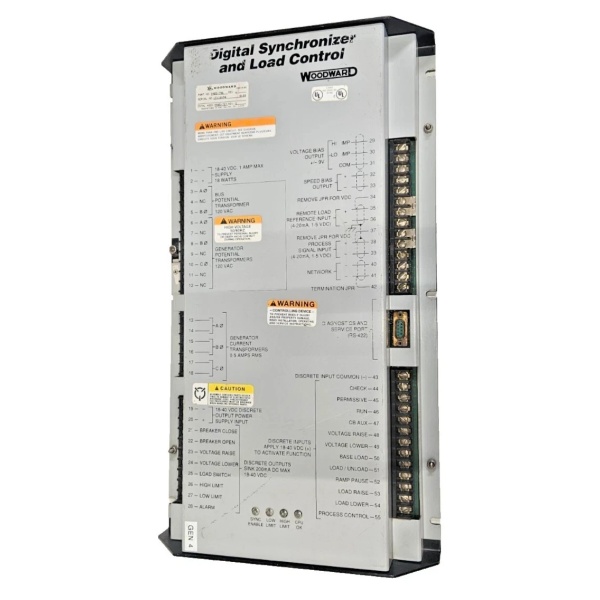
Woodward 9905-796
Technical Deep Dive & Overview
The Woodward 1691-143 is a modular expansion chassis for the Netcon distributed control platform, designed to increase I/O capacity without adding independent controllers. It represents a hardware-centric approach to control system scalability, where processing remains centralized in the main Netcon chassis but I/O handling is distributed across expansion racks.
The chassis consists of a metal enclosure with a passive or active backplane (depending on configuration—”B842″ typically indicates active backplane with communication interface
), power distribution circuitry, and slots for standard Netcon I/O modules. These modules slide into the chassis and connect to the backplane via high-density edge connectors, providing the electrical interface for field signals and communication with the main controller.
The backplane architecture uses a parallel bus or high-speed serial communication (depending on Netcon generation) to connect I/O modules to the main processor. In active backplane configurations (B842), the expansion chassis contains interface circuitry that packetizes I/O data for transmission to the main controller, reducing wiring complexity and improving noise immunity. In passive configurations, the backplane simply extends the main chassis bus, requiring more direct wiring but offering lower latency.
From a system architecture perspective, the 1691-143 allows the Netcon platform to scale from small single-turbine applications (using just the main chassis) to large complex installations with hundreds of I/O points. The expansion chassis can be mounted locally (same cabinet) or remotely (up to cable length limits), providing flexibility in control room layout. Typical I/O modules supported include:
-
Digital input modules (24Vdc, 125Vdc, AC)
-
Digital output modules (relay, solid-state)
-
Analog input modules (4-20mA, 0-10V, RTD, thermocouple)
-
Analog output modules (4-20mA, 0-10V)
-
Communication modules (Modbus, Ethernet, proprietary)
The 1691-143 is part of Woodward’s broader Netcon ecosystem, which competed in the 1990s and 2000s with systems like Allen-Bradley PLC-5, Modicon Quantum, and Emerson Ovation for turbine and generator control applications. While newer Woodward platforms (like the EasyGen series) have moved toward more integrated architectures, the Netcon system with 1691-143 expansion chassis remains in service in many industrial plants due to its reliability and the high cost of control system migration.