Description
Key Technical Specifications
-
Model Number: 1C31129G04
-
Manufacturer: Westinghouse (now Emerson)
-
Function: 4-channel analog current output
-
Output Range: 0-20 mA (4-20 mA selectable in I/O Builder)
-
Diagnostics: None (use 1C31129G03 if diagnostics required)
-
Personality Mate: 1C31132G01 (4-channel AO personality module)
-
Supply Voltage: 220 VAC module power (from Ovation rack)
-
Output Frequency: 50 kHz carrier (PWM current regulation)
-
Isolation: 2 kV channel-to-bus basic (per Ovation spec)
-
Accuracy: ±0.1 % full scale typical
-
Dimensions / Weight: 121 × 51 × 166 mm, 0.35 kg
-
Operating Temperature: –40…+70 °C (Ovation rack ambient)
-
Protection: Short-circuit, over-temp, reverse-polarity protected outputs
-
Status: Factory discontinued – new & tested spares available

1C31203G01
Field Application & Problem Solved
In the field the biggest headache is getting a rock-steady 4-20 mA signal to a governor valve positioner without running copper cables all the way back to the PLC. The 1C31129G04 lives in the Ovation rack: it sources up to 20 mA into 750 Ω loops, clamps inductive spikes, and reports “loop OK” status (even without full diagnostics). You’ll typically find one per valve bank on Frame-7/9 peakers—swap time is under two minutes with the unit on turning gear. Core value: it collapses four precision current sources, loop protection, and V-bus isolation into one 0.35 kg plug-in card you can carry in your pocket.
In the field the biggest headache is getting a rock-steady 4-20 mA signal to a governor valve positioner without running copper cables all the way back to the PLC. The 1C31129G04 lives in the Ovation rack: it sources up to 20 mA into 750 Ω loops, clamps inductive spikes, and reports “loop OK” status (even without full diagnostics). You’ll typically find one per valve bank on Frame-7/9 peakers—swap time is under two minutes with the unit on turning gear. Core value: it collapses four precision current sources, loop protection, and V-bus isolation into one 0.35 kg plug-in card you can carry in your pocket.
Installation & Maintenance Pitfalls (Expert Tips)
Loop Power Comes from the Card – Don’t Double-Source
The module sources 24 V compliance. If your positioner also sources power you’ll fight the regulator and the output drifts. Break the loop at the field junction box and verify only one power source is active.
The module sources 24 V compliance. If your positioner also sources power you’ll fight the regulator and the output drifts. Break the loop at the field junction box and verify only one power source is active.
No Diagnostics Means No Early-Warning
Use 1C31129G03 if you need loop-open alarm. With G04 you won’t know the wire is broken until the valve doesn’t move—megger the loop during every outage.
Use 1C31129G03 if you need loop-open alarm. With G04 you won’t know the wire is broken until the valve doesn’t move—megger the loop during every outage.
Output Frequency Heats the Card – Keep Airflow
The 50 kHz PWM regulator runs warm. If your rack fan fails the heat-sink hits 80 °C and accuracy drops 0.05 %. Blow the cabinet out every major or add a muffin fan if ambient > 60 °C.
The 50 kHz PWM regulator runs warm. If your rack fan fails the heat-sink hits 80 °C and accuracy drops 0.05 %. Blow the cabinet out every major or add a muffin fan if ambient > 60 °C.
Spare Lead-Time Is 6-8 Weeks – Keep One on the Shelf
Factory stock is gone; new & tested spares are available but not overnight. If you burn an output or crack a layer you’ll be down until the part arrives—keep one in stores or you’ll discover the weakness during the next grid event.
Factory stock is gone; new & tested spares are available but not overnight. If you burn an output or crack a layer you’ll be down until the part arrives—keep one in stores or you’ll discover the weakness during the next grid event.
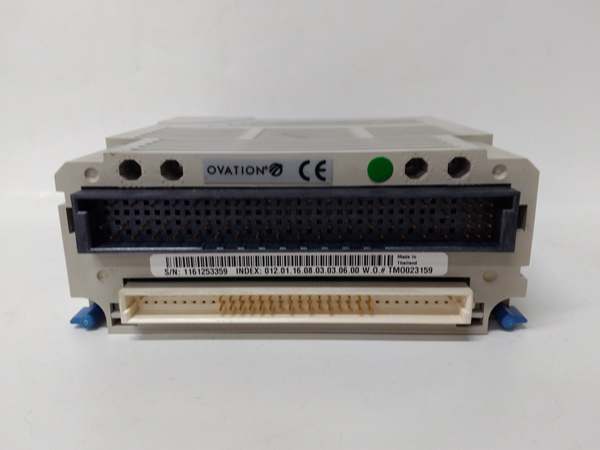
1C31203G01
Technical Deep Dive & Overview
Internally the module is a four-channel PWM current source bolted to a 2 kV isolation barrier. Each channel uses a 50 kHz buck regulator to servo the loop current; the on-board sense resistor gives ±0.1 % accuracy. No on-board CPU—pure hardware—so you can hot-swap it without reloading parameters; just remember to torque the front-panel screws or the connector will walk out on the first vibration cycle.
Internally the module is a four-channel PWM current source bolted to a 2 kV isolation barrier. Each channel uses a 50 kHz buck regulator to servo the loop current; the on-board sense resistor gives ±0.1 % accuracy. No on-board CPU—pure hardware—so you can hot-swap it without reloading parameters; just remember to torque the front-panel screws or the connector will walk out on the first vibration cycle.