Description
Product Core Brief
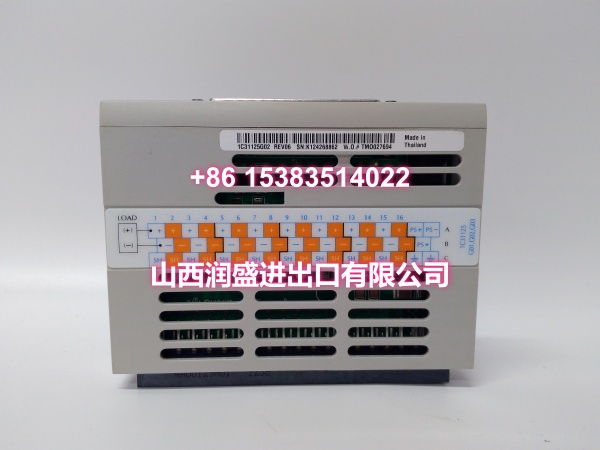
- Model: 1C31125G02
- Brand: Westinghouse / Emerson Ovation lineage
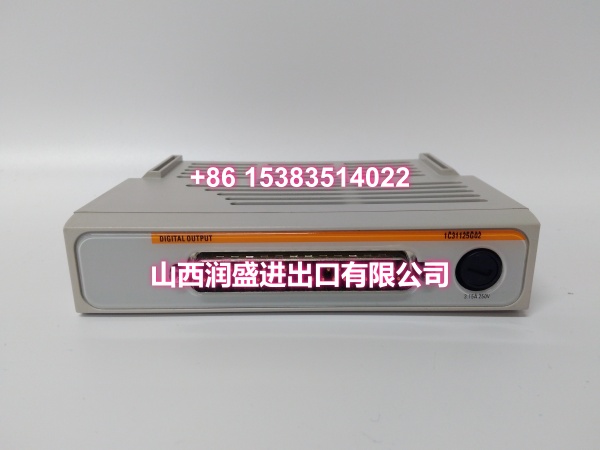
- Correct Class: Personality module, also called PMOD, for the Ovation digital output path
- Core Function: Used when the power is locally supplied from the I/O backplane auxiliary supply, providing the interface from the digital output module to the relay module. It can also be used to connect the digital output module to the field through a terminal block
- Paired EMOD: 1C31122G01, listed as the electronic module for digital output driving 60VDC loads
- Not A Standalone Card: It does not run logic, does not program, and does not communicate over Modbus or OPC
- Condition: New Original / New Surplus / Refurbished, demand nameplate photos
Product Introduction
1C31125G02 is a digital output personality module, not the digital output card itself. In Ovation the electronic module handles the switching and the PMOD defines what the field side actually looks like. For this part, the key detail is that it covers local power supplied by the I/O backplane auxiliary supply, interfacing the digital output module to the relay module, and it can also be used for terminal block connection to the field
That single sentence kills most wrong orders. If your relay coil power comes from a remote supply, you need 1C31125G03 instead, which interfaces the digital output module to the relay module when power is remotely supplied from the relay module If you only need terminal block connection to the field, 1C31125G01 is the one listed for connecting the digital output module to the field through a terminal block
A lot of trading pages call this a 16 channel digital output module with relay output, 3.15A, 24VDC and IP67, or claim it supports Modbus and OPC programming That is copied filler. A PMOD has no firmware to program and no protocol stack. If your fault is communication, this part will not fix it.
Key Technical Specifications
| Parameter | Value |
|---|---|
| Part Number | 1C31125G02 |
| Platform | Ovation DCS, Westinghouse and Emerson heritage |
| Module Class | PMOD, personality module for digital output |
| Common Function | Local supply via I/O backplane auxiliary power, DO module to relay module interface, also usable for terminal block field connection |
| Paired EMOD | 1C31122G01, digital output electronic module for 60VDC loads |
| Sibling PMODs | 1C31125G01 terminal block field connection, 1C31125G03 remote supply from relay module |
| Mounting | Ovation standard and compact modules install in base units on DIN rails in Ovation cabinets, and each base holds two I/O modules even if only one is used |
| Jumpers | Most Ovation personality modules have no configurable jumpers, and where they exist the card must come out of the PMOD case to change defaults |
| Typical Failure Mode | Cracked case, burned trace, corroded clamp, failed internal path causing dead output, wrong PMOD installed for the supply scheme |
| Handling | Anti-static bag with desiccant, store flat, keep away from conductive dust |
| Verification Method | Confirm local or remote power scheme against cabinet drawing and Ovation hardware manual |
Quality Control Process
A PMOD gets a continuity and isolation check, not a firmware load.
- Nameplate and suffix match. Confirm G02, not G01 or G03. The three look nearly identical on the shelf and cover different power schemes.
- Power scheme confirmation. Verify whether your relay coil power comes from the I/O backplane auxiliary supply or a remote supply.
- EMOD pairing check. Confirm the EMOD is the digital output electronic module your drawing calls for, commonly 1C31122G01
- Visual burn inspection. Look for discoloration, melted plastic and arcing marks around the relay interface path.
- Continuity trace with a Fluke multimeter. Probe from the field terminal through to the mating point on every channel.
- Clamp and thread check. Run every screw in by hand first. Cross threaded clamps walk loose under vibration weeks later.
- Insulation test using a Megger. Confirm no short between channel groups and cabinet ground.
- Live channel test with the load disconnected first. Drive each output and confirm the relay pulls in, then recheck with the real load attached.
I once saw a maintenance team chase a stuck feedwater valve for a full shift. The EMOD was fine. The PMOD installed was for remote supply while the cabinet ran on local backplane power. Nobody had checked the drawing.
Replacement Pitfall Guide
Buying G03 instead of G02. G03 is for remote power supplied from the relay module, and using it ties the remote and local supply回路 together, so the supply return must be grounded at the same point to avoid ground potential difference problems Get this wrong and you create a grounding headache instead of fixing one.
Believing it is a 16 channel relay output card with IP67 and 3.15A. Those specs circulate on trading pages and do not match the PMOD role in Ovation documentation
Expecting Modbus, OPC or programming support. Some pages claim it integrates through Modbus or OPC and can be programmed for logic and fault handling. A personality module does not do that
Ignoring the base unit. Ovation standard and compact modules mount in base units on DIN rails, and each base holds two I/O modules even when only one is used A cracked base makes a good PMOD look dead.
Assuming jumpers can be changed in place. Where a personality module has configurable jumpers, the card usually has to come out of the PMOD case to change default settings
Trusting placeholder pricing. Some listings show 1C31125G02 at 1 RMB per unit from a Shanghai supplier, which is bait rather than a real quote Other sellers list it around 1000 to 5000 RMB alongside 1C31122G01 and 1C31116G04
Keep these in mind and you’ll cut most rework time.
Compatibility Matrix & Benchmarks
| Original Model | Replacement / Alternative | Compatibility Level | Migration Notes |
|---|---|---|---|
| 1C31125G02 | Refurbished same part | Direct | Inspect for burn marks, run continuity and insulation on every channel |
| 1C31125G02 | 1C31125G01 | Needs Adaptation | For terminal block field connection only, no local to relay module interface |
| 1C31125G02 | 1C31125G03 | Needs Adaptation | For remote supply from the relay module, ties remote and local supply returns together |
| 1C31125G02 | 1C31122G01 | Not Compatible | Digital output EMOD, pairs with the PMOD rather than replacing it |
| 1C31125G02 | 1C31238H01 | Not Compatible | Compact DI or contact input insert, different signal direction |
| 1C31125G02 | Third party relay output module | Needs Adaptation | Loses native Ovation registration, diagnostics and backplane power scheme |
Benchmark references
- Acceptance criterion: every channel drives the relay reliably with the real load attached, with no intermittent drop out while the harness is flexed by hand.
- Isolation target: no short between channel groups and cabinet ground on a Megger test.
- Wiring target: supply return grounded at a single point consistent with your power scheme, especially if switching to a remote supply PMOD
Procurement Notes
Push for four things before paying: a clear nameplate photo showing the G02 suffix, confirmation from the seller that it is a personality module for local backplane supplied DO rather than a standalone DO card, customs paperwork if it is claimed as imported original stock, and confirmation of which EMOD and base it is meant to sit with.
If a supplier describes it as a programmable module with Modbus or OPC support, treat the listing as unverified and move on. That description usually means nobody in that office has ever opened an Ovation cabinet.