Description
Hard-Numbers: Technical Specifications
General Specifications
- Resolution: 7½ digits (26 bits)
- Basic DC Voltage Accuracy (10 V range, 2-year): 12 ppm of reading + 0.5 ppm of range (±0.0012%)
- ADC Linearity: 0.5 ppm of reading + 0.5 ppm of range
- Warm-up Time: 60 minutes to rated accuracy
- Calibration Interval: 2 years (recommended)
- Measurement Categories: CAT I (up to 1000 VDC, 700 Vrms, 1000 Vpk), CAT II (up to 500 VDC or Vrms)
- Environmental: Operating 0°C to 55°C, Storage -40°C to 71°C, Humidity <80% RH noncondensing
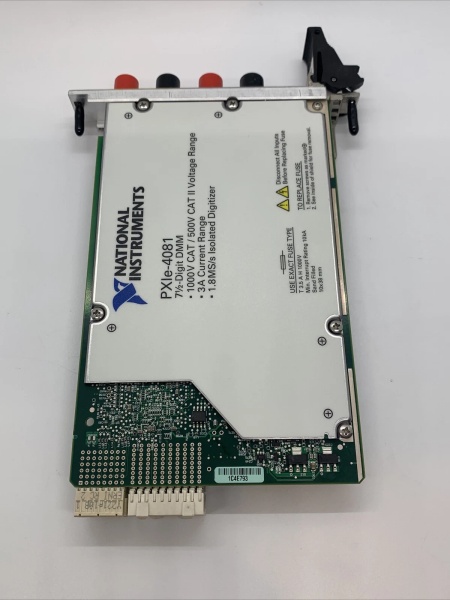
- Physical: 3U single-slot PXIe module, 2.0 cm × 13.0 cm × 21.6 cm (0.8″ × 5.1″ × 8.5″), Weight 340 g (12 oz)
DC Voltage Measurement
- Range: ±100 mV, ±1 V, ±10 V, ±100 V, ±1000 V
- Input Resistance: >10 GΩ / 10 MΩ switchable
- Sensitivity: 10 nV
- 24-Hour Accuracy (Tselfcal ±1°C):
- 100 mV range: 8 ppm reading + 1 ppm range
- 1 V range: 4 ppm reading + 0.5 ppm range
- 10 V range: 3 ppm reading + 0.5 ppm range
- 100 V range: 3 ppm reading + 0.5 ppm range
- 1000 V range: 5 ppm reading + 0.5 ppm range
AC Voltage Measurement
- Range (rms): 50 mV, 500 mV, 5 V, 50 V, 500 V, 700 V
- Peak Voltage: 1000 V (700 Vrms range)
- Frequency Range: 1 Hz to 300 kHz
- Accuracy (2-Year, Tselfcal ±10°C):
- 1 Hz to 40 Hz: 0.1% reading + 0.02% range
- 40 Hz to 20 kHz: 0.05% reading + 0.02% range
- 20 kHz to 50 kHz: 0.07% reading + 0.02% range
- 50 kHz to 100 kHz: 0.3% reading + 0.02% range
- 100 kHz to 300 kHz: 0.7% reading + 0.15% range
DC Current Measurement
- Range: ±100 µA, ±1 mA, ±10 mA, ±100 mA, ±1 A, ±3 A
- Burden Voltage: 0.2 V typical at 3 A range
- Sensitivity: 1 pA
- 24-Hour Accuracy (Tselfcal ±1°C):
- 100 µA to 100 mA ranges: 25 ppm reading + 4 ppm range
- 1 A range: 30 ppm reading + 5 ppm range
- 3 A range: 35 ppm reading + 5 ppm range
AC Current Measurement
- Range (rms): 100 µA, 1 mA, 10 mA, 100 mA, 1 A, 3 A
- Peak Current: 4.2 A (3 A range)
- Frequency Range: 1 Hz to 100 kHz (1 mA and above ranges)
- Accuracy (2-Year, Tselfcal ±10°C): Same as DC current + add 20 ppm reading
Resistance Measurement
- Range: 100 Ω, 1 kΩ, 10 kΩ, 100 kΩ, 1 MΩ, 10 MΩ, 100 MΩ, 1 GΩ, 10 GΩ
- Sensitivity: 10 µΩ (100 Ω range)
- Maximum Measurement: 5 GΩ
- Modes: 2-wire and 4-wire (Offset Compensated Ohms for ≤10 kΩ, Auto Zero for ≥100 kΩ)
- 24-Hour Accuracy (Tselfcal ±1°C):
- 100 Ω to 1 MΩ: 12 ppm reading + 3 ppm range
- 10 MΩ to 100 MΩ: 20 ppm reading + 5 ppm range
- 1 GΩ range: 50 ppm reading + 10 ppm range
Frequency/Period Measurement
- Frequency Range: 15 Hz to 500 kHz
- Period Range: 2 µs to 66.67 ms
- Input Sensitivity: >1% of range
- Aperture Time: 150 ms
Digitizer Mode (Isolated High-Voltage Digitizer)
- Voltage Ranges: ±100 mV to ±1000 V (DC or AC coupled)
- Current Ranges: 100 µA to 3 A
- Sample Rate Range: 10 S/s to 1.8 MS/s (r = 1.8 MS/s / y, where y = 1, 2, 3, … 1.8×10⁵)
- Analog Bandwidth: 300 kHz (voltage), 400 kHz (current, 1 mA and above)
- Resolution: 10-bit to 26-bit (variable with sample rate)
- Coupling: DC or AC selectable
- Maximum Slew Rate:
- 1000 V range: 2000 V/µs
- 100 V range: 200 V/µs
- 10 V range: 20 V/µs
- 1 V range: 2 V/µs
- 100 mV range: 0.2 V/µs
Input/Output
- Input Impedance (Digitizer): 10 MΩ ±2% parallel with 90 pF
- Common Mode Voltage: ±500 VDC/Vrms
- Input Protection: 1000 VDC/Vpk, Current fuse T 3.5 A 1000 V (Siba 5019906.3.5, 10 kA interrupt rating)
Power
- Power Consumption: <9 W from PXIe backplane
- +12 V Load: 0.55 A maximum
- +3.3 V Load: 0.55 A maximum
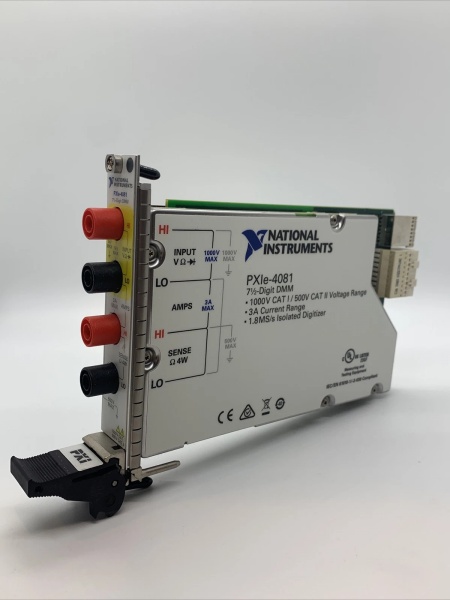
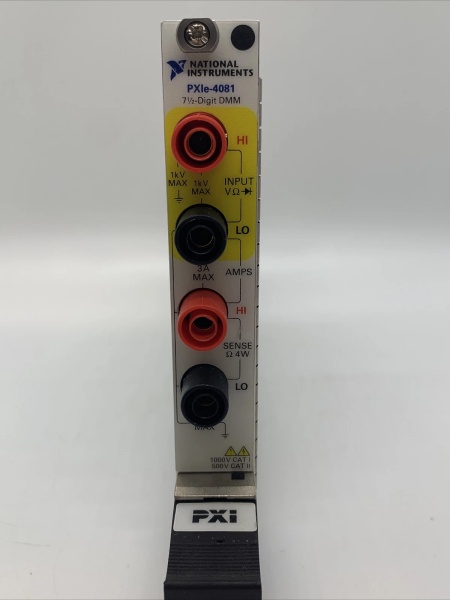
NI PXIE-4081 783130-01
The Real-World Problem It Solves
Traditional 7½-digit benchtop DMMs trade speed for precision—measurements take seconds to stabilize, and they cannot capture transient waveforms. The PXIe-4081 delivers metrology-grade accuracy (12 ppm DC voltage) with measurement throughput up to 10 kS/s in DMM mode and 1.8 MS/s in digitizer mode, all in a single PXI slot. This eliminates the need for separate precision DMMs and high-speed digitizers in ATE systems, reducing equipment cost and test time while enabling both static precision measurements and dynamic waveform analysis.
Where you’ll typically find it:
- Calibration laboratories: Verifying multi-function calibrator outputs with 12 ppm accuracy and capturing calibration drift over time
- Automotive electronics testing: Measuring sensor signals with µV precision while capturing power-up transients in EV battery management systems
- Aerospace power systems: Characterizing 270 V DC aircraft power distribution with high-accuracy voltage/current measurements and waveform capture for harmonic analysis
Bottom line: This DMM replaces two instruments (precision DMM + high-voltage digitizer) in one PXI slot, delivering 26-bit accuracy at 1.8 MS/s with 2-year calibration intervals, reducing test system cost and downtime.
Hardware Architecture & Under-the-Hood Logic
The PXIe-4081 is built on NI’s FlexADC architecture, which combines a commercial off-the-shelf high-speed ADC with a custom sigma-delta converter to achieve both 7½-digit precision and 1.8 MS/s digitization in a single module. The frontend uses a single 10 MΩ input attenuator with an innovative scaled bootstrap circuit to eliminate traditional 1 MΩ attenuator capacitance issues, enabling 300 kHz AC bandwidth while maintaining CAT I 1000 V safety ratings. Solid-state high-voltage switches replace mechanical relays for range selection, eliminating contact wear and enabling faster switching. An onboard DSP calculates true RMS using digital signal processing rather than analog circuits, providing faster stable readings and immunity to peak factor variations. Self-calibration corrects DC gain and offset drift using a precision internal voltage reference with exceptional temperature and time stability, maintaining accuracy across the 0-55°C operating range.
- Signal Input → Front-panel banana connectors receive voltage/current signals → Input protection circuitry (1000 V rated) and solid-state range switches route signal to appropriate attenuation path
- 10 MΩ Attenuator Network → Scaled bootstrap circuit (R1-R4, C1, U1) nulls stray capacitance → Delivers flat frequency response to 300 kHz without 1 MΩ compensator capacitor → Eliminates temperature coefficient errors associated with 1 MΩ attenuators
- FlexADC Core → High-speed commercial ADC provides raw digitization → Custom sigma-delta converter applies oversampling and digital filtering → DSP computes true RMS and performs DC measurements → Resolution varies from 10-bit (1.8 MS/s) to 26-bit (7½-digit DMM mode)
- Measurement Modes: DMM Mode (DC/AC voltage/current, resistance, frequency/period) uses aperture times ≥100 ms for full accuracy → Digitizer Mode (isolated, high-voltage) samples continuously at 1.8 MS/s with DC/AC coupling selection
- Self-Calibration Loop → Precision internal voltage reference (high-stability, low TC) → Compares against internal reference to correct DC gain and offset drift → Accounts for resistance and current source drift → Maintains 2-year calibration interval
- Digital AC RMS Calculation → Digitizes waveform using onboard ADC → DSP algorithm calculates RMS over 4 cycles → Automatically suppresses DC component → Immune to peak factor variations → Faster settling than analog RMS converters
- Bus Interface → PXI Express Gen 1 x1 lane (250 MB/s) → Transfers measurement data to host controller → Controlled via NI-DMM driver software
- Power Distribution → PXIe backplane provides +12 V and +3.3 V rails → Isolated digitizer section uses dedicated power path → Total power consumption <9 W
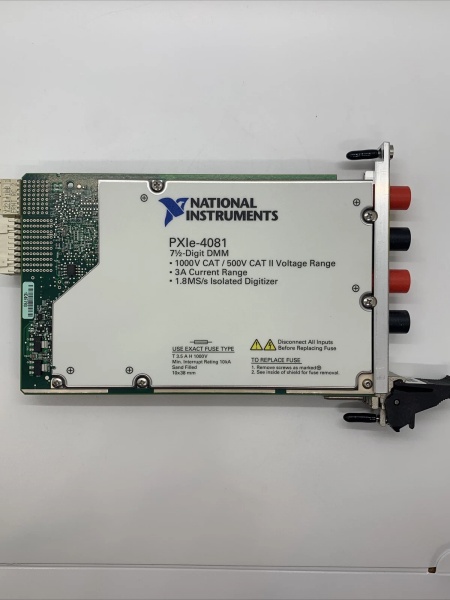
NI PXIE-4081 783130-01
Field Service Pitfalls: What Rookies Get Wrong
Neglecting Warm-Up Time for Metrology Accuracy
Technicians power up the PXIe-4081 and immediately start taking precision measurements, ignoring the 60-minute warm-up requirement. The internal reference temperature hasn’t stabilized, causing measurements to drift outside the 12 ppm accuracy specification. For sub-ppm applications like calibration verification, this error exceeds the uncertainty budget.
Field Rule: Power on the PXIe-4081 at least 60 minutes before critical measurements. Monitor the internal temperature via NI MAX—when it stabilizes within ±1°C of ambient, the module is ready. For repeatable metrology work, maintain the chassis at constant temperature and use the self-calibration feature before critical measurements. Remember: warm-up is required every time the module is powered down or ambient temperature changes >5°C.
Exceeding Slew Rate Limits in Digitizer Mode
Engineers capture fast-rising signals in digitizer mode assuming the 1.8 MS/s sample rate handles any waveform. However, the PXIe-4081 has input slew rate limits (e.g., 20 V/µs on the 10 V range). Exceeding these limits causes distortion and amplitude errors, especially when measuring switching power supply transients with fast rise times.
Quick Fix: Verify signal slew rate against specifications before acquisition. If the signal exceeds the limit for the current range, switch to a higher range (higher voltage ranges support higher slew rates). For example, a 50 V signal with 1000 V/µs rise time requires the 100 V range (200 V/µs limit), not the 10 V range. Use the trigger function to capture transients at the appropriate range setting.
Ignoring Cable Thermal EMF in Sub-µV Measurements
Rookies use standard copper test leads for DC voltage measurements in the 100 mV range, introducing thermal EMF errors of 1-5 µV that corrupt 10 nV resolution measurements. At 7½-digit resolution, copper-copper junctions with even 0.1°C temperature difference generate measurement noise exceeding the DMM’s capability.
Field Rule: Use low thermal EMF copper cables (copper-to-copper connections) for precision DC measurements below 1 V. Allow 2 minutes for thermal EMF to stabilize after connections before taking readings. For critical applications, use offset nulling—short the inputs, measure the offset, and subtract it from subsequent readings. The specifications assume offset nulling; otherwise, add 2 µV to the accuracy specifications.
Forgetting Auto Zero and ADC Calibration for Maximum Accuracy
Technicians disable Auto Zero and ADC calibration to increase measurement speed, not realizing this compromises accuracy beyond warranted specifications. Without Auto Zero, internal offsets accumulate; without ADC calibration, gain drift degrades precision over temperature changes.
Quick Fix: Enable Auto Zero and ADC calibration for all metrology-grade measurements. These functions are required to achieve the published 12 ppm DC voltage accuracy. If speed is critical and you can accept degraded accuracy, disable them—but document the tradeoff in your test procedure. Remember: for 24-hour specifications, Self-Cal must be performed within the last 24 hours, and Auto Zero must be ON.
Misunderstanding Digitizer Bandwidth vs. Sample Rate
Users assume the 1.8 MS/s sample rate allows accurate measurement of 900 kHz signals (Nyquist limit). However, the analog bandwidth is only 300 kHz—signals above this frequency are attenuated at -3 dB or more, causing amplitude errors regardless of sample rate.
Field Rule: Treat the PXIe-4081 digitizer as a 300 kHz bandwidth instrument for voltage measurements (400 kHz for current above 1 mA). The 1.8 MS/s sample rate provides oversampling (6× at 300 kHz) for improved resolution and reduced aliasing, but doesn’t extend the analog bandwidth. For signals above 300 kHz, use a dedicated PXIe digitizer with higher bandwidth.
Commercial Availability & Pricing Note
Please note: The listed price is for reference only and is not binding. Final pricing and terms are subject to negotiation based on current market conditions and availability.