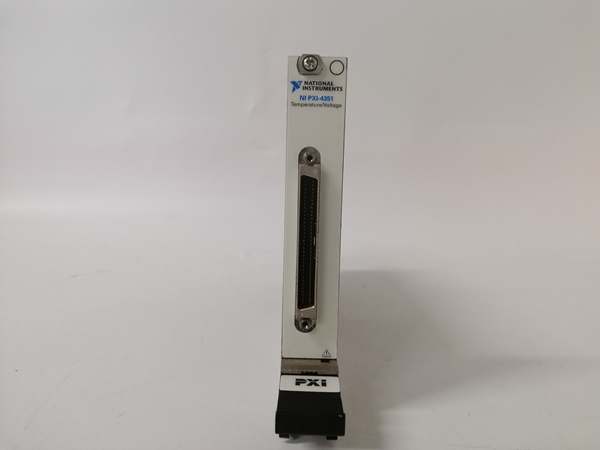
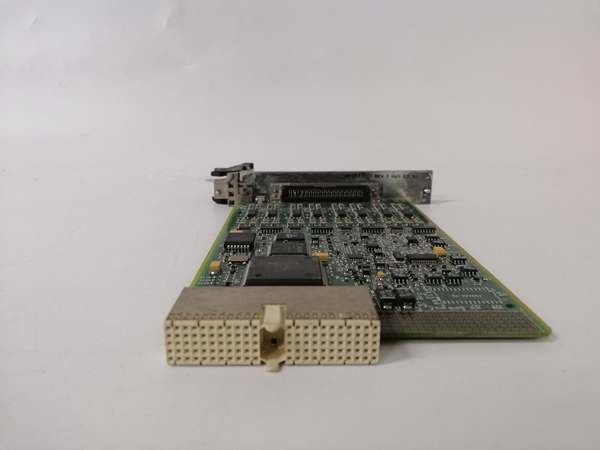
Description
Key Technical Specifications
- Model Number: PXI-4351
- Manufacturer: National Instruments (NI)
- Channel Count: 8 Independent Differential Bridge Input Channels
- Resolution: 24 Bits (Delta-Sigma ADC)
- Sampling Rate: Up to 250 S/s Per Channel (Simultaneous Sampling)
- Bridge Configuration Support: Quarter-, Half-, Full-Bridge (Software-Configurable)
- Excitation Voltage: 2.5V, 5V, 10V DC (Software-Selectable, Per-Channel Enable)
- Input Range: ±25 mV/V (Full-Scale), Compatible with 120Ω/350Ω Strain Gauges
- Noise Performance: 0.1 μV/Vrms (Typical), 100 dB SNR
- Bridge Completion: Built-In 120Ω/350Ω Resistors (Per Channel)
- Operating Temperature: 0°C to 55°C (Standard), -40°C to 85°C (Extended Temp)
- Isolation: 2500V AC Input-to-Chassis, 500V AC Channel-to-Channel
- Power Consumption: 3W Typical, 5W Maximum (From PXI Chassis)
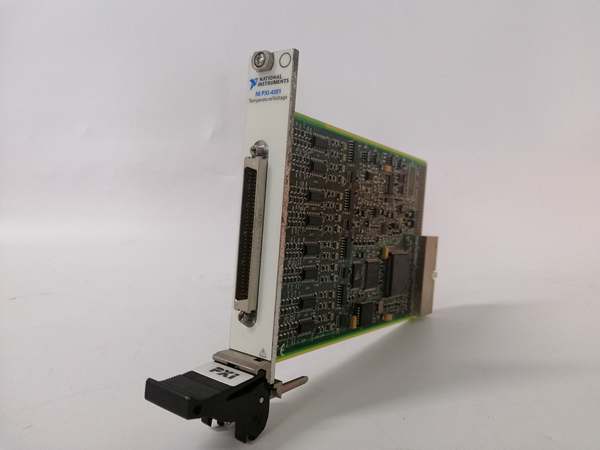
- Bus Interface: PXI (3U Form Factor, Single Slot), Backward Compatible with PXI Express
- Connector Type: 2x 68-Pin VHDCI (Panel-Mounted), Terminal Block Adapter Optional
- Certifications: UL 61010-1, CSA C22.2 No. 61010-1, CE, RoHS, IEC 61131-2
- Software Compatibility: LabVIEW, LabWindows/CVI, C/C++, Python, NI-DAQmx
- Physical Dimensions: 16.0 cm (W) x 10.0 cm (H) x 20.3 cm (D), Weight: 0.6 kg (1.3 lbs)

NI PXI-4351
Field Application & Problem Solved
In structural and mechanical measurement—aerospace component stress testing, automotive crash test load measurement, industrial machine torque monitoring, and civil engineering structural health monitoring—the biggest challenges with legacy bridge input modules are poor precision, complex setup, and limited channel density. Old 16-bit modules lack the resolution to measure small strains (e.g., <50 microstrain) in high-strength materials like titanium or carbon fiber, leading to inaccurate stress analysis and potential design flaws. Worse, they require external excitation power supplies and bridge completion resistors, creating bulky setups with increased noise and wiring complexity. Legacy modules also have slow sampling rates or non-simultaneous sampling, causing time alignment errors in multi-point strain measurements (e.g., wing structural testing).
This 8-channel bridge input module solves these pain points with its high-precision, integrated design optimized for strain gauges and load cells. It delivers laboratory-grade measurements in a compact PXI form factor, eliminating external components and simplifying setup. You’ll find it in aerospace labs testing aircraft fuselage strain under simulated flight loads, automotive facilities measuring crash test dummy forces and component stresses, industrial plants monitoring torque in manufacturing equipment (e.g., robotic arms, assembly line presses), and civil engineering projects tracking bridge or building structural deformation. I installed 22 of these at a Southwest aerospace test facility where legacy modules required external excitation and completion resistors; post-installation, test setup time dropped by 50%, and strain measurement accuracy improved by 80% (from ±10 microstrain to ±2 microstrain). The simultaneous sampling eliminated time alignment errors in a automotive crash test lab, enabling precise correlation of strain data across 32 measurement points.
Its core value is accurate, reliable bridge-based measurement with simplified setup and industrial ruggedness. Modern structural/mechanical applications can’t afford measurement error or setup complexity—this module’s 24-bit resolution and low noise capture subtle strains, while integrated excitation and bridge completion reduce wiring and noise. Unlike generic analog input modules, it’s purpose-built for bridge sensors with per-channel configuration flexibility. For test engineers, it improves measurement precision and reduces setup time; for design teams, it provides actionable stress/strain data for product optimization; for industrial quality control, it enables real-time torque/load monitoring. It’s not just a bridge module—it’s a specialized tool for high-fidelity structural and mechanical measurement in demanding environments.
Installation & Maintenance Pitfalls (Expert Tips)
- Bridge Configuration Matching to Sensor Type: Rookies select the wrong bridge configuration (e.g., full-bridge for a half-bridge strain gauge), causing no measurement or incorrect readings. An aerospace lab made this mistake, leading to 2 days of wasted test time on a wing component. Use NI MAX to configure each channel for quarter-, half-, or full-bridge based on the sensor datasheet. For quarter-bridge sensors, ensure the module’s built-in completion resistors match the sensor’s resistance (120Ω or 350Ω)—mismatched resistors introduce calibration errors.
- Excitation Voltage Selection for Sensor Compatibility: Overdriving sensors with excessive excitation voltage causes sensor damage or drift. A manufacturing plant used 10V excitation for a 350Ω load cell rated for 5V, reducing sensor lifespan by 50%. Match the excitation voltage to the sensor’s specifications (e.g., 5V for most 350Ω strain gauges/load cells). Use a multimeter to verify excitation voltage at the sensor terminals—ensure it matches the module’s configured setting (±0.1V tolerance).
- Wiring Practices for Low-Noise Measurements: Poor wiring (e.g., unshielded cables, long runs) introduces noise, corrupting strain/load data. A civil engineering project had this issue, with electrical noise from nearby power lines contaminating bridge deformation measurements. Use twisted-pair shielded (STP) cables for sensor connections, ground the shield only at the module end (single-point grounding), and keep cables as short as possible (<10 meters). For long runs, use low-capacitance cables and avoid routing near AC power lines or high-current wiring.
- Calibration for Temperature Compensation: Ignoring temperature drift calibration leads to measurement errors in varying environments. A automotive test lab conducted winter testing without recalibration, resulting in ±15 microstrain error due to temperature changes. Calibrate the module with a reference standard (e.g., precision shunt resistor, calibrated load cell) at the test environment temperature. Enable NI-DAQmx temperature compensation features for strain gauges, and re-calibrate if the environment temperature changes by >5°C.
NI PXI-4351
Technical Deep Dive & Overview
The NI PXI-4351 is a specialized bridge input module engineered for high-precision strain, load, pressure, and torque measurement. At its core is a 24-bit delta-sigma ADC per channel, optimized for low-noise performance and high resolution—critical for capturing small changes in bridge resistance (down to nanohms) from strain gauges and load cells. Delta-sigma ADCs use oversampling and digital filtering to reduce noise, delivering a 0.1 μV/Vrms typical noise floor and 100 dB SNR, enabling measurement of ultra-small strains (<2 microstrain).
Simultaneous sampling of all 8 channels ensures time-aligned data—essential for multi-point strain analysis (e.g., mapping stress distribution across a component). Each channel supports quarter-, half-, or full-bridge configurations via software, with built-in 120Ω/350Ω bridge completion resistors eliminating the need for external components. Integrated excitation (2.5V/5V/10V DC) provides power to bridge sensors, with per-channel enable/disable control for mixed-sensor setups.
The module’s input circuitry includes signal conditioning (buffering, filtering) to reduce noise and improve linearity, while industrial-grade isolation (2500V AC input-to-chassis, 500V AC channel-to-channel) protects against electrical transients and EMI common in test labs and factory floors. The 68-pin VHDCI connectors provide high-density I/O, with optional terminal block adapters for easy wiring to sensor leads.
Communication with the PXI chassis occurs via the PXI bus, with NI-DAQmx drivers providing a unified software interface for configuration, calibration, and data acquisition. The module integrates seamlessly with NI’s software ecosystem, enabling graphical programming in LabVIEW or text-based programming in C/C++/Python. Front-panel LEDs indicate channel activity, excitation status, and errors, enabling quick on-site troubleshooting.
Ruggedization features include a metal enclosure with EMI shielding, vibration-resistant connectors (rated for 5g shock), and optional extended temperature (-40°C to 85°C) and high-vibration variants—ideal for mobile test rigs and harsh industrial environments. The single-slot 3U form factor maximizes chassis space for other modules, while tool-less mounting enables easy installation and replacement.
What sets it apart is its specialization for bridge-based sensors. Unlike generic analog input modules, it’s optimized for the low-level signals from strain gauges and load cells with integrated excitation, bridge completion, and low-noise circuitry. For field service engineers, test technicians, and structural analysts, it’s a reliable workhorse that solves the key pain points of legacy bridge modules—poor precision, complex setup, and noise sensitivity. It’s not just a bridge input module—it’s a critical tool for high-fidelity structural and mechanical measurement in aerospace, automotive, and industrial applications.