Description
Key Technical Specifications
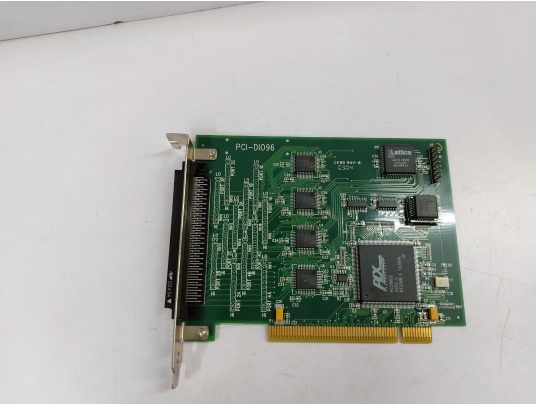
- Model Number: PCI-DIO-96
- Manufacturer: National Instruments (NI)
- Digital I/O Channels: 96 Bidirectional Lines (Configurable as 3×32-Bit Ports or 12×8-Bit Ports)
- Voltage Compatibility: 5V TTL/CMOS (VIL=0.8V Max, VIH=2.0V Min; VOL=0.4V Max, VOH=2.4V Min)
- Current Drive: 24 mA Sink/Source per Channel (Maximum)
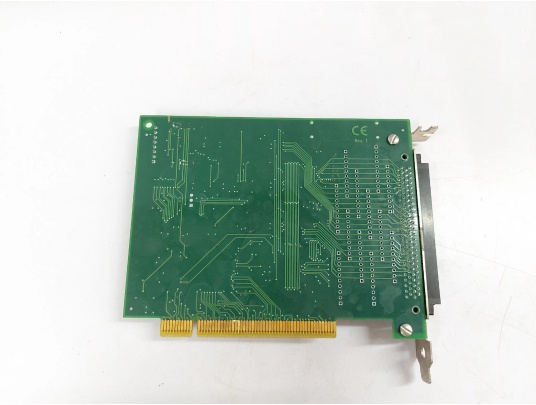
- Bus Interface: 32-Bit PCI (33 MHz), Plug-and-Play Compliant
- Data Transfer: Programmed I/O (PIO) + Direct Memory Access (DMA) for High-Volume Data
- On-Board Memory: 16 KB FIFO per 32-Bit Port (48 KB Total)
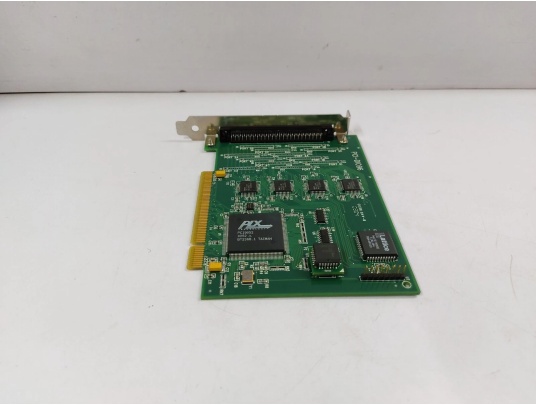
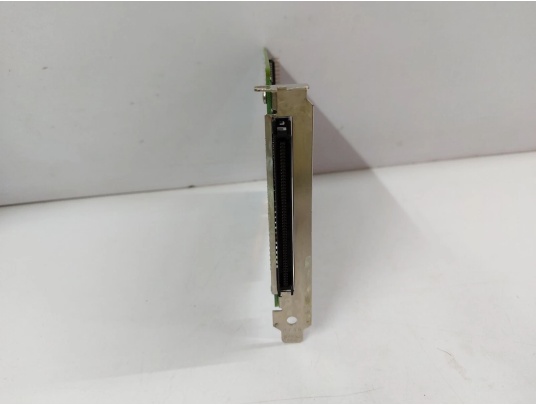
- Connectors: 6×50-Pin Male Ribbon Cable Connectors (Port 0/1/2, 2 Connectors per Port)
- Operating Temperature: 0°C to 55°C (Standard), -40°C to 85°C (Extended Temp)
- Power Consumption: 12W Typical, 15W Maximum (From PCI Bus)
- Isolation: 2500V AC Input-to-Chassis Isolation (Channel-to-Chassis)
- Software Compatibility: NI-DAQmx Driver, LabVIEW, LabWindows/CVI, C/C++, Python, Windows 2000/XP/Vista/7/10 (32/64-Bit)
- Protection Features: Overcurrent Protection (Auto-Recovery), ESD Protection (±15kV Human Body Model)
- Physical Dimensions: 16.5 cm (L) × 10.2 cm (W), Weight: 0.6 kg (1.3 lbs)

NI PCI-DIO-96
Field Application & Problem Solved
In high-density industrial and test environments—automotive assembly lines, electronics manufacturing ATE, and aerospace component testing—controlling hundreds of digital sensors, actuators, or test points requires a compact, reliable I/O solution. Legacy systems often rely on multiple low-density I/O cards that clutter PCI slots, complicate wiring, and increase failure points. For example, an electronics factory testing complex circuit boards needs to control 60+ digital test points (power enable, signal triggers, status reads) simultaneously, but using six 16-channel cards creates wiring chaos and resource conflicts.
This 96-channel high-density I/O card solves those pain points by packing 96 lines into a single PCI slot, reducing chassis footprint and simplifying wiring. You’ll find it in automotive plants controlling relay banks for powertrain testing, electronics factories managing high-channel-count ATE fixtures, and aerospace facilities monitoring sensor arrays in wind tunnel tests. It’s also a staple in legacy system upgrades—expanding I/O capacity for older PLCs or test systems without replacing the entire control infrastructure.
Its core value is density and reliability for high-channel-count applications. The 96 lines cover most industrial and test needs, while 2500V isolation and overcurrent protection ensure durability in harsh environments. For plant managers, this means reduced hardware costs and maintenance time—one card replaces six low-density modules. For test engineers, it’s a plug-and-play solution that integrates seamlessly with automation software, enabling rapid setup of complex test sequences.
Installation & Maintenance Pitfalls (Expert Tips)
- Connector Labeling & Wiring Errors: With 6×50-pin connectors, rookies often mix up Port 0/1/2 wiring—connecting a sensor to Port 1 instead of Port 0 causes “no signal” faults that are time-consuming to trace. Label cables with port numbers and cross-reference the user manual’s pinout diagram before tightening connections. In an automotive test lab, mislabeled cables led to 4 hours of downtime until we mapped each connector to the correct port.
- Power Budget Overload: The card draws up to 15W from the PCI bus—installing it in an older industrial PC with limited power delivery causes intermittent resets or card disconnections. Check the PC’s PCI bus power rating (minimum 25W per slot) and avoid daisy-chaining high-power peripherals. A electronics factory’s ATE system kept crashing until they moved the card to a dedicated PCI slot with sufficient power.
- Overlooking Current Limitations for High-Density Loads: While 24 mA per channel is sufficient for logic-level signals, activating 32 channels simultaneously (e.g., 32 relays) draws 768 mA—exceeding the PCI slot’s current limit if other high-power cards are installed. Use relay drivers or solid-state relays (SSRs) for high-current loads, and spread active channels across ports to balance power draw. A wind tunnel test facility fried a PCI bus by activating 64 channels at once; adding SSRs resolved the issue.
- Outdated NI-DAQmx Drivers Cause Channel Mapping Errors: Legacy drivers (pre-16.0) mismap channels in 32-bit port mode, leading to incorrect signal routing. Update to NI-DAQmx 18.0+—it fixes channel mapping bugs and improves compatibility with Windows 10+. I’ve fixed countless “signal mismatch” issues in ATE systems by updating drivers, even for legacy hardware.
NI PCI-DIO-96
Technical Deep Dive & Overview
The PCI-DIO-96’s design is optimized for high-density digital I/O, balancing channel count, reliability, and ease of use. At its core, three independent 32-bit I/O controllers handle signal routing and data transfer, enabling simultaneous operation of all 96 channels without cross-talk. Each controller includes a 16 KB FIFO buffer, which stores data before DMA transfer to the host PC—preventing underruns during high-volume data acquisition (e.g., reading 96 sensor statuses at 1 kHz).
The card’s 96 channels are split into three 32-bit ports (Port 0/1/2), each with two 50-pin connectors—this modular design simplifies wiring, as users can connect sensors/actuators to specific ports without disrupting other channels. The bidirectional lines are configurable via software, supporting input, output, or handshake modes to match diverse application needs (e.g., sensor reading, relay control, master-slave communication).
Isolation (2500V AC) and ESD protection (±15kV) make the card rugged enough for industrial environments, where voltage transients and electrostatic discharge are common. Overcurrent protection on each channel automatically shuts down the line if current exceeds 24 mA, preventing permanent damage from wiring errors or load faults—a critical feature in high-density setups where tracing a single faulty channel is difficult.
Data transfer relies on DMA for high-volume data (e.g., reading 96 channels at 1 kHz) and PIO for low-latency tasks (e.g., triggering a single relay). While the PCI bus’s 132 MB/s bandwidth is sufficient for the card’s maximum data rate (96 channels × 10 kHz × 1 bit = 1.2 MB/s), it’s not suitable for high-speed applications (e.g., 1 MHz signal generation)—this card is designed for density, not speed.
For field engineers and maintenance teams, the PCI-DIO-96’s biggest strength is its simplicity and scalability. It’s a “workhorse” card that handles high-channel-count tasks without complex configuration, stands up to harsh industrial conditions, and integrates seamlessly with legacy systems. While newer PCIe cards offer higher bandwidth, the PCI-DIO-96 remains a trusted component in applications where density and reliability matter most—proven by its widespread adoption in automotive, electronics, and aerospace sectors.