Description
Hard-Numbers: Technical Specifications
- Analog Inputs: 16 single-ended or 8 differential channels
- ADC Resolution: 16-bit
- Maximum Sampling Rate: 1.25 MS/s aggregate (single channel) or 1.00 MS/s aggregate (multichannel)
- Input Range: ±10 V, ±5 V, ±0.5 V, ±0.1 V (software selectable)
- Analog Outputs: 2 channels, 16-bit, 2.8 MS/s update rate
- Digital I/O: 24 lines (8-bit port 0, 8-bit port 1, 8-bit port 2)
- Counters/Timers: 2 x 32-bit counters
- Bus Interface: 32-bit PCI, 33 MHz
- Triggering: Analog and digital triggering supported
- Operating Temperature: 0°C to 50°C (32°F to 122°F)
- Power Draw: 5 V at 0.8 A (typical), 5 V at 1.2 A (max)
- Connector: 68-pin VHDCI female connector
- Isolation: 250 V RMS channel-to-earth ground (analog inputs)

The Real-World Problem It Solves
When you need to mix analog input, analog output, digital I/O, and counter operations on a single card without burning PCI slots, the PCI-6250 packs it all into one module. The 16-bit resolution gives you usable precision for most test applications, and the aggregate sampling rate handles moderate-speed data acquisition without breaking a sweat.
Where you’ll typically find it:
- Automated test equipment for electronics manufacturing
- Laboratory data acquisition systems with mixed signal requirements
- Process monitoring and control applications in industrial environments
Bottom line: It’s a workhorse multifunction card that gets the job done when you don’t need specialized high-resolution or isolated I/O.
Hardware Architecture & Under-the-Hood Logic
The PCI-6250 uses a single 16-bit ADC multiplexed across all input channels, with dedicated DACs for analog output and a counter/timer chip for digital operations. The PCI interface handles DMA transfers for efficient data streaming to host memory.
Signal flow and processing logic:
- PCI Interface: Host CPU configures card and initiates DMA transfers via PCI bus.
- Analog Input Multiplexer: Channel selection routes input signals to the ADC.
- ADC Conversion: 16-bit ADC samples at up to 1.25 MS/s aggregate rate.
- FIFO Buffer: On-board FIFO stores samples before DMA transfer to host.
- Analog Output: Dual 16-bit DACs generate output waveforms at up to 2.8 MS/s.
- Digital I/O: 24 digital lines controlled directly via registers.
- Counter/Timer: 32-bit counters count external events or generate pulses.
- DMA Transfer: Data streams to host memory via PCI bus without CPU intervention.
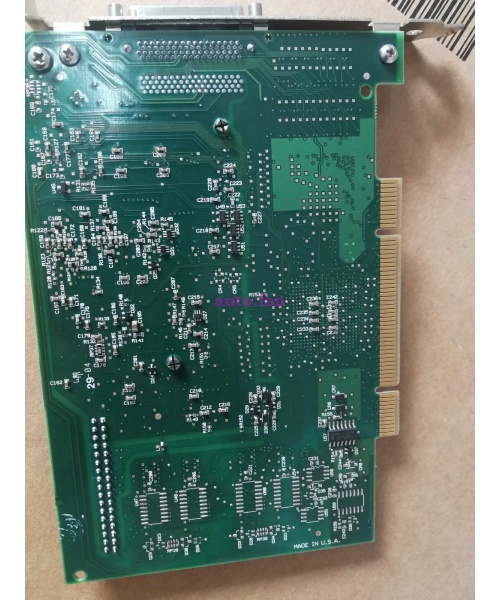
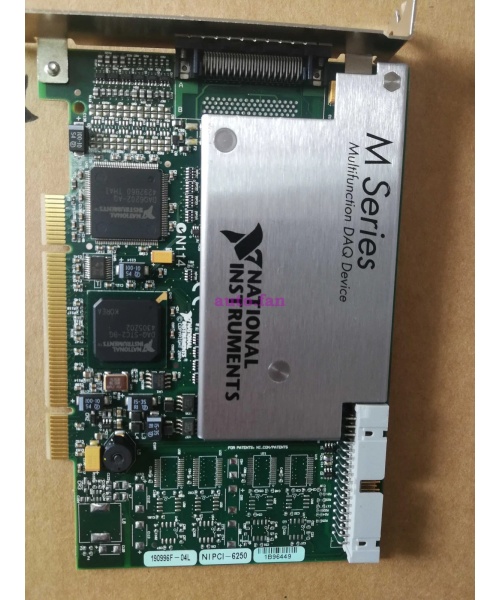
NI PCI-6250
Field Service Pitfalls: What Rookies Get Wrong
Wrong Ground Reference Configuration
New engineers often confuse single-ended and differential input modes, leading to ground loops or noisy readings. Single-ended ties all inputs to a common ground, while differential measures the difference between two inputs.
- Field Rule: Use differential mode whenever possible for noise rejection. If you must use single-ended, ensure all signal sources share the same ground reference. Don’t mix single-ended and differential inputs on the same card.
Ignoring Aggregate Sampling Rate Limits
The 1.25 MS/s spec is an aggregate rate shared across all active channels. Sampling 4 channels at 500 kS/s each exceeds the limit, but rookies often miss this and wonder why their data is corrupted.
- Quick Fix: Calculate total required rate before configuration. If you need 4 channels at 100 kS/s each, that’s 400 kS/s aggregate—well within limits. For high channel counts, reduce per-channel rate or consider a higher-speed card.
Improper Shield Connection
The 68-pin connector has a shield pin that must be connected to chassis ground at the host end only. Connecting it at both ends or floating it causes noise issues.
- Field Rule: Connect the shield pin to chassis ground at the DAQ card end. Leave it floating at the remote device end unless you have a specific single-point-ground scheme. Use shielded cables (SHC68-68-EPM) for long runs.