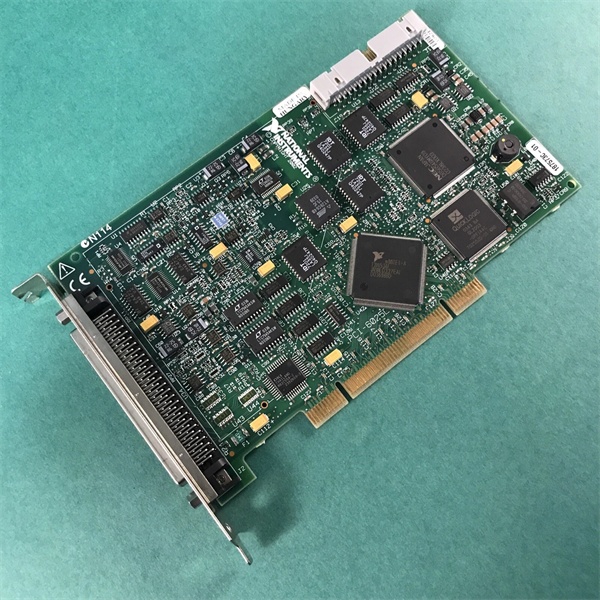
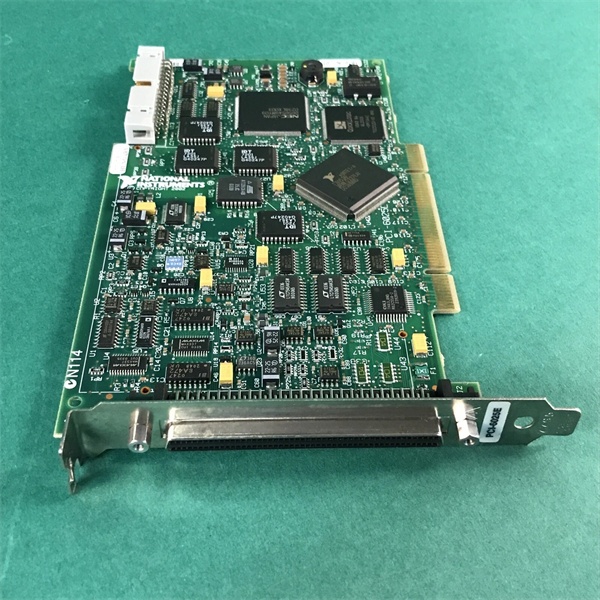
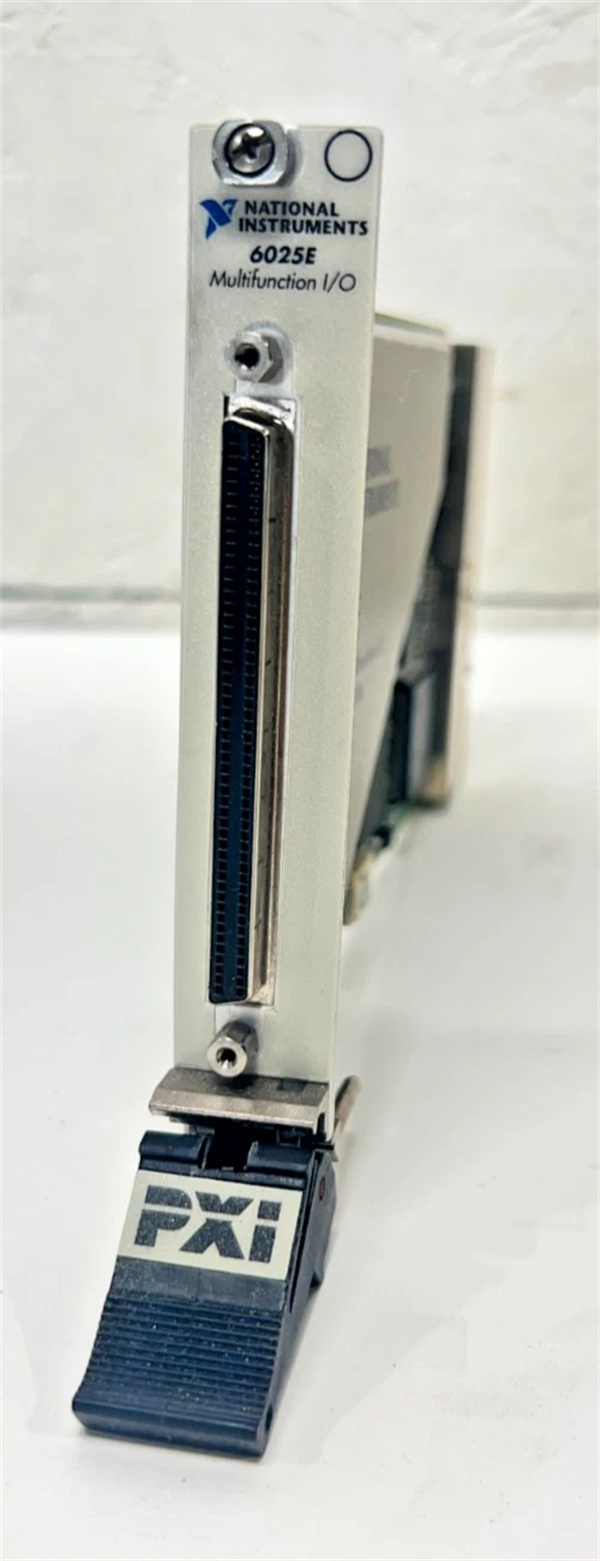
Description
Key Technical Specifications
- Model Number: PCI-6025E
- Manufacturer: National Instruments (NI)
- Analog Input (AI):
- Channel Count: 16 Single-Ended (SE) / 8 Differential (DIFF)
- Resolution: 12-Bit SAR ADC
- Sampling Rate: Up to 200 kS/s (Single Channel), 100 kS/s (Dual Channel Interleaved)
- Input Ranges: ±10V, ±5V, ±2.5V, ±1.25V, ±0.625V (Software-Configurable)
- Input Impedance: 100 MΩ (Differential), 50 MΩ (Single-Ended)
- Noise Performance: 4.8 μVrms (Typical, ±10V Range)
- Analog Output (AO):
- Channel Count: 2 Independent Channels
- Resolution: 12-Bit DAC
- Output Range: ±10V (Unipolar/Bipolar Configurable)
- Output Current: ±5 mA Per Channel (Maximum)
- Settling Time: 10 μs (To ±0.1% of Full Scale)
- Digital I/O (DIO):
- Channel Count: 16 Bidirectional TTL/CMOS Lines
- Voltage Levels: TTL-Compatible (VIL=0.8V Max, VIH=2.0V Min)
- Current Drive: 24 mA Sink/Source Per Line
- Counters/Timers: 2× 32-Bit Up/Down Counters (Event Counting, Pulse Width Modulation)
- Bus Interface: 32-Bit PCI (33 MHz), Plug-and-Play Compliant
- Connectors: 1× 68-Pin Male SCSI-II (High-Density I/O)
- Operating Temperature: 0°C to 55°C (Standard), -40°C to 85°C (Extended Temp)
- Power Consumption: 5W Typical, 8W Maximum (From PCI Bus)
- Software Compatibility: NI-DAQmx Driver, LabVIEW, LabWindows/CVI, C/C++, Python, Windows 2000/XP/Vista/7/10 (32/64-Bit)

NI PCI-6025E
Field Application & Problem Solved
In industrial and laboratory settings—small manufacturing lines, university research labs, and legacy control system maintenance—multifunction data acquisition (DAQ) tasks (e.g., sensor monitoring, analog control, digital I/O) demand a low-cost, integrated solution. Legacy DAQ systems often require separate cards for analog input, analog output, and digital I/O, cluttering PCI slots and increasing setup complexity. Budget constraints in academia and small businesses make high-end DAQ cards impractical, while generic cards lack compatibility with industry-standard software like LabVIEW.
This multifunction PCI DAQ card solves those pain points by packing analog I/O, digital I/O, and counters into a single slot at an accessible price point. You’ll find it in small electronics factories monitoring temperature and pressure during production, university labs teaching basic DAQ principles to engineering students, and refineries maintaining legacy control systems that require analog signal acquisition. It’s also a go-to for field engineers troubleshooting older equipment—its plug-and-play design and broad software compatibility make it easy to integrate into existing setups.
Its core value is versatility and affordability for mixed-signal tasks. The 12-bit resolution and 200 kS/s sampling rate strike a balance between performance and cost, covering most non-high-speed applications. For plant managers, this means reduced hardware costs and simplified maintenance—one card replaces three separate modules. For educators, it’s an accessible tool to teach real-world DAQ concepts without overwhelming students with advanced features or price tags.
Installation & Maintenance Pitfalls (Expert Tips)
- Analog Input Range Mismatch: Rookies often use the default ±10V range for low-amplitude signals (e.g., 0-5V sensors), wasting resolution. Match the input range to the sensor’s output—use ±2.5V for 0-5V signals or ±0.625V for millivolt-level sensors (e.g., thermocouples). A student’s pressure sensor data was noisy until they switched from ±10V to ±2.5V, doubling the effective resolution.
- Digital I/O Overcurrent Damage: The 24 mA per channel drive is for logic-level signals—connecting relays or motors directly burns out DIO lines. Use a relay driver or MOSFET for loads >5 mA. A small factory fried four DIO channels by powering 30 mA LEDs directly; adding a $3 relay module prevented further damage.
- PCI Slot Compatibility Confusion: The card uses a 32-bit PCI slot—inserting it into a PCIe slot (physically incompatible) or a 64-bit PCI-X slot (electronically compatible but may cause performance issues) leads to failure. Verify slot type before installation—32-bit PCI slots have a shorter connector and lack the PCIe keyway. I’ve seen countless “card not detected” calls resolved by moving the card to a proper 32-bit PCI slot.
- Outdated NI-DAQmx Drivers Limit Functionality: Legacy drivers (pre-16.0) don’t support Windows 10+ or LabVIEW 2018+, and may disable advanced features like counter/timer synchronization. Update to NI-DAQmx 18.0+—it fixes compatibility bugs and unlocks the card’s full 200 kS/s sampling rate. A manufacturing plant’s data loggers were capped at 50 kS/s until they updated drivers, improving measurement throughput by 4x.

NI PCI-6025E
Technical Deep Dive & Overview
The PCI-6025E’s design centers on balancing performance, versatility, and cost for mainstream DAQ applications. At its core, a 12-bit successive approximation register (SAR) ADC handles analog input—this architecture delivers fast sampling (200 kS/s) with low latency, ideal for capturing dynamic but non-high-speed signals like temperature, pressure, or slow-changing voltages. The 16 single-ended/8 differential input channels offer flexibility for sensor connectivity, while software-configurable ranges let users optimize resolution for specific signal amplitudes.
The dual 12-bit DACs for analog output support ±10V ranges, enabling control of analog actuators (e.g., variable-speed pumps, analog valves) or signal generation for component testing. The 16 bidirectional digital I/O lines and two 32-bit counters add versatility, covering tasks from relay control to event counting (e.g., part counting on a production line).
Plug-and-play compliance simplifies installation—unlike older ISA DAQ cards, the PCI-6025E auto-negotiates resources with the PC’s BIOS, eliminating manual IRQ/base address configuration. This is critical for non-technical users in academia or small businesses, where setup time and complexity are major pain points.
Data transfer relies on programmed I/O for small datasets and DMA for larger streams, balancing simplicity and performance. While the 200 kS/s sampling rate is slow by high-speed DAQ standards, it’s more than sufficient for most industrial process monitoring and laboratory applications. The card’s low power consumption (5W typical) makes it suitable for embedded systems and fanless industrial PCs.
While it lacks the resolution (16-bit+) and speed (1 MS/s+) of high-end DAQ cards, the PCI-6025E excels at its core mission: reliable, affordable multifunction DAQ. For field engineers and maintenance teams, it’s a “swiss army knife” that handles mixed-signal tasks without requiring multiple cards or complex configuration. Its longevity in industrial and academic settings is a testament to its design—proven, practical, and priced for real-world use cases.